
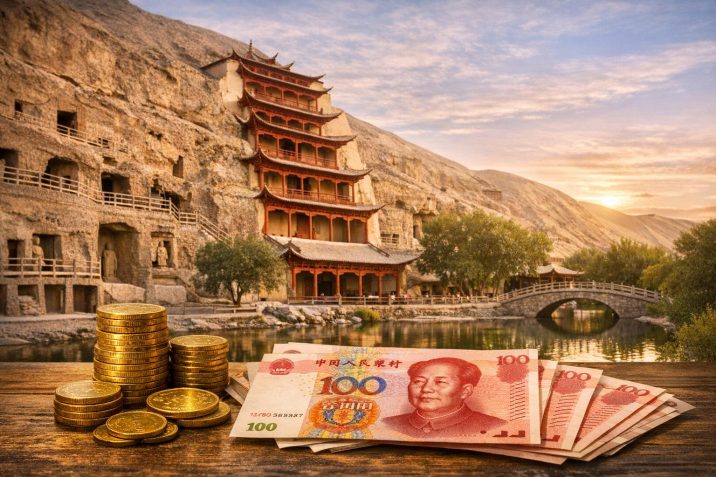
The Mogao Caves are a complex of Buddhist cave temples located near Dunhuang in Gansu Province, northwestern China. Stretching along a cliff face above the Dachuan River, the site consists of hundreds of decorated caves carved into soft conglomerate rock. Over a period spanning roughly a millennium, from the 4th to the 14th century, these caves were developed as places of worship, meditation, artistic production, and manuscript preservation. Today, the Mogao Caves are recognized as one of the most significant collections of Buddhist art in the world and are listed as a UNESCO World Heritage Site. Their long history, extensive mural cycles, sculptural programs, and manuscript discoveries make them central to the study of religious exchange and artistic development along the Silk Road.
Geographical and Historical Context
Dunhuang lies near the edge of the Gobi Desert, historically positioned at a crossroads of the ancient Silk Road. This network of trade routes linked China with Central Asia, the Middle East, and Europe. Caravans carrying silk, spices, precious metals, paper, and luxury textiles passed through the region. Along with material exchange, religious ideas, artistic conventions, technologies, and linguistic traditions circulated between distant regions. As a frontier town near shifting imperial borders, Dunhuang functioned as both a military outpost and a cultural gateway.
The location of the Mogao Caves reflects Dunhuang’s strategic importance. Situated near an oasis fed by seasonal rivers descending from the Qilian Mountains, the site provided water, agricultural potential, and relative stability in an otherwise arid environment. The desert cliffs offered a workable rock surface for excavation and a natural boundary that protected interiors from direct exposure. According to traditional accounts, the first cave was dug in 366 CE by a Buddhist monk named Le Zun, who experienced a vision of radiant Buddhas illuminating the cliff face. Although this narrative cannot be fully verified through textual documentation, archaeological evidence confirms that cave construction began in the 4th century during the Former Qin period.
Over subsequent centuries, especially during the Northern Liang, Northern Wei, Sui, and Tang dynasties, the number of caves increased steadily. Patronage came from local elites, military governors, merchants engaged in long-distance trade, monastic communities, and at times imperial officials. These patrons financed carving and decoration as acts of religious devotion and as a means to accumulate merit within Buddhist belief systems. Inscriptions within the caves often record the names, official titles, and family affiliations of donors, linking the site to broader social and political networks in northwestern China.
The region surrounding Dunhuang experienced alternating phases of stability and conflict. Control shifted among Chinese dynasties, Tibetan forces, and local regimes. Each political change affected patterns of patronage and artistic emphasis within the caves. Despite these fluctuations, the Mogao Caves remained a sustained religious center, illustrating how frontier communities adapted to changing circumstances while maintaining long-term ritual continuity.
Development Across Dynasties
The early caves of the 4th and 5th centuries reflect formative stages in the transmission of Buddhism into China. Many visual elements show connections with Central Asian and Indian prototypes. During the Northern Wei period, elongated figures with stylized drapery and defined halos appear frequently. These characteristics correspond to artistic traditions that passed through oasis kingdoms such as Kucha and Khotan before reaching Dunhuang.
By the Sui dynasty in the late 6th century, artistic production demonstrated increased confidence and adaptation to Chinese formats. Compositions became more expansive, and mural programs grew more organized. The Tang dynasty marked a period of consolidation and scale, but later centuries under Tibetan occupation and the subsequent Guiyijun regime continued to sustain artistic patronage. During the Song and Western Xia periods, iconography and stylistic approaches evolved further, reflecting ongoing regional interaction.
Even as maritime trade routes grew more prominent after the 10th century, Mogao did not immediately lose relevance. Artistic activity continued into the Yuan dynasty, though at reduced intensity. Over time, changing trade patterns and political priorities diminished Dunhuang’s economic and strategic importance, contributing to the eventual decline of large-scale cave construction by the 14th century.
Architectural Layout and Spatial Organization
The Mogao complex includes more than 700 caves, with approximately 492 containing murals and painted sculpture. The caves vary considerably in size, plan, and decorative focus. Some are small meditation chambers measuring only a few meters across, while others are large halls capable of hosting communal rituals. The diversity of layouts reveals experimentation in responding to devotional needs and spatial constraints.
Many caves follow a rectangular plan with a main chamber and a front antechamber. Central pillar caves, a common early type, feature a square pillar in the center representing a stupa. Devotees could walk around this pillar in circumambulation, a ritual practice symbolizing reverence and meditative reflection. Ceiling structures often imitate wooden architecture, with painted beams and coffered designs creating the appearance of constructed interiors carved from rock.
Larger caves frequently contain altar platforms supporting primary Buddha images. Flanking walls depict narrative scenes arranged in horizontal registers. Vaulted ceilings are covered with patterned motifs, lotus medallions, celestial beings, and geometric designs intended to envelop viewers visually. The holistic integration of architecture, sculpture, and painting produces an immersive environment structured for ritual engagement.
The façades visible today are the result of multiple restoration phases. Wooden eaves and entrance corridors were added to shield cave mouths from wind and sand. Over centuries, repairs were made to stabilize weakened cliff sections. Because the conglomerate rock is relatively soft and susceptible to erosion, structural reinforcement has been an ongoing necessity since the medieval period.
Artistic Techniques and Workshop Practices
The artistic program of the Mogao Caves consists primarily of wall paintings and polychrome clay sculptures executed through specialized workshop practices. After carving a chamber from the cliff, artisans coated the rough stone surface with layers of mud plaster mixed with straw or plant fibers to prevent cracking. A finer plaster layer created a smooth finish suitable for painting detailed imagery.
Artists used mineral pigments to achieve a broad range of colors. Blue tones derived from azurite, green from malachite, red from cinnabar or iron oxides, and white from kaolin clay. Binders such as animal glue were used to affix pigments to the prepared plaster. Analysis of surviving surfaces indicates careful layering and deliberate sequencing of outlines, base coats, shading, and highlights.
The murals portray scenes from Buddhist scripture, cosmology, and didactic parables. Episodes from the life of the historical Buddha, including his birth, enlightenment, and Parinirvana, appear alongside Jataka stories recounting earlier incarnations. In addition, murals visualize entire sutras, translating textual narratives into accessible pictorial formats for worshippers who may not have been literate.
Clay sculpture supplemented painted imagery. Artisans constructed figures around wooden armatures, applying layers of clay mixed with fiber to build form. After drying, the figures were painted in vivid tones and occasionally gilded. Drapery folds were modeled to suggest weight and movement, while facial features were shaped to conform to contemporary aesthetic standards. The scale of sculptures ranges from small guardians to monumental seated Buddhas exceeding 30 meters in height, such as those found in Cave 96 and Cave 130.
Iconography and Religious Interpretation
The iconography at Mogao reveals the development of Buddhist doctrine as it adapted within Chinese society. Images of Buddhas, bodhisattvas, heavenly kings, protective deities, and donor figures form interconnected visual programs. Bodhisattvas are enlightened beings who postpone final nirvana in order to guide others toward liberation. In mural representations, they often appear wearing jeweled crowns, necklaces, and elaborate garments, emphasizing their intermediary status between the earthly and transcendent realms.
Pure Land themes gained particular prominence during the Tang dynasty. Murals representing the Western Paradise of Amitabha Buddha depict symmetrical arrangements of pavilions, lotus ponds, orchestras of celestial musicians, and orderly ranks of devotees. These complex compositions functioned as visual expressions of aspiration toward rebirth in an idealized realm. They also illustrate architectural forms and garden designs reflective of Tang cultural models.
Mandala-like diagrams and cosmological charts appear in some later caves, demonstrating the incorporation of esoteric Buddhist traditions. Simultaneously, narrative cycles illustrating moral causality emphasize karmic consequences and ethical conduct. The diversity of iconographic themes indicates that Mogao served multiple devotional communities with varied ritual interests.
Donor portraits, positioned near lower wall registers, anchor the religious imagery within social reality. These images often include inscriptions specifying the cave’s date and the identities of sponsors. Such details provide essential evidence for reconstructing lineage networks, official hierarchies, and gender roles in medieval Dunhuang. Female donors appear frequently, indicating participation across different segments of society.
The Tang Dynasty Peak
The Tang dynasty (618–907 CE) marked the height of artistic activity at Mogao. Dunhuang prospered as a cosmopolitan center integrating influences from Sogdia, India, and the Chinese heartland. Diplomatic missions and trade activity introduced new visual motifs and luxury goods, some of which are depicted directly in murals.
Tang-era paintings demonstrate sophisticated composition and greater attention to spatial modeling. Figures are rendered with fuller proportions and more naturalistic gestures than in earlier periods. Drapery appears more fluid, and shading techniques suggest volume. Architectural backdrops incorporate detailed bracket systems and tiled roofs indicative of contemporary building practices.
Large-scale caves from the Tang period reflect significant patronage. Some were sponsored by local military governors overseeing frontier defense. Others may have received imperial endorsement. The combination of political authority and religious devotion is visible in the elaborate scale of construction and decoration during this era.
The Library Cave and Manuscript Culture
One of the most important developments in the modern understanding of Mogao was the discovery of the Library Cave (Cave 17) in 1900. The sealed chamber contained tens of thousands of manuscripts, printed texts, silk paintings, and ritual banners dating primarily from the 4th to the 11th centuries. The cache appears to have been sealed in the early 11th century, possibly to protect aging documents or as part of a ritual deposit.
The manuscripts include Buddhist sutras, commentaries, liturgical texts, secular documents, contracts, medical treatises, calendars, and personal letters. They are written in multiple languages, including Chinese, Tibetan, Sanskrit, Sogdian, Khotanese, and Uighur. This multilingual archive provides evidence of sustained intercultural contact. Scholars consult these materials to examine administrative systems, trade networks, and daily life in Dunhuang.
In the early 20th century, explorers such as Aurel Stein and Paul Pelliot acquired large portions of the manuscripts, which were transported to institutions abroad. Today, the dispersed collections are held in Beijing, London, Paris, and other cities. International digitization initiatives now enable researchers to consult high-resolution images virtually. For historical background and updated research resources, the site’s role is further documented by the UNESCO World Heritage Centre, which outlines its global cultural significance.
Conservation Science and Management
The preservation of the Mogao Caves requires interdisciplinary collaboration. Environmental threats include wind erosion, sand infiltration, fluctuations in humidity, and salt crystallization within plaster layers. Human visitation introduces carbon dioxide and temperature variations that can accelerate deterioration. As a result, visitor numbers to individual caves are carefully regulated.
The Dunhuang Research Academy, established in 1944, oversees conservation, research, and site management. Scientific monitoring systems track microclimatic conditions within caves. Conservators stabilize flaking pigments, consolidate plaster layers, and reinforce vulnerable structural elements. Where necessary, protective shelters mitigate exposure to direct sunlight and rainfall.
Digital documentation plays a central role in preservation. High-resolution photography, infrared imaging, and three-dimensional scanning record mural surfaces and sculptural forms in detail. Virtual reality installations and replica caves enable visitors to experience representative interiors without overwhelming fragile originals. These technological measures aim to ensure long-term access for research and education.
Art Historical and Global Significance
The Mogao Caves offer an unparalleled chronological sequence of Buddhist visual culture extending across ten centuries. Few other sites provide such continuity in one geographic location. Through comparative analysis of styles, scholars trace patterns of influence linking India, Central Asia, Tibet, and China. Motifs introduced through Silk Road exchange were reshaped within local aesthetic frameworks, generating hybrid visual forms that reflect sustained interaction.
In addition to religious themes, murals depict musicians playing lutes, flutes, and percussion instruments, many of which originated outside China. Scenes showing caravans, travelers, and foreign envoys reinforce the impression of Dunhuang as a hub of movement. Architectural representations document timber-frame structures and urban layouts otherwise absent from surviving buildings of the same periods.
The integration of painting, sculpture, manuscript culture, and donor inscriptions makes Mogao a comprehensive archive of medieval society. Art historians examine compositional techniques, while linguists analyze vernacular documents from the Library Cave. Conservators study ancient pigments to refine preservation strategies. Each discipline contributes to a broader understanding of cross-cultural exchange across Eurasia.
Contemporary Access and Interpretation
Today the Mogao Caves are accessible under structured conditions. Advance reservations, mandatory guided tours, and limits on group size help regulate the flow of visitors. An on-site visitor center presents introductory films and digital reconstructions that contextualize the caves before entry. Some especially sensitive caves remain closed except to researchers.
Replica caves, constructed with detailed fidelity to original designs, serve both educational and conservation purposes. These reproductions allow extended viewing of mural cycles that might otherwise require restricted exposure. Traveling exhibitions featuring digital facsimiles broaden international awareness of the site without removing original works from their context.
Ongoing scholarship continues to refine chronological attributions and identify workshop lineages. Radiocarbon testing, pigment spectroscopy, and epigraphic study assist in dating individual caves more precisely. As methods advance, interpretations of patronage structures and iconographic programs become increasingly nuanced.
Conclusion
The Mogao Caves represent a sustained interaction between environment, trade, religion, and artistic production over approximately one thousand years. Located at a pivotal junction of the Silk Road, the site absorbed influences from multiple cultural spheres while contributing to the transmission of Buddhist imagery across Asia. Its architectural diversity, mural programs, sculptural monuments, and manuscript archive together form a comprehensive record of medieval religious life.
Through coordinated conservation efforts, digital documentation, and regulated access, the Mogao Caves continue to function as both a research center and a major heritage destination. Their significance lies not solely in artistic achievement but also in their testimony to long-term cultural exchange and adaptation. As preservation initiatives proceed, the caves remain central to understanding the interconnected histories of Eurasian civilizations.
