
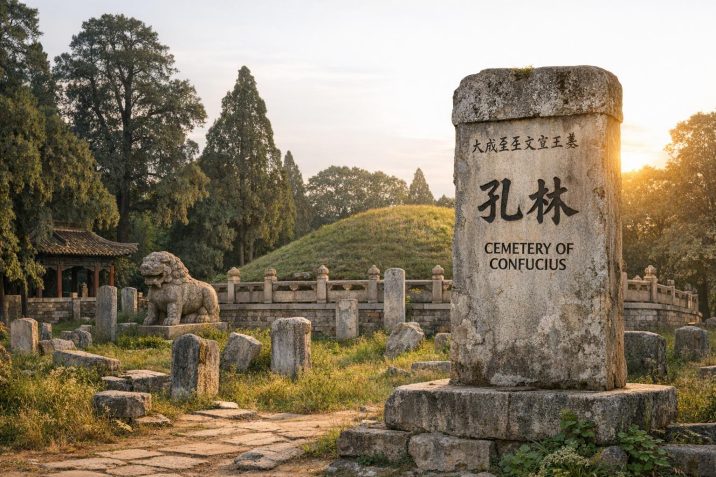
The Cemetery of Confucius, also known as the Kong Lin (Forest of the Kong Family), stands as one of the most historically significant burial grounds in China. Situated in Qufu, in Shandong Province, it serves as the final resting place of Confucius (551–479 BCE), the philosopher whose teachings shaped Chinese intellectual, social, and political life for more than two millennia. The cemetery forms part of a larger sacred complex that includes the Temple of Confucius and the Kong Family Mansion. Together, these monuments were inscribed in 1994 on the UNESCO World Heritage List under the designation Temple and Cemetery of Confucius and the Kong Family Mansion in Qufu. Detailed information about the UNESCO listing can be found through the official UNESCO World Heritage Centre.
More than a burial site, the cemetery represents a continuous record of lineage, ritual, landscape planning, political patronage, and classical scholarship. Its development over more than 2,500 years reflects changing conceptions of authority, family hierarchy, education, and memory in Chinese civilization.
Origins and Early History
Confucius, born Kong Qiu in 551 BCE during the Spring and Autumn period of the Eastern Zhou dynasty, spent his life teaching moral philosophy and advocating ethical government. His emphasis on proper conduct, ritual observance, and filial duty would later become foundational principles of Chinese society. When he died in 479 BCE, he was buried on the northern bank of the Si River, outside the walls of Qufu.
Early accounts describe a relatively simple grave. His disciples are said to have constructed huts near the burial site and observed a formal mourning period lasting three years, in accordance with Confucian prescriptions for filial devotion. One disciple, Zigong, reportedly remained for an additional three years. These acts established the tone of reverence that would define the site’s future.
In the generations that followed, Confucius’ descendants chose to bury family members in proximity to his grave. What began as a single burial mound gradually evolved into a large clan cemetery. The continuity of interment across more than eighty generations created a rare genealogical landscape in which family memory became materially embedded in the terrain.
Expansion During the Han Dynasty
The transformation of the cemetery began in earnest during the Han dynasty (206 BCE–220 CE), when Confucianism was adopted as the ideological foundation of state administration. The Han court institutionalized Confucian classics as the basis of civil service examinations and political ethics. As Confucius’ stature grew, so too did imperial interest in honoring his burial place.
Emperors conferred posthumous titles upon Confucius, gradually elevating him from respected teacher to cultural sage. State sponsorship provided funds for the protection and extension of the burial grounds. Stone markers were added, and ritual visits by officials became formalized. These developments positioned the cemetery as both a family necropolis and a site of national commemoration.
The Han period established patterns that endured: imperial patronage reinforced local stewardship, and ritual observance at the tomb symbolized political legitimacy grounded in classical tradition.
Institutionalization in the Tang and Song Periods
During the Tang dynasty (618–907), Confucius received even higher honorary titles, reflecting the consolidation of his status as a sage whose teachings transcended regional boundaries. Architectural enhancements were introduced to both the cemetery and the adjacent temple complex. The layout of spirit paths and commemorative steles became more systematized, emphasizing axial symmetry and hierarchical order.
The Song dynasty (960–1279) marked another critical phase. Neo-Confucianism emerged as a sophisticated philosophical movement, synthesizing metaphysical speculation with classical textual study. With renewed scholarly interest came heightened respect for sites associated with Confucius’ life and lineage. The cemetery’s boundaries were clarified, and genealogical records were carefully maintained.
It was also during these centuries that the Kong family’s hereditary privilege became firmly institutionalized. The head of the lineage held noble rank, ensuring economic resources for maintenance of ancestral estates, including the cemetery.
Ming and Qing Architectural Consolidation
Much of the present physical form of the Cemetery of Confucius dates to the Ming (1368–1644) and Qing (1644–1912) dynasties. This era witnessed large-scale reconstruction and fortification. A substantial perimeter wall—measuring approximately 7.5 kilometers in circumference—was erected to define and protect the sacred grounds. Entry gates, watchtowers, and regulated pathways established a clear ceremonial sequence for visitors.
The spatial organization during this period reinforced Confucian ideas of hierarchy. The tomb of Confucius occupied a central and elevated position along a main axis, with subsequent generations arranged according to genealogical proximity and social status. The integration of stone bridges, pavilions, and inscribed tablets created a landscape in which architecture and text jointly conveyed authority.
The Ming and Qing courts repeatedly sponsored repairs after floods, fires, or other natural damage. Imperial inscriptions commemorating such interventions remain visible on many steles. These inscriptions provide valuable primary sources for historians studying both the evolution of Confucian honorific titles and patterns of imperial engagement with cultural heritage.
Physical Layout and Sacred Topography
The cemetery occupies roughly 200 hectares of gently undulating terrain. Dense groves of cypress and pine trees create a wooded environment that distinguishes the grounds from the surrounding urban fabric of Qufu. The name Kong Lin, meaning “Forest of the Kong Family,” accurately describes this character.
Visitors traditionally enter through a southern gate and proceed along a spirit way. This path leads toward the central burial mound of Confucius. The tomb itself remains comparatively simple: an earthen mound fronted by a stone stele bearing an inscription identifying the philosopher’s resting place. The relative restraint of the grave marker reflects ancient funerary norms, even though later dynasties embellished the surrounding precincts.
To the east stand the graves of Confucius’ son, Kong Li, and his grandson, Kong Ji (Zisi). Their proximity established a pattern of clustering immediate descendants near the founding ancestor. Beyond this core area extend thousands of additional graves, distributed according to generational lines and internal family hierarchies.
Over time, more than 100,000 documented descendants have been interred within the cemetery. The density and continuity of these burials render the site one of the largest and longest-used clan cemeteries in the world.
Genealogy and Lineage Continuity
The Kong family lineage is among the best-documented in global history. Genealogical compilations were revised regularly, recording births, marriages, official positions, and deaths. These records ensured proper placement within the cemetery according to generational rank and familial branch.
Such meticulous documentation had both ritual and political implications. Ritual correctness demanded accurate identification of ancestral relationships. Politically, the continuity of the Kong lineage reinforced claims of cultural authority derived directly from Confucius himself.
The hereditary title Duke Yansheng was granted to the senior male descendant and confirmed by successive dynasties. This title carried responsibilities for overseeing rituals at the cemetery and temple. Even after the abolition of imperial rule in the early twentieth century, the genealogical consciousness of the Kong family persisted, maintaining a symbolic link to the ancient sage.
Stone Steles and Calligraphic Heritage
The cemetery contains thousands of stone steles, many of which record imperial decrees, commemorative essays, or genealogical notes. These steles constitute a substantial archive carved in stone. They provide chronological markers for repairs, expansions, and honorary title changes over centuries.
Calligraphy on these monuments reflects stylistic diversity across dynastic periods. Scripts range from formal seal script to clerical and regular script forms. Scholars of Chinese epigraphy study the inscriptions to trace both linguistic changes and aesthetic developments.
In addition to textual value, the steles display varied sculptural ornamentation. Dragon motifs, cloud patterns, and pedestal carvings indicate imperial favor, while simpler markers denote lesser rank within the lineage. Differences in size and decoration illustrate internal hierarchy without disrupting the overall coherence of the cemetery’s layout.
Ritual Functions and State Ceremonies
From the Han dynasty onward, state-sponsored sacrifices to Confucius were conducted regularly. While the primary ceremonial venue was the adjacent temple, the cemetery formed an essential component of the ritual landscape. Officials dispatched by the emperor performed offerings that included libations of wine, trays of food, silk fabrics, and musical accompaniment.
These rites were governed by detailed classical prescriptions outlining posture, music, costume, and sequence. Observance at the tomb symbolized continuity between past sages and present governance. By honoring Confucius, the imperial court affirmed its commitment to moral administration.
The Kong family also maintained private ancestral rites. Seasonal ceremonies ensured ongoing veneration of deceased relatives. The integration of state and family ritual within a single physical space illustrates the merging of public ideology and private lineage characteristic of Confucian civilization.
Landscape Design and Geomantic Principles
The wooded character of the cemetery reflects more than aesthetic preference. Traditional Chinese geomancy, often referred to as feng shui, emphasizes harmonious alignment between human activity and natural forces. The location north of Qufu, with protective hills and access to water, was considered auspicious.
Trees such as cypress symbolize endurance and moral steadfastness. Over centuries, deliberate planting created an environment conducive to contemplation and ritual procession. Pathways wind through groves in patterns that balance axial clarity with adaptation to natural contours.
The interaction of constructed elements and organic growth produces a layered landscape in which time is visibly inscribed. Ancient trunks stand beside Ming and Qing stone carvings, linking natural longevity with cultural memory.
Challenges in the Modern Era
The fall of the Qing dynasty in 1912 marked the end of imperial patronage. Although the Kong family retained symbolic prominence, political transformations reduced hereditary privileges. Maintenance of the cemetery depended increasingly on local and later national authorities.
During the Cultural Revolution (1966–1976), Confucianism was criticized as representative of a pre-modern social order. Red Guard groups damaged numerous steles and desecrated certain graves. Archival materials were destroyed, and sections of the site deteriorated due to neglect.
In subsequent decades, changing assessments of Confucius led to restoration initiatives. Damaged monuments were repaired where possible, and archaeological surveys documented surviving artifacts. The shift reflected broader reevaluation of traditional culture within contemporary China.
Archaeological Research and Conservation
Systematic archaeological investigation has enhanced understanding of burial patterns and construction phases. Ground surveys and limited excavations reveal stratified layers corresponding to different dynasties. Researchers analyze soil composition, masonry techniques, and inscription styles to reconstruct sequences of development.
Conservation work addresses challenges posed by weathering, plant overgrowth, and tourism. Preservationists monitor the stability of ancient trees and treat stone surfaces vulnerable to erosion. Modern documentation methods, including digital mapping and 3D scanning, create detailed records to guide future interventions.
Balancing accessibility with protection remains a central concern. Clearly designated visitor paths reduce inadvertent damage, while interpretive signage provides historical context without intrusive alteration of the environment.
UNESCO World Heritage Status
The 1994 inscription of the cemetery and associated monuments on the UNESCO World Heritage List acknowledged their outstanding universal value. The designation emphasized the ensemble’s testimony to the enduring influence of Confucian philosophy on East Asian civilization.
World Heritage recognition has strengthened legal protections and facilitated international cooperation in conservation. It has also increased scholarly exchange, situating the cemetery within global discussions of cultural landscapes and ancestral heritage sites.
The inscription underscores not only architectural merit but also intangible associations, including ritual continuity, classical scholarship, and ethical tradition.
Role in Contemporary Society
In present-day China, Confucius occupies a renewed position of cultural significance. Educational initiatives, academic conferences, and public commemorations reference his teachings on ethics, governance, and social harmony. Annual ceremonies in Qufu mark his birth anniversary, attracting participants from across China and abroad.
The cemetery functions as a site of historical inquiry and tourism. Students and scholars examine inscriptions firsthand, while visitors encounter a tangible representation of philosophical heritage. For members of the Kong lineage, it remains a locus of ancestral identity, even as modern burial regulations limit new interments within the historic grounds.
Through these overlapping roles, the cemetery connects ancient doctrine with contemporary cultural policy.
Conclusion
The Cemetery of Confucius in Qufu represents a sustained interaction among philosophy, family lineage, political authority, and landscape design. Originating as a modest grave beside the Si River, it expanded across centuries into a vast necropolis defined by walls, trees, carved steles, and carefully structured pathways. Each dynastic period contributed architectural layers and inscriptions that collectively narrate the history of Confucian reverence.
As a material record of more than two millennia of continuous use, the cemetery offers insight into Chinese funerary customs, genealogical organization, and the institutionalization of moral philosophy within state governance. Despite episodes of political upheaval and physical damage, preservation efforts and international recognition have ensured its survival.
Today, the wooded expanse of Kong Lin stands not only as the resting place of Confucius and his descendants but also as a cultural landscape through which the development of Chinese civilization can be studied in enduring form.
