
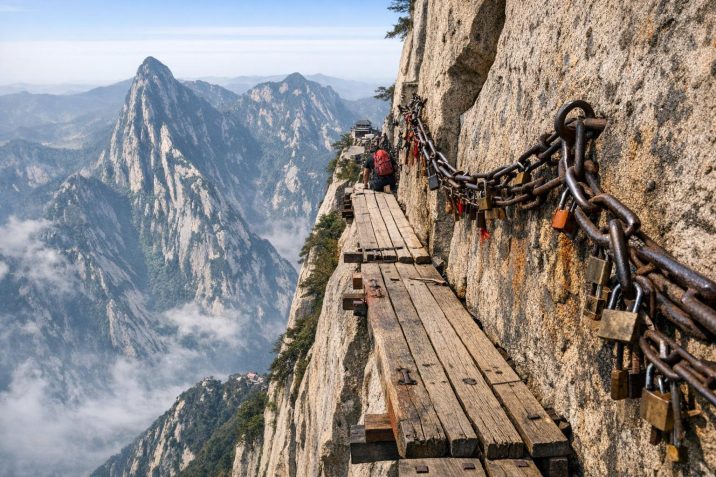
The Mount Hua Ancient Plank Road is one of the most recognized historical pathways in China, notable for its distinctive method of construction along steep cliff faces. Built onto the granite slopes of Mount Hua in Shaanxi Province, the route extends across vertical rock surfaces at considerable height above the valley floor. Mount Hua, also known as Huashan, is counted among the Five Great Mountains of China and has long been associated with Taoist traditions, pilgrimage, and recorded cultural practice. The plank road is frequently referenced in historical and architectural discussions for its engineering techniques and enduring physical presence rather than for modern recreational innovation. Its continued existence reflects the intersection of geography, belief, and practical construction methods developed centuries ago.
Geographical Context of Mount Hua
Mount Hua is situated near the city of Huayin, approximately 120 kilometers east of Xi’an, the historic capital of several Chinese dynasties. The mountain range is composed of five principal peaks: East Peak, West Peak, South Peak, North Peak, and Central Peak. Among them, South Peak is the highest, rising to around 2,154 meters above sea level. The peaks are connected by narrow ridgelines and abrupt stone stairways carved directly into the rock. Sheer cliffs, vertical granite walls, and sharp precipices define much of the topography.
The geological foundation of Mount Hua consists largely of hard granite formations shaped by tectonic activity and long-term erosion. Over time, wind and water have sculpted the mountain into steep faces and fractured ledges. These natural features influenced the placement of historical paths, including the Ancient Plank Road, which follows accessible contours along otherwise inaccessible cliffs.
Climatic conditions vary significantly with elevation. At lower altitudes, the area experiences a temperate continental climate with distinct seasons. Summers can be warm and relatively humid, while winters bring cold temperatures and occasional snowfall. Higher elevations are exposed to stronger winds and lower temperatures throughout the year. Snow and ice accumulation during winter months can temporarily restrict access to exposed pathways. The limited vegetation near the upper cliffs further exposes rock surfaces to direct weathering, contributing to the stark and angular landscape commonly associated with Mount Hua.
Natural resources on the mountain are limited by its steep terrain. Forested sections appear primarily at lower slopes, while higher elevations are characterized by sparse shrubs and resilient plant species adapted to thin soil and rock fissures. The dramatic verticality of the environment required specialized approaches for creating passageways, particularly for individuals seeking to reach isolated sites.
Historical Background
The origins of the Ancient Plank Road are widely traced back more than seven centuries, with early construction believed to have taken place during the Yuan Dynasty (1271–1368). Historical accounts suggest that Taoist practitioners, seeking remote environments conducive to meditation and spiritual cultivation, initiated the creation of this narrow cliffside passage. By carving anchor points directly into the rock and installing wooden beams, they established a viable connection to secluded caves and shrines.
Mount Hua had already acquired religious importance long before the Yuan period. As one of the Five Great Mountains, it was integrated into imperial ritual systems and regional religious networks. Records from earlier dynasties indicate that hermits and monks inhabited caves and simple structures along its slopes. Stone inscriptions discovered in various locations across the mountain document pilgrimages and temple patronage over several centuries.
The plank road’s development likely occurred in phases. Initial sections may have been constructed to reach specific caves used for solitary practice. Over time, these segments were extended or improved. Although precise documentation of each stage is limited, surviving beams, sockets carved into stone, and written accounts support the conclusion that the route developed gradually rather than as a single coordinated project.
During subsequent dynasties, particularly the Ming (1368–1644) and Qing (1644–1912) periods, maintenance and partial reconstruction were undertaken. Administrative records and temple inscriptions reference repairs following weather damage or structural decay. These interventions preserved the core alignment of the path while reinforcing vulnerable sections. Unlike many other historical routes that deteriorated beyond recovery, the plank road at Mount Hua retained both its function and symbolic status.
Construction and Engineering Methods
The construction of the Ancient Plank Road demonstrates an understanding of weight distribution, material durability, and rock stability. Builders carved rectangular holes horizontally into the granite cliff face. Into these openings they inserted sturdy wooden beams, typically crafted from hardwood selected for its resistance to cracking and environmental wear. The beams projected outward from the rock, forming a skeletal support system.
Across these supports, wooden planks were laid to create a narrow walkway. In many sections the walking surface measures approximately 30 centimeters in width, allowing passage for a single individual at a time. This dimension reflects both the physical limitations of the cliff surface and the relatively low volume of expected traffic during its early use.
Some stretches incorporated iron chains affixed to the rock to function as handholds. These chains were secured using metal rings embedded in drilled cavities. The integration of both wood and metal components enhanced overall stability while maintaining relatively simple construction principles. The reliance on manual labor required workers to suspend themselves at elevation with minimal protective equipment, making precision and coordination essential.
Transporting materials to construction sites posed logistical challenges. Timber had to be carried upward along steep trails or hoisted using rope systems anchored above. Tools were limited to chisels, hammers, wedges, and manual drills. Carving anchor holes into granite required consistent force and careful angle control to prevent cracking of surrounding stone. Improper placement could have compromised both beam stability and rock integrity.
Modern preservation has introduced discreet structural reinforcement. In certain segments, steel supports have replaced deteriorated wooden beams. Contemporary fasteners provide additional anchoring strength while remaining visually similar to traditional components. These measures seek to retain historical appearance while increasing resistance to heavy use and environmental stress.
Religious and Cultural Significance
Mount Hua occupies a prominent position within Taoist religious geography. Taoism emphasizes alignment with natural forces, disciplined practice, and the pursuit of longevity. Mountain environments have long been regarded as favorable sites for meditation and ritual due to their isolation and proximity to what practitioners interpret as concentrated natural energy.
The Ancient Plank Road leads to a small shrine located near the South Peak. Historically, this shrine functioned as a place for ritual observance and solitary retreat. Practitioners utilized the cliffside access to distance themselves from populated temple compounds and daily disturbances. The physical act of traversing a narrow path along a vertical cliff may also have been understood as reinforcing intentional focus and self-discipline.
In addition to institutional religious practice, Mount Hua appears frequently in literary texts and folklore. Stories describe encounters with sages, itinerant scholars, and legendary figures pursuing instruction from reclusive masters. Although some accounts are fictional or embellished, they reinforce the mountain’s longstanding reputation as a place of introspection and instruction.
Imperial patronage also contributed to the site’s importance. Emperors and regional officials sponsored temple repairs and inscribed commemorative tablets. These inscriptions, carved directly into stone surfaces, provide documentary evidence of recurring engagement with the mountain. The plank road, as a means of reaching remote sanctuaries, formed part of this broader network of religious infrastructure.
Access and Visitor Management
In contemporary times, Mount Hua is administered as a protected scenic area. Regulated entry systems help manage visitor flow across sensitive terrain. Access to the Ancient Plank Road requires the purchase of a supplementary ticket beyond the general admission to the mountain park. Visitors must also wear a safety harness that clips onto a fixed steel cable running parallel to sections of the walkway.
Most visitors approach the plank road by taking a cable car to West Peak. From there, they proceed on foot along established ridgelines toward South Peak. The connecting routes include steep stairways carved directly into rock and fitted with metal railings. Signage provides instructions regarding pace, harness attachment, and weather advisories.
Visitor numbers are monitored carefully, particularly during national holidays when tourism increases significantly. Temporary closures may be implemented in response to strong winds, heavy rainfall, or icy conditions. Due to the exposed setting, even moderate weather changes can affect surface traction and comfort. Controlled scheduling helps prevent congestion on narrow sections where passing space is limited.
Supervisory staff are stationed at both ends of the plank road to manage equipment distribution and to ensure compliance with safety protocols. Time limits may be applied during peak conditions to maintain steady flow. These measures are designed to allow public access while minimizing strain on both structure and surrounding terrain.
Safety Considerations
The reputation of the Ancient Plank Road often centers on its height and limited width. However, contemporary safety systems reduce objective risk significantly. The harness mechanism secures each visitor to a continuous cable, creating a secondary barrier that prevents falls beyond a limited distance. Equipment is inspected regularly, and worn components are replaced promptly.
The most common difficulties reported by visitors relate to vertigo or hesitation when traversing exposed segments. The narrow planking requires steady balance and deliberate foot placement. During warmer months, accumulated moisture from fog or rainfall can increase slipperiness. Staff supervision helps coordinate bi-directional movement, particularly where the path curves around protruding rock.
Regular maintenance inspections assess beam integrity, metal anchor stability, and plank surface condition. Wood exposed to variable weather undergoes periodic replacement. Metal components are evaluated for corrosion, and protective coatings are applied where necessary. These routine interventions contribute to a comparatively low accident rate in recent decades.
Comparison with Other Historical Plank Roads
Cliffside plank roads have appeared elsewhere in Chinese history, particularly in mountainous provinces where vertical terrain restricted inland travel. In earlier eras, some of these routes supported trade caravans or military logistics by connecting isolated valleys. They were sometimes described as “sky roads” due to their elevated and suspended appearance.
The Mount Hua example differs in primary function. Rather than serving commercial transport, it facilitated religious access to specific sites of retreat. Its scale reflects individual rather than collective movement. Additionally, its preservation distinguishes it from many other historic plank roads that disappeared after disuse or structural failure.
International awareness of the Mount Hua plank road has increased through photography and travel documentation. Visual depictions highlighting wooden planks extending from smooth granite walls have contributed to its distinct identity. For readers seeking a broader overview of the mountain’s history and features, the Mount Hua overview provides contextual background on its geography and cultural development.
Environmental Impact and Preservation
Managing environmental impact is essential for maintaining Mount Hua’s ecological stability. Concentrated tourism can accelerate erosion along approach trails and strain waste management systems. Park authorities have installed designated walking corridors and reinforced staircases to channel movement efficiently.
Preservation of the Ancient Plank Road involves balancing historical authenticity with long-term structural reliability. Replacing decayed wood with modern materials can slightly alter appearance, yet failing to intervene would compromise safety and historical continuity. Conservation specialists therefore adopt methods that retain original alignment and visual structure while strengthening concealed supports.
Weather monitoring systems help guide maintenance scheduling. After severe storms, inspections ensure that anchor points remain secure. Snow removal procedures during winter reduce prolonged moisture exposure to wood surfaces. Preservation initiatives integrate the plank road within the broader conservation strategy applied to temples, inscriptions, and natural rock formations throughout Mount Hua.
Role in Contemporary Tourism and Regional Economy
The Ancient Plank Road functions today as one component of a larger scenic and cultural complex. While its scale remains limited, its presence enhances the overall historical narrative presented to visitors. Cable cars, regulated trails, and information displays facilitate structured access to the mountain’s peaks without extensive alteration of heritage sites.
Tourism revenue contributes to economic activity in surrounding communities such as Huayin. Accommodation providers, transportation services, and local vendors benefit from steady visitation. At the same time, authorities regulate ticket quotas to prevent excessive concentration of visitors on sensitive sections of the mountain.
Media exposure through documentaries and digital platforms has broadened international recognition of the plank road. Nevertheless, its sustained importance lies primarily in its architectural persistence and religious origin. The engineering concept remains comparatively simple, yet its execution under difficult geographic conditions illustrates resourceful adaptation to environment.
Continuity and Heritage Value
The continued existence of the Mount Hua Ancient Plank Road demonstrates how functional infrastructure can acquire layered cultural meaning over time. Initially constructed for specific spiritual purposes, it later became integrated into regional identity and eventually into heritage tourism frameworks. Each period of maintenance added contemporary techniques without erasing earlier structural logic.
The embedded wooden beams, carved sockets, and attached chains remain tangible evidence of historical construction strategies. Unlike purely symbolic monuments, the plank road retains an experiential dimension; it is traversed rather than only observed. This functional continuity distinguishes it within the study of historic pathways.
As part of China’s extensive architectural and religious legacy, the Ancient Plank Road represents a convergence of natural topography and human adaptation. Its placement along near-vertical granite walls required practical problem-solving informed by environmental awareness. Through successive generations, maintenance efforts have preserved not only a route across stone but also a record of technological and religious history.
The Mount Hua Ancient Plank Road thus remains an enduring fixture within the mountain landscape. Rooted in Yuan Dynasty religious practice, strengthened through later dynastic repairs, and maintained under modern conservation standards, it continues to illustrate the integration of engineering, geography, and cultural tradition within a single structure.
