
Historical Background of the Temple of Confucius
The Temple of Confucius in Qufu, located in Shandong Province, China, is one of the most significant cultural and historical sites in East Asia. It is dedicated to Confucius (551–479 BCE), the Chinese philosopher, teacher, and political thinker whose ideas profoundly influenced social organization, political theory, and educational institutions throughout East Asia. The temple stands in Confucius’s birthplace, the ancient state of Lu, and remains the largest and most renowned temple honoring him.
Shortly after Confucius’s death in 479 BCE, the Duke of Lu converted his former residence into a temple to commemorate him. At that early stage, the site functioned primarily as a memorial space maintained by local authorities and Confucius’s disciples. The original structure was modest, reflecting both the political limitations of the state of Lu and the transitional status of Confucius’s intellectual legacy. In the centuries immediately following his death, Confucius was respected as a teacher and moralist, but Confucianism had not yet evolved into the dominant state doctrine it later became.
The transformation of the site into a major ritual center occurred gradually. During the Han Dynasty (206 BCE–220 CE), Confucianism was adopted as the official state ideology under Emperor Wu. This decision had long-term consequences for the temple’s development. Confucian classics became foundational texts for governance and education, and the commemoration of Confucius acquired political meaning. Imperial patronage elevated the temple’s status, and successive emperors sponsored expansions, reconstructions, and ceremonial performances to emphasize their adherence to Confucian moral authority.
Throughout the Tang (618–907), Song (960–1279), Yuan (1271–1368), Ming (1368–1644), and Qing (1644–1912) dynasties, the temple underwent repeated enlargement. These expansions were not uniform; each reconstruction reflected the architectural technologies, artistic preferences, and ideological concerns of its period. Natural disasters such as fires and floods necessitated rebuilding, while political instability sometimes interrupted ritual activity. Nevertheless, state support ensured continuity. By the Ming and Qing periods, the temple complex had reached a scale and formal grandeur comparable to imperial palaces, marking Confucius’s symbolic elevation within the state hierarchy.
Architectural Layout and Spatial Organization
The Temple of Confucius covers approximately 16,000 square meters and contains more than 460 rooms distributed among over 100 buildings. Its layout follows a strict north–south axis, a fundamental principle of traditional Chinese monumental architecture. This linear arrangement conveys hierarchy and order, guiding visitors from outer spaces of preparation toward inner spaces of veneration.
Entry into the complex involves passing through a sequence of gates and courtyards. Each threshold creates a shift in spatial experience. The progressive movement inward reflects the Confucian emphasis on structured relationships and graduated authority. The symmetrical placement of buildings on either side of the central axis reinforces this sense of balance and propriety. Architectural form thus corresponds with philosophical principle, particularly the Confucian concept of li, or ritual order.
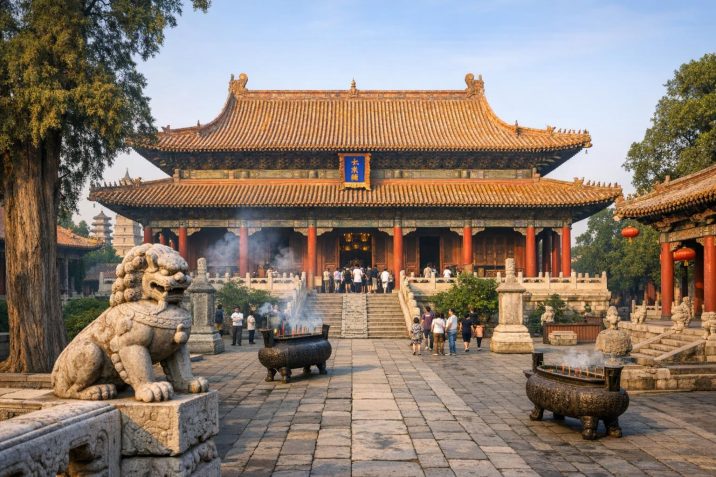
The architectural vocabulary mirrors that of imperial compounds. Yellow glazed roof tiles—historically associated with the emperor—appear on major halls. Roof ridges display ornamental figures, and bracket sets (dougong) support overhanging eaves with structural precision. Red perimeter walls enclose the site, separating ritual space from the surrounding urban environment. The resemblance to the Forbidden City underscores the degree to which Confucius was granted symbolic status parallel to imperial authority.
The surrounding landscape also contributes to the site’s organization. Ancient cypress trees line the courtyards, creating visual continuity across centuries. Stone-paved pathways regulate circulation, while bridges and carved balustrades define transitions between courtyards. These elements are not accidental embellishments but components of a carefully articulated ritual environment.
Main Architectural Structures
The central structure of the complex is the Dacheng Hall (Hall of Great Perfection). The term “Great Perfection” refers to the Confucian view of moral and intellectual completeness. The hall occupies a dominant position along the central axis and served historically as the primary site for sacrificial ceremonies.
Although an earlier version existed during the Tang Dynasty, the present structure largely dates to the Ming Dynasty following reconstruction after a fire in 1499. Measuring approximately 32 meters wide and 54 meters long, it rests upon a high stone platform accessed by stairways adorned with carved reliefs. Twenty-eight stone pillars support the roof, some intricately carved with dragon motifs that symbolize authority and cosmic order. The craftsmanship of these columns represents a high point in Ming stone carving.
Inside Dacheng Hall, spirit tablets dedicated to Confucius and selected disciples are arranged in hierarchical order. Rather than housing a sculpted statue as in many religious temples, the emphasis on tablets reflects Confucian restraint and textual tradition. The spatial arrangement of tablets illustrates the ranking of historical figures according to their perceived intellectual contributions.
Adjacent structures contribute to the overall ceremonial function. The Apricot Pavilion marks the traditional site where Confucius reputedly lectured his students beneath apricot trees. Although the existing pavilion dates to later dynasties, its association with teaching reinforces the temple’s educational symbolism. Other halls commemorate notable scholars such as Mencius and Zhu Xi, whose interpretations shaped Confucian orthodoxy during their respective periods.
Secondary courtyards contain bell and drum towers, storage facilities for ritual instruments, and additional commemorative chambers. Together these structures form a comprehensive ritual complex capable of accommodating elaborate state ceremonies.
Ritual Practices and State Ceremonies
Ritual observance constituted the temple’s primary historical function. From the Han Dynasty onward, emperors dispatched officials to conduct sacrifices at designated times during the year. On certain occasions, emperors themselves presided, reinforcing the political importance of Confucian orthodoxy.
The sacrificial ceremonies followed procedures codified in classical texts such as the Book of Rites. Offerings included incense, grains, wine, and livestock. Musical accompaniment formed an essential component. Ensembles performed on bronze bells, stone chimes, zithers, flutes, and drums. Dancers executed prescribed movements in coordinated rows, visually representing hierarchical harmony.
The rituals did not function as acts of worship in a theological sense. Rather, they affirmed moral continuity between past sages and present rulers. By participating in Confucian rites, the state articulated its commitment to ethical governance and social stability. The temple therefore operated as a political as well as cultural institution.
After the fall of the Qing Dynasty in 1912, official imperial sponsorship ended. However, commemorative ceremonies did not disappear entirely. Local authorities and cultural organizations continued observances, and since the late twentieth century, annual celebrations marking Confucius’s birthday on September 28 have been conducted with restored musical and choreographic elements.
Steles, Calligraphy, and Documentary Records
The Temple of Confucius contains one of China’s most extensive collections of stone steles, numbering more than 2,000. These inscribed monuments span multiple dynasties and provide a substantial documentary archive. Recorded texts include imperial decrees, honorific titles, renovation accounts, and eulogies.
Many inscriptions were composed by emperors or high-ranking scholars. Their calligraphy represents authoritative examples of evolving script styles, from clerical and regular scripts to more stylized forms. The steles therefore offer material for the study of both political rhetoric and the history of Chinese calligraphy.
The progressive elaboration of Confucius’s titles is evident in these records. Early commemorations referred to him as a respected teacher. By later dynasties, titles expanded to include “Ultimate Sage and First Teacher.” Such language reflected the integration of Confucianism into state ideology and the desire of rulers to align themselves with established moral authority.
The preservation of these steles allows historians to track changes in interpretation across centuries. Variations in wording reveal shifts in emphasis, such as increased attention to loyalty or filial piety during periods of political consolidation.
Integration with the Kong Family Mansion and Cemetery
The Temple of Confucius forms part of a larger historical ensemble in Qufu that includes the Kong Family Mansion and the Cemetery of Confucius. Together these sites were inscribed as a UNESCO World Heritage Site in 1994 due to their outstanding representation of Confucian tradition and architectural heritage. Further information about the designation can be found on the UNESCO World Heritage List official page.
The Kong Family Mansion, located immediately east of the temple, served for centuries as the residence of Confucius’s direct descendants. The head of the lineage held the hereditary title of Duke Yansheng and oversaw ritual affairs. Administrative offices and reception halls within the mansion demonstrate the intertwining of familial responsibility and state-sponsored commemoration.
North of the city lies the Cemetery of Confucius, a vast wooded area containing the graves of Confucius, his descendants, and other clan members. The cemetery’s axial alignment with the temple and mansion symbolizes continuity between life, ritual memory, and ancestral veneration. Together the three sites form a coherent spatial expression of Confucian familial ethics.
Damage, Reconstruction, and Preservation Efforts
Over its long history, the temple experienced episodes of destruction caused by fire, warfare, and neglect. A major fire in 1499 during the Ming Dynasty destroyed significant portions of the complex. Reconstruction following this disaster established much of the current architectural character. Skilled artisans replicated earlier forms while incorporating contemporary stylistic details.
The twentieth century presented new challenges. During the Cultural Revolution (1966–1976), Confucianism was criticized as representative of hierarchical tradition. The temple sustained damage, including defacement of steles and destruction of ritual objects. However, large-scale demolition was avoided, and many core structures survived intact.
Since the 1980s, systematic preservation programs have been implemented. Structural reinforcements address weathering and subsidence. Conservation specialists monitor humidity, biological growth, and visitor impact. Digital documentation projects record inscriptions and architectural features to assist future restoration.
Educational and Intellectual Significance
The Temple of Confucius represents more than a commemorative monument; it symbolizes the educational foundation of imperial China. For over a thousand years, the civil service examination system required mastery of Confucian classics. Scholars preparing for examinations regarded Confucius as the archetypal teacher.
Pilgrimage to Qufu became a physical manifestation of scholarly aspiration. Visits to the temple allowed candidates to align themselves symbolically with the sage. Such practices reinforced shared intellectual standards across extensive territories.
Confucian doctrines—including ren (benevolence), yi (righteousness), and li (ritual propriety)—shaped administrative ethics and interpersonal conduct. The temple stands as a material representation of these principles, providing spatial context for abstract teachings.
Artistic Elements and Material Culture
Artistic features throughout the complex reflect high levels of craftsmanship. Carved dragons coil around stone columns, while relief panels depict clouds and auspicious symbols. Painted beams combine mineral pigments with protective lacquers, preserving color intensity across centuries.
Ritual vessels, musical instruments, and ceremonial costumes associated with the temple illustrate developments in material culture. Bronze bells are tuned to specific pitches, demonstrating technical knowledge of acoustics. Stone chimes produce resonant tones when struck with wooden mallets, contributing to the solemnity of ritual performance.
Ancient cypress trees provide continuity between architectural and natural heritage. Some specimens are several centuries old, contributing to the historical atmosphere of the courtyards while also presenting conservation challenges.
Contemporary Context and Tourism Management
In the present era, the Temple of Confucius functions as both a protected heritage site and a destination for domestic and international visitors. Interpretive exhibits present historical information in multiple languages. Academic conferences and cultural forums occasionally convene in Qufu, linking the historic site with contemporary scholarship.
Visitor management strategies aim to balance accessibility with preservation. Regulated pathways limit wear on stone pavements, and protective barriers shield vulnerable carvings. Seasonal fluctuations in tourism require coordinated planning by heritage authorities.
Renewed scholarly interest in Confucian thought has contributed to increased attention to the site. Discussions regarding ethical governance, education reform, and cultural heritage often reference Confucian principles, reinforcing the temple’s relevance within modern discourse.
Conclusion
The Temple of Confucius in Qufu embodies a continuous historical process spanning more than two millennia. Established to commemorate a local teacher, it evolved into a central symbol of state ideology, educational tradition, and cultural continuity. Its architectural form reflects hierarchical order; its inscriptions document political endorsement; its rituals institutionalized ethical norms.
As part of a broader ensemble including the Kong Family Mansion and the Cemetery of Confucius, the temple represents an integrated expression of philosophical, familial, and political values. Ongoing preservation efforts ensure that the complex remains a substantial resource for understanding the development of Confucian thought and its enduring influence on East Asian civilization.
