
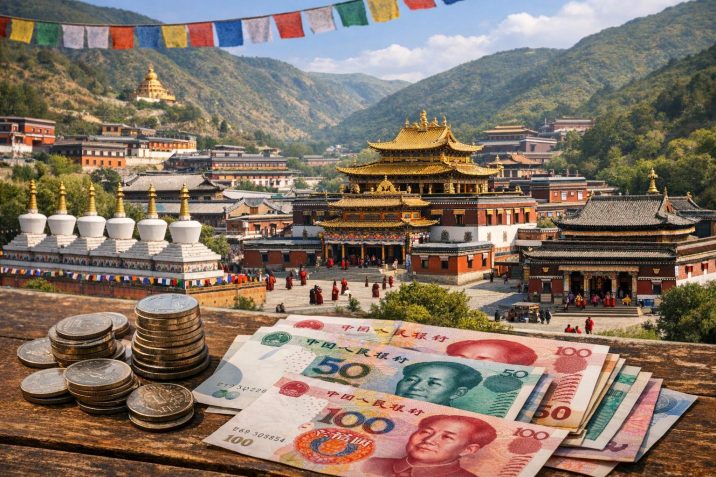
Kumbum Monastery, also known as Ta’er Monastery, is one of the most important monasteries of Tibetan Buddhism in China. It is located in Huangzhong District, approximately 25 kilometers southwest of Xining, the capital of Qinghai Province. The monastery sits in a narrow valley surrounded by mountains, at an altitude of about 2,600 meters above sea level. As one of the six great monasteries of the Gelug school of Tibetan Buddhism, Kumbum has played a significant role in religious, educational, cultural, and political life in the northeastern Tibetan region for centuries. Its geographic position in Amdo placed it at the crossroads of Tibetan, Mongolian, and Han Chinese cultural spheres, shaping its development and influence over time.
Geographical and Cultural Setting
The location of Kumbum Monastery in the Amdo region has had a lasting impact on its identity. Amdo, historically one of the three principal Tibetan cultural regions alongside Ü-Tsang and Kham, has long functioned as a contact zone between pastoral Tibetan communities, Mongolian groups, and Chinese administrative centers. Situated near major trade and communication routes linking central Tibet to Gansu, Sichuan, and Inner Mongolia, the monastery benefited from consistent interaction with travelers, merchants, pilgrims, and officials.
The surrounding valley provides a natural enclosure that contributes to the monastic atmosphere. The terrain includes rolling hills, cultivated fields, and grazing lands. The climate is characterized by cold, dry winters and relatively mild summers, conditions that influence both daily monastic routines and the preservation of buildings and artworks. Seasonal changes mark the rhythm of religious festivals and agricultural activity in nearby communities, reinforcing ties between the monastery and lay society.
The monastery’s proximity to Xining has also been significant. As a regional administrative center under various dynasties and modern provincial authorities, Xining facilitated economic exchange and political oversight. This closeness allowed Kumbum to receive imperial patronage while remaining firmly embedded in Tibetan religious traditions.
Historical Background
Kumbum Monastery was founded in 1583 during the Ming dynasty. Its establishment is closely connected to the birth of Tsongkhapa (1357–1419), the founder of the Gelug school of Tibetan Buddhism. Tsongkhapa was born in the region where the monastery now stands. According to tradition, shortly after his birth, his father planted a sandalwood tree at the site. It is said that images of the Buddha later appeared naturally in the bark and leaves of the tree, attracting pilgrims and giving rise to the sacred status of the location.
The name “Kumbum” comes from the Tibetan words “sku ‘bum”, meaning “one hundred thousand images.” This refers to the legendary appearance of countless Buddha images on the leaves of the sandalwood tree associated with Tsongkhapa’s birth site. The Chinese name “Ta’er” derives from a transliteration of the Tibetan term. Over time, the location became a major pilgrimage destination, and religious structures were gradually built around the original commemorative shrine.
The earliest structure at the site was a small temple erected to honor Tsongkhapa. As devotion to Tsongkhapa spread and the Gelug tradition consolidated its institutional strength, the need for a larger monastic complex became clear. With patronage from local Mongol leaders and support from the Ming and later Qing dynasties, the monastery expanded significantly. By the 17th and 18th centuries, Kumbum had become one of the major monastic centers outside central Tibet, drawing monks and scholars from across Amdo, Mongolia, and other Tibetan regions.
Throughout the Qing period, imperial authorities recognized the strategic importance of maintaining stable relations with Tibetan Buddhist institutions. Kumbum, as the birthplace of Tsongkhapa and a leading Gelug monastery, received official seals, donations, and ceremonial recognition. Such support reinforced its prestige and enabled architectural expansion. By the height of its development, the monastery housed several thousand monks and encompassed a large network of affiliated temples and estates.
Religious Significance
Kumbum Monastery is one of the foremost centers of the Gelug, or “Yellow Hat,” school of Tibetan Buddhism. The Gelug tradition emphasizes strict monastic discipline, systematic study of Buddhist philosophy, and structured tantric practice. Founded by Tsongkhapa in the late 14th century, the Gelug school became the dominant tradition in central Tibet and later established major institutions throughout the Tibetan cultural world.
As Tsongkhapa’s birthplace, Kumbum occupies a unique position within this network. Pilgrims visiting the monastery often focus on the shrine that commemorates his birth. The sacred sandalwood tree, preserved within protective structures, remains a central object of reverence. The site embodies both historical memory and doctrinal continuity, linking the physical landscape of Amdo with the intellectual and spiritual legacy of the Gelug school.
Historically, the monastery housed numerous incarnate lamas, known as tulkus, who played key roles in administration, teaching, and ritual leadership. These figures participated in broader networks of reincarnate lineages that connected Kumbum to Lhasa and other major monasteries such as Drepung, Sera, and Ganden. Through these relationships, ideas, texts, and personnel moved between central Tibet and Amdo.
Ritual life at Kumbum follows the annual liturgical calendar of the Gelug tradition. Daily chanting sessions, offering ceremonies, and philosophical debates structure the monastic schedule. Collective rituals are performed for the welfare of local communities, including prayers for agricultural abundance, protection from disease, and social stability. In this way, the monastery serves not only as a center of advanced study but also as a provider of ritual services for laypeople.
Architectural Layout and Design
Kumbum Monastery is a large complex comprised of temples, assembly halls, stupas, residential quarters, scripture repositories, and courtyards arranged along the slopes of the valley. Over centuries of expansion, the architectural plan developed in response to both religious functions and topographical constraints. Stone pathways and staircases connect the various levels, guiding movement between major halls and smaller chapels.
The architecture combines Tibetan structural forms with Han Chinese and Mongolian decorative influences. Many buildings feature whitewashed walls that contrast with red-painted upper sections, a common characteristic of Tibetan monastic design. Roofs may be gilded or covered with green tiles, reflecting Chinese stylistic elements introduced during periods of imperial patronage. Golden finials, prayer flags, and carved window frames add to the visual complexity of the site.
The Great Golden Roof Hall marks the traditional birthplace of Tsongkhapa. Its gilded roof and central position underscore its importance within the complex. Inside, richly decorated altars display statues of Tsongkhapa and other Gelug masters. Murals narrate episodes from his life and present doctrinal themes central to his teachings.
The Great Scripture Hall functions as the primary assembly space for communal ceremonies. Large pillars support the roof, and rows of low seats accommodate monks during chanting sessions. Shelves along the walls hold volumes of canonical texts, including editions of the Kangyur and Tengyur. The arrangement of interior space reflects the importance placed on collective recitation and study.
Numerous smaller temples are dedicated to specific deities, protective figures, or lineage masters. Stupas within the monastery grounds commemorate respected teachers and incarnate lamas. Their presence reinforces continuity between generations and serves as a focal point for devotional practice.
Artistic Traditions and Craftsmanship
Kumbum Monastery is widely recognized for three major artistic traditions: butter sculptures, murals, and barbola (embossed applique) art. These forms constitute a distinctive aspect of its cultural heritage and have attracted scholarly and public attention.
Butter sculptures are created using colored yak butter mixed with mineral pigments. Artisans shape the butter into elaborate figures depicting Buddhas, bodhisattvas, guardians, animals, and symbolic motifs. The production of these sculptures requires controlled temperature conditions, often achieved during winter when cold air prevents melting. The sculptures are particularly associated with the Butter Lamp Festival, where they are displayed temporarily before being dismantled.
The mural tradition at Kumbum spans several centuries. Walls of major temples are covered with painted scenes illustrating the life of Tsongkhapa, episodes from the Buddha’s biography, mandalas representing cosmic diagrams, and depictions of protective deities. Stylistic analysis reveals a synthesis of Tibetan iconography with shading techniques and compositional elements influenced by Chinese painting. Restoration projects in recent decades have aimed to stabilize pigments and repair damaged surfaces.
Barbola art involves shaping malleable materials into raised relief designs applied directly to walls or panels. Once dried and painted, these reliefs create a three-dimensional visual effect. Subjects often include floral patterns, auspicious symbols, and narrative scenes. The technique demonstrates the adaptability of monastic artisans in integrating sculptural and pictorial forms.
Educational Institutions and Scholarly Life
Historically, Kumbum Monastery was organized into several monastic colleges, each with defined areas of specialization. The philosophical college emphasized logic, epistemology, and Madhyamaka philosophy. Students memorized root texts and commentaries before engaging in structured debate sessions. These debates, conducted in formalized gestures and rhetorical exchanges, served as a means of testing comprehension and refining analytical skills.
Advanced students could pursue degrees comparable to the Geshe qualification recognized throughout the Gelug world. This educational system fostered intellectual cohesion across geographically dispersed monasteries. Tantric colleges within the complex provided instruction in ritual performance, visualization practices, and esoteric doctrine, complementing philosophical study.
The monastery also functioned as a repository of texts. Manuscripts and printed editions of scriptures were preserved in dedicated libraries. Subjects extended beyond strictly religious works to include medical treatises, calendrical calculations, and historical chronicles. Such collections underscore the role of monasteries as centers of knowledge production and preservation in Inner Asia.
Political and Cultural Role
The history of Kumbum Monastery cannot be separated from broader political developments. During the Ming and Qing dynasties, imperial authorities extended patronage to prominent Tibetan Buddhist institutions as part of frontier governance strategies. Official gifts, titles, and financial contributions enhanced Kumbum’s standing while aligning it symbolically with the state.
Mongolian elites were also significant patrons. Many Mongolian monks studied at Kumbum, and religious exchanges strengthened connections between Amdo and Mongolian territories. These interactions illustrate how Tibetan Buddhism functioned as a unifying cultural framework across diverse ethnic groups in Inner Asia.
In the 20th century, the monastery faced substantial challenges. Periods of military conflict, administrative restructuring, and ideological campaigns affected religious institutions across China. During the Cultural Revolution (1966–1976), many monasteries experienced damage and the suspension of regular activities. Kumbum was no exception. Since the 1980s, policies allowing religious practice have enabled restoration of buildings and revival of monastic education on a more limited scale.
Pilgrimage and Festivals
Kumbum remains an active pilgrimage site. Devotees circumambulate sacred buildings, spin prayer wheels, and offer butter lamps. Pilgrimage often involves prostration, recitation of mantras, and donations to support monastic activities. The sacred geography of the site structures these devotional movements, with pilgrims following established paths around key halls.
The Monlam Prayer Festival, held during the first lunar month, gathers monks for extended chanting sessions and public teachings. Ritual dances known as cham are performed in ceremonial courtyards, combining masked choreography with symbolic narratives. The Butter Lamp Festival concludes New Year celebrations, displaying intricate butter sculptures illuminated at night.
These events attract both religious participants and visitors interested in cultural heritage. Tourism has become an integral part of the monastery’s contemporary economy. Administrative measures regulate visitor flow to protect fragile artworks while maintaining access.
Additional information about visiting arrangements and regional context can be found through the Qinghai provincial tourism resources at Qinghai cultural and heritage travel information, which outline travel connections and preservation initiatives relevant to sites such as Kumbum.
Present-Day Administration and Preservation
Today, Kumbum Monastery functions under a dual identity as both a working religious institution and a protected cultural site. A resident community of monks continues to engage in study, ritual performance, and community outreach. Administrative committees coordinate between religious leaders and local authorities regarding conservation, security, and tourism management.
Preservation efforts focus on stabilizing wooden beams, preventing water infiltration, and protecting murals from environmental damage. The high-altitude climate poses challenges, particularly fluctuations in temperature that affect paint layers and structural materials. Conservation specialists employ traditional techniques where possible, supplemented by modern methods of analysis and reinforcement.
Visitor infrastructure has been expanded to include ticketing systems, guided tour services, and informational displays. These measures aim to balance educational access with respect for active worship areas. The continued presence of monks ensures that ritual sound, movement, and study remain integral to the site’s character.
Conclusion
Kumbum Monastery stands as a major institution within Tibetan Buddhism and the broader history of Inner Asia. Founded in 1583 at the birthplace of Tsongkhapa, it developed into a leading center of Gelug scholarship, ritual practice, and artistic production. Its architecture reflects Tibetan foundations enriched by Chinese and Mongolian influences, while its butter sculptures, murals, and barbola art demonstrate sustained craftsmanship.
Over centuries, the monastery navigated shifting political landscapes, benefiting from imperial patronage while maintaining doctrinal connections to central Tibet. Despite periods of disruption, it continues to function as both a monastic community and a cultural heritage site. Through education, pilgrimage, and preservation, Kumbum Monastery remains a significant reference point for understanding the historical and contemporary dimensions of Tibetan Buddhism in Qinghai and beyond.
