
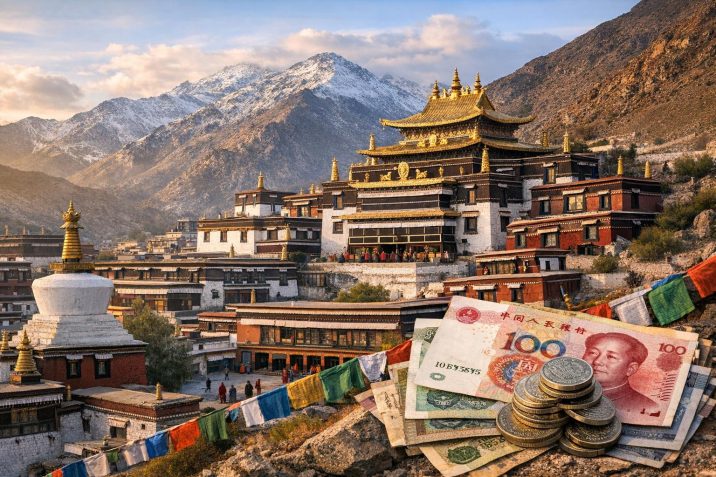
Tashilhunpo Monastery is one of the most significant religious institutions in Tibetan Buddhism. Located in Shigatse, the second-largest city in the Tibet Autonomous Region of China, the monastery has served as an important center of religious study, political authority, and artistic production since the fifteenth century. As the traditional seat of the Panchen Lama, Tashilhunpo occupies a distinctive position within the Gelug school of Tibetan Buddhism and remains an active religious community in the twenty-first century. Its long institutional history reflects broader developments in Tibetan religious organization, regional governance, and cross-cultural exchange across Inner Asia.
Foundation and Historical Background
Tashilhunpo Monastery was founded in 1447 by Gendun Drub, who was later recognized as the First Dalai Lama. During his lifetime, however, he was known primarily as a scholar and disciple of Je Tsongkhapa, the founder of the Gelug school. Tsongkhapa’s reform movement emphasized monastic discipline, scholastic rigor, and systematic study of Buddhist philosophy. The establishment of Tashilhunpo formed part of the broader expansion of Gelug institutions throughout central Tibet during the fifteenth century.
The site selected for the monastery lies at the base of Drolmari (Tara) Mountain in Shigatse. At the time of its founding, the Tsang region had its own political leadership separate from Lhasa. By positioning the new monastery in this region, Gendun Drub effectively extended Gelug influence beyond central administrative centers. The monastery grew steadily in scale, supported by regional patrons and by its reputation for disciplined scholarship.
The name “Tashilhunpo” may be translated as “Heap of Glory” or “All Fortune and Happiness Gathered Here.” Over the sixteenth and seventeenth centuries, the monastery expanded both physically and institutionally. By this period it had developed colleges for structured study, residential quarters for monks, and chapels dedicated to specific ritual functions. Its later identification as the permanent seat of the Panchen Lama further secured its status among the leading monastic centers of Tibet.
The Development of the Panchen Lama Lineage
Tashilhunpo Monastery is most closely associated with the lineage of the Panchen Lama, regarded as the second-highest spiritual authority in the Gelug tradition after the Dalai Lama. The title combines the Sanskrit term Pandita, meaning learned scholar, and the Tibetan word Chenpo, meaning great. The Panchen Lama is considered an emanation of Amitabha Buddha, the Buddha associated with boundless light and the Western Pure Land.
The institutional link between Tashilhunpo and the Panchen Lama took clearer shape in the seventeenth century. The Fourth Panchen Lama, Lobsang Chökyi Gyaltsen, played a decisive role in consolidating this connection. From that time forward, successive Panchen Lamas resided at Tashilhunpo and directed its expansion. The monastery thus became not only a scholastic center but also the core residence of a major reincarnate lineage.
The relationship between the Dalai Lama and Panchen Lama lineages developed into one of reciprocal recognition. Historically, each lineage participated in identifying the reincarnation of the other. This mutual recognition reinforced the authority of both institutions and contributed to the structure of governance in Tibet. The Panchen Lama exercised particular influence in the Tsang region, where Tashilhunpo functioned as a religious and administrative nucleus.
Religious Authority and Regional Governance
During certain periods, especially in the seventeenth and eighteenth centuries, Tashilhunpo was closely connected to political administration. Monastic officials managed estates, collected revenues allocated for religious purposes, and supervised local communities affiliated with the monastery. The Panchen Lama’s authority was therefore not limited to spiritual instruction but extended into regional governance.
Relations between the Panchen Lama and the central government in Lhasa varied over time. In some periods cooperation prevailed, while at other times political tensions emerged. These shifts reflected broader changes in Tibetan political structures and in relations with neighboring powers, including Mongolia and the Qing dynasty. Tashilhunpo’s institutional continuity nevertheless persisted across these transitions.
Architectural Layout and Spatial Organization
The monastery complex extends across terraced slopes beneath Drolmari Mountain. Its layout follows traditional Tibetan principles that adapt architecture to mountainous terrain. Buildings are arranged in ascending tiers, with larger assembly halls and principal chapels occupying central or elevated positions. Residential quarters and subsidiary buildings cluster around interior courtyards that function as spaces for gathering and debate.
Tibetan monastic architecture is characterized by thick stone walls designed for insulation, inward-sloping façades that provide structural stability, and flat roofs suited to a dry, high-altitude climate. Whitewashed walls are complemented by red bands marking sacred structures and by golden rooftop ornaments identifying important halls. The skyline of Tashilhunpo is marked by gilded finials and prayer flags, which signal its ritual significance within the urban landscape of Shigatse.
Within the main assembly halls, rows of low platforms provide seating for monks during communal chanting and debate. Pillars are painted with mineral pigments and often wrapped in ceremonial textiles during major festivals. Murals cover interior walls, depicting lineage masters, protective deities, cosmological diagrams, and episodes from the life of the historical Buddha.
Artistic Traditions and Murals
The mural cycles preserved at Tashilhunpo represent several centuries of artistic development. Early paintings reveal stylistic connections with central Tibetan schools, while later works incorporate influences from Nepalese and Chinese traditions. Artists used natural mineral pigments mixed with binding agents to create durable colors suited to the dry climate.
Iconographic programs within the chapels are arranged according to doctrinal hierarchies. Central figures such as Shakyamuni Buddha, Tsongkhapa, or the Panchen Lamas are surrounded by attendant bodhisattvas and protective deities. These compositions serve pedagogical functions, visually conveying complex theological relationships. The integration of image and ritual reinforces the educational environment of the monastery.
The Maitreya Chapel
One of the most prominent structures within the complex is the Maitreya Chapel. This chapel houses a monumental statue of Maitreya, the Future Buddha who, according to Buddhist doctrine, will appear in a distant era to renew the teachings. Completed in 1914 under the direction of the Ninth Panchen Lama, the statue measures approximately 26 meters in height and is regarded as one of the largest gilded bronze statues of its kind.
The construction of the statue required substantial material resources and skilled artisanship. Copper plates were shaped and assembled over an internal framework, then gilded to create a radiant surface. Gemstones and decorative elements accentuate the crown, ornaments, and ritual implements. The scale of the statue underscores the association between Tashilhunpo and the expectation of future spiritual renewal symbolized by Maitreya.
The chapel housing the statue was engineered to accommodate its height, with multiple internal levels allowing visitors to circumambulate and view the image from different elevations. Windows positioned high along the walls illuminate the face and torso of the statue, reinforcing its visual prominence during ceremonies.
Tomb Stupas of the Panchen Lamas
Another significant feature of Tashilhunpo is the series of tomb stupas dedicated to deceased Panchen Lamas. These stupas enshrine relics and serve as focal points for ritual remembrance. Architecturally, they combine traditional Tibetan stupa design with elaborate ornamentation that reflects the status of the individuals commemorated.
The tomb of the Tenth Panchen Lama is especially notable for its scale and decorative detail. Constructed in the late twentieth century, it incorporates gold plating, carved woodwork, and murals recounting aspects of his life. The structure also reflects renewed interest in monumental religious architecture following earlier periods of destruction.
Several earlier stupas were damaged during the Cultural Revolution, when religious sites across Tibet experienced destruction or repurposing. Subsequent reconstruction efforts restored a number of these monuments. Restoration involved both state-sponsored initiatives and contributions from local communities.
Monastic Education and Scholastic Life
Tashilhunpo has long functioned as a center for advanced study within the Gelug tradition. Monastic education typically begins with memorization of foundational texts, followed by systematic instruction in logic, epistemology, Madhyamaka philosophy, Abhidharma, Vinaya (monastic discipline), and tantric theory. Instruction is delivered through lectures, commentary, and formal debate sessions conducted in courtyards.
The debate tradition is a defining feature of Gelug scholarship. Monks engage in structured exchanges that test comprehension and logical consistency. This method encourages precise articulation of doctrinal positions and trains students in analytical reasoning. Academic progress may culminate in advanced degrees recognized within the monastic hierarchy.
Historically, Tashilhunpo contained multiple colleges specializing in distinct curricular emphases. These colleges operated within the broader institutional framework of the monastery and maintained residential communities of monks affiliated with specific teachers.
Ritual Calendar and Daily Routine
Daily life within the monastery follows a regulated schedule structured around prayer sessions, study periods, and communal meals. Early morning chanting precedes philosophical study, while afternoons may be dedicated to debate or ritual preparation. Senior monks supervise novices and oversee administrative responsibilities.
The ritual calendar is based on the Tibetan lunar system. Major observances commemorate events in the life of the Buddha, anniversaries of Tsongkhapa, and significant dates associated with the Panchen Lama lineage. Ritual specialists conduct initiations and empowerment ceremonies that transmit tantric practices to qualified participants.
Festivals and Community Interaction
Public festivals at Tashilhunpo strengthen ties between the monastery and lay communities. The annual Thangka Unveiling Ceremony during the Tibetan New Year period involves displaying a large embroidered image of the Buddha on a hillside. Residents of Shigatse and pilgrims from surrounding regions gather to witness the event.
Cham dances, performed by monks wearing elaborate masks and costumes, form part of certain ceremonial observances. These ritual dances dramatize narratives involving protective deities and historical figures, reinforcing religious teachings through visual performance. Such events illustrate the monastery’s function not only as a scholastic institution but also as a center of communal religious life.
Twentieth-Century Transformations
The twentieth century introduced substantial changes to Tibet’s political landscape. Following the establishment of the People’s Republic of China and the subsequent incorporation of Tibet, monasteries experienced new forms of regulation. Tashilhunpo’s administrative and financial structures were reshaped under state policies.
During the Cultural Revolution (1966–1976), religious practice was curtailed, and many structures within the monastery were damaged. Monastic populations declined sharply, and numerous artifacts were destroyed or removed. This period represented a major interruption in the continuity of institutional life.
In the post-1978 reform period, restrictions on religious practice eased to some degree. Restoration projects repaired assembly halls, reconstructed stupas, and reopened educational programs. The monastery was designated a protected cultural relic, acknowledging its historical and architectural importance.
The Recognition of the Eleventh Panchen Lama
The question of identifying the Eleventh Panchen Lama generated international attention in the 1990s. In 1995, the Fourteenth Dalai Lama recognized one candidate, while Chinese authorities endorsed another. The disagreement reflects broader tensions related to religious authority and political sovereignty. Tashilhunpo, as the historical seat of the Panchen Lama, remains central to this issue.
Information on contemporary developments concerning the Panchen Lama lineage can be found in academic and institutional resources such as Britannica’s overview of the Panchen Lama, which provides historical background and context.
Current Status and Preservation
Today, Tashilhunpo Monastery functions both as a working religious institution and as a site of cultural tourism. Resident monks continue to conduct daily prayers and educational programs. Visitor access is regulated, and sections of the monastery are maintained as heritage zones.
Preservation efforts focus on stabilizing murals, repairing structural damage caused by climate fluctuations, and safeguarding statues and relics. Conservation specialists employ techniques designed to respect traditional materials while ensuring durability. The integration of tourism revenue with preservation policies introduces ongoing administrative considerations.
Geographical and Economic Context
Shigatse lies at an elevation of approximately 3,800 meters above sea level, within the Tsang region of western central Tibet. Historically, this region supported agriculture based on barley cultivation and livestock herding. Trade networks linking Nepal, Bhutan, and central Tibet passed near Shigatse, contributing to the economic resources available to the monastery.
The high-altitude environment influences construction methods and daily routines. Thick walls moderate interior temperatures, and flat roofs facilitate drying of grains and storage of materials. Seasonal climate patterns determine the scheduling of construction and major festivals.
Comparative Position Within Tibetan Buddhism
Within the broader landscape of Tibetan Buddhism, Tashilhunpo stands alongside major monasteries such as Drepung and Sera near Lhasa. While those institutions were historically associated more directly with the Dalai Lama, Tashilhunpo developed its distinctive institutional identity through the Panchen Lama lineage. Together, these centers formed an interconnected educational network that shaped the intellectual life of the Gelug school.
The monastery’s influence extended beyond Tibet into Mongolia and parts of Inner Asia, where Gelug scholarship gained prominence. Exchanges of texts, teachers, and students reinforced these transregional connections and contributed to the spread of Tibetan Buddhist doctrine.
Continuity and Adaptation
Across nearly six centuries, Tashilhunpo Monastery has experienced cycles of expansion, disruption, and renewal. Its survival reflects adaptive strategies that balanced religious tradition with changing political frameworks. While the size of its monastic population has fluctuated, the institution continues to function as a site of learning, ritual practice, and historical memory.
The architectural layers visible today encapsulate different historical moments, from the fifteenth-century foundations to twentieth-century reconstructions. The continued presence of monks engaged in study and ceremony sustains an unbroken link with earlier generations.
Tashilhunpo Monastery therefore remains a central institution in Tibetan Buddhism. Its role as the seat of the Panchen Lama, its record of scholastic achievement, and its architectural and artistic heritage ensure its enduring significance within the Himalayan region. Through ongoing preservation and regulated religious activity, the monastery continues to shape the religious and cultural landscape of Shigatse and beyond.
