
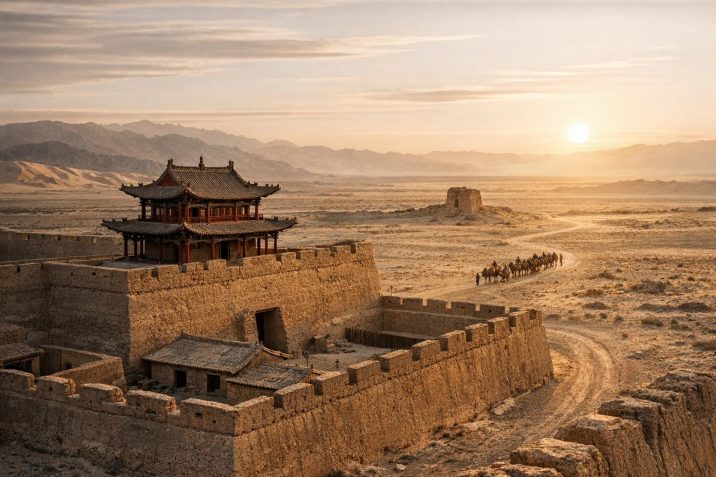
Yumen Pass, known in Chinese as Yumenguan (玉门关), is one of the most historically significant frontier passes along the ancient Silk Road. Located in present-day Gansu Province in northwestern China, it served as a strategic gateway between the Chinese heartland and the vast regions of Central Asia. For centuries, Yumen Pass functioned as a military outpost, a trade checkpoint, and a focal point of frontier administration. Its role in shaping long-distance trade, diplomacy, and cross-cultural exchange makes it an important subject in the study of Eurasian history.
Geographic Setting
Yumen Pass lies approximately 90 kilometers west of Dunhuang in Gansu Province, positioned at the western edge of the Hexi Corridor. The surrounding region is defined by arid plains, gravel deserts, and sparse vegetation typical of the eastern Gobi Desert. Annual rainfall is extremely limited, and temperature fluctuations between day and night can be significant. Despite these environmental challenges, the location of Yumen Pass held exceptional strategic value.
The Hexi Corridor forms a narrow strip of land bounded by the Qilian Mountains to the south and the Gobi Desert to the north. This corridor provided the most practical overland connection between the Wei River basin in central China and the Tarim Basin farther west. Control of this natural passageway was essential for any sustained political or economic engagement with Central Asia. Yumen Pass marked one of the principal exits from this corridor into territories historically inhabited by various nomadic and oasis-based societies.
From a logistical perspective, the pass did not simply function as a gate in isolation. It occupied a nodal position between cultivated oases and expansive desert landscapes. Caravans traveling through the region relied on oasis settlements for water, fodder, and rest. Dunhuang, situated to the east, acted as the final major administrative and urban center before travelers advanced toward less densely settled zones. By situating Yumen Pass at this threshold, the Chinese state created a regulated checkpoint between the agrarian core and the steppe-desert frontier.
Origins and Early Development
The establishment of Yumen Pass can be traced to the Western Han Dynasty (206 BCE–9 CE), a period characterized by territorial consolidation and expansion. During the early Han period, the empire faced persistent pressure from the Xiongnu confederation, a powerful nomadic entity that controlled large sections of the northern степpe. These dynamics prompted the Han court to adopt proactive frontier policies.
Emperor Wu of Han (r. 141–87 BCE) played a central role in campaigns aimed at reducing Xiongnu influence and extending imperial control westward. Military expeditions, diplomatic missions, and colonization programs were implemented to secure the Hexi Corridor. The opening of the so-called “Western Regions” was both a defensive measure and an economic strategy.
The envoy Zhang Qian, dispatched in the 2nd century BCE, journeyed across Central Asia in search of allies against the Xiongnu. Although he was captured and detained for several years, his eventual return provided the Han court with detailed intelligence regarding the political geography and trade networks of Central Asia. His reports contributed to the strategic rationale for establishing a series of fortified passes and garrisons, including Yumen Pass and Yang Pass.
The designation “Yumen,” meaning “Jade Gate,” reflects the prominence of jade as a trade commodity. High-quality nephrite jade from Khotan in the Tarim Basin had long been prized in Chinese ritual and artistic traditions. By routing jade imports through an official checkpoint, the Han state could supervise and tax this valuable resource. The name symbolized both economic regulation and imperial authority.
Administrative Structure and Frontier Governance
Yumen Pass was embedded in a broader administrative system that integrated military, fiscal, and civil functions. Frontier commanderies established in the Hexi Corridor oversaw agricultural colonies known as tuntian, where soldiers and settlers cultivated crops to sustain local garrisons. This arrangement reduced reliance on long and vulnerable supply lines from the interior.
Officials stationed at Yumen Pass were responsible for verifying documents, collecting duties, and recording movements. Travelers required permits to pass legally. The enforcement of documentation suggests a sophisticated understanding of frontier management. Rather than serving only as a defensive barrier, the pass functioned as an administrative filter that structured cross-regional interaction.
Archaeological discoveries of wooden slips bearing official inscriptions illustrate the procedural dimension of governance. These slips mention troop rotations, logistical inventories, and the transmission of orders. Communication between frontier outposts and central authorities relied on mounted couriers who navigated established relay stations. Through these communication chains, imperial directives could reach even remote desert garrisons.
Role in the Silk Road Trade Network
Yumen Pass formed a critical component of the transcontinental trade system commonly known as the Silk Road. It is important to recognize that this term refers to a network rather than a single route. Multiple branches connected China with Central Asia, South Asia, and eventually the Mediterranean world. Yumen Pass regulated one of the principal northern routes extending from Dunhuang toward Hami, Turfan, and the Tarim Basin.
Merchants transported silk textiles, lacquerware, metal implements, and ceramics westward. In exchange, goods such as horses, jade, precious stones, woolen textiles, and glassware entered Chinese markets. Horses from Ferghana were particularly valued for their strength and endurance, and they became a strategic military asset for the Han state.
The exchange encompassed more than material goods. Artistic motifs and technological techniques traveled along the same routes. Metallurgical knowledge, weaving methods, and agricultural products such as grapes and certain grains were transmitted across regions. Yumen Pass, as an official checkpoint, facilitated and regulated these exchanges. Goods passing through were subject to inspection, and in some cases state monopolies governed specific commodities.
The structured nature of trade through Yumen Pass contrasts with the perception of the Silk Road as an entirely informal system. While private merchants played a central role, the presence of garrisons and customs officials demonstrates active state involvement.
Military Significance
The defensive function of Yumen Pass remained fundamental throughout much of its history. Frontier fortifications were constructed primarily from rammed earth, a technique that involved compacting layers of soil within wooden frames. This method provided durability in an environment where stone was scarce and timber resources were limited.
Beacon towers situated near the pass enabled rapid signaling across long distances. Smoke signals by day and fire signals by night conveyed coded messages regarding hostile movement. The integration of Yumen Pass into a chain of observation points extended the defensive reach of the empire deep into the frontier zone.
Military colonies established in the Hexi Corridor supplied grain and supported cavalry units. Control over the corridor ensured that nomadic incursions could be monitored and, when necessary, repelled. In this context, Yumen Pass functioned as both an early-warning station and a physical barrier regulating access to inner territories.
During periods of instability, reinforcement of frontier defenses intensified. At other times, particularly when diplomatic relations with neighboring polities improved, the military emphasis coexisted with flourishing trade activity.
Relationship with Dunhuang
The city of Dunhuang played a complementary role to Yumen Pass. As a significant administrative center, Dunhuang housed officials responsible for managing western territories. It also served as a logistical hub where caravans assembled before crossing more desolate stretches of desert.
The cultural life of Dunhuang flourished alongside Silk Road commerce. The Mogao Caves, located southeast of the city, contain an extensive collection of Buddhist murals, sculptures, and manuscripts. These artistic and textual materials reflect the religious exchanges that occurred along transcontinental routes. Monks and pilgrims traveling between China, India, and Central Asia would have passed through the same corridor regulated by Yumen Pass.
The interdependence of Dunhuang and Yumen Pass demonstrates how military, economic, and religious institutions intersected along the frontier. Administrative supervision at the pass provided conditions under which trade and cultural transmission could occur with relative stability.
Continuity and Transformation in Later Dynasties
Yumen Pass continued to be referenced in subsequent dynasties, including the Tang Dynasty (618–907 CE), when long-distance trade experienced renewed vitality. Tang political power extended into parts of Central Asia, and diplomatic exchanges with Sogdian, Turkic, and Persian communities intensified.
During the Tang era, frontier administration became more complex, involving protectorates that governed regions beyond the immediate borders. While the precise strategic prominence of Yumen Pass evolved, its symbolic association with the western frontier persisted.
In later centuries, geopolitical shifts altered overland trade patterns. The rise of maritime commerce during the Song Dynasty redirected portions of international exchange to sea routes connecting China with Southeast Asia and the Indian Ocean world. At the same time, changing control over Central Asian territories affected the functioning of desert corridors. As these dynamics unfolded, Yumen Pass gradually diminished in administrative importance, though it remained embedded in historical memory.
Archaeological Research and Material Evidence
Systematic archaeological investigation of Yumen Pass has yielded significant insights into early imperial frontier systems. Excavations have uncovered remnants of walls, gates, and watchtowers, as well as everyday artifacts such as pottery fragments and metal tools.
The discovery of Han Dynasty wooden slips is especially important. These texts, written in ink on narrow wooden strips, include official correspondence, accounting records, and legal documents. Their preservation has been aided by the arid climate, which limits microbial decay. Scholars analyze these materials to reconstruct troop numbers, supply procedures, and patterns of mobility.
Modern research methods, including satellite imagery and geographic information systems, have contributed to a more comprehensive mapping of the defensive network associated with Yumen Pass. By examining alignments of walls and beacon towers, historians can better understand how communication and surveillance were organized across vast distances.
Literary and Cultural Representation
Yumen Pass occupies a prominent place in Chinese literary tradition, particularly in frontier poetry of the Tang period. Poets referenced the pass as a marker of geographic and cultural distance. In such works, it appears as a boundary between the settled agrarian world and the expansive western regions.
The phrase “beyond Yumen Pass” became an idiomatic expression signifying departure from the political center. Although these literary depictions often employed stylized imagery, they reflect the enduring association of the pass with themes of travel, service on distant frontiers, and contact with foreign lands.
This symbolic dimension complements the historical record. The combination of physical ruins and textual references reinforces the pass’s position within collective memory.
Integration into the Great Wall System
Yumen Pass is frequently discussed in relation to the Great Wall of China, though the concept of a single uninterrupted wall can be misleading. Different dynasties constructed and reconstructed defensive barriers adapted to local circumstances. In the Hexi Corridor, walls often consisted of rammed earth strengthened with layers of reeds and gravel.
The integration of Yumen Pass into this broader system illustrates a strategic principle: rather than sealing the frontier entirely, authorities focused on channeling movement through specified gateways. By concentrating surveillance and customs procedures at key points, the state exercised influence over long-distance mobility. Additional context on the broader defensive network can be found at the UNESCO description of the Silk Roads: the Routes Network of Chang’an–Tianshan Corridor, which situates Yumen Pass within a transnational heritage framework.
Environmental Conditions and Logistical Challenges
The environmental context of Yumen Pass shaped both its preservation and historical operation. The scarcity of water required careful planning. Wells and stored water supplies were critical for sustaining garrisons and caravans. Seasonal variations influenced travel schedules, as extreme temperatures could hinder movement.
Transporting provisions from agricultural zones in the Hexi Corridor demanded coordination. Grain shipments supported soldiers stationed in isolated posts. The stability of frontier defense therefore depended on agricultural productivity and effective distribution networks.
While the arid climate preserved organic materials, wind erosion gradually reduced built structures. Present-day remains appear as earthen formations rising from the gravel plain, providing a tangible reference to earlier architectural forms.
Comparative Perspective
From a comparative standpoint, Yumen Pass shares characteristics with other historical frontier gateways. Empires across Eurasia established controlled transit points to supervise commerce and maintain security. Examples include fortified passes in the Caucasus and defensive lines along the Roman frontier. In each case, regulation of movement was as significant as physical defense.
Within China, Yang Pass functioned as a complementary checkpoint south of Yumen. Together, these passes demonstrate a coordinated approach to overseeing multiple branches of the Silk Road network. Their existence highlights the importance of Dunhuang as a convergence point of routes leading toward Central Asia.
Modern Preservation and Interpretation
Today, Yumen Pass is protected as a cultural heritage site within Gansu Province. Conservation efforts aim to stabilize earthen structures and mitigate erosion. Interpretive signage provides context for visitors, explaining the site’s military and commercial functions.
Inclusion within the UNESCO-listed Silk Roads network underscores its international historical significance. This designation promotes research collaboration and encourages sustainable tourism management. Although the site remains geographically remote, improved transportation infrastructure has facilitated controlled access.
Scholarly interest continues to evolve, with interdisciplinary research combining textual analysis, archaeology, and environmental studies. These approaches contribute to a more nuanced understanding of how Yumen Pass operated within broader regional systems.
Historical Significance
The long-term importance of Yumen Pass lies in its embodiment of structured transcontinental exchange. It demonstrates how imperial expansion, economic interests, and defensive strategy converged at specific geographic nodes. Rather than viewing the Silk Road as an unregulated expanse of paths, Yumen Pass illustrates the degree to which states organized and supervised long-distance interaction.
Its establishment during the Han Dynasty marked a decisive moment in the projection of Chinese power into Central Asia. Administrative documents recovered from the site provide detailed evidence of daily frontier governance, reinforcing the historical record preserved in dynastic chronicles.
Although political and environmental transformations eventually reduced its direct administrative role, Yumen Pass remains a key reference point in discussions of Eurasian connectivity. Its physical remnants, documentary archives, and literary representations collectively illuminate the complexities of ancient frontier management and intercultural exchange.
Through military oversight, trade regulation, and symbolic association with distant territories, Yumen Pass contributed to shaping patterns of contact between East Asia and Central Asia for centuries. As both an archaeological site and a historical concept, it continues to inform scholarly analysis of how empires structured movement across vast and challenging landscapes.
