
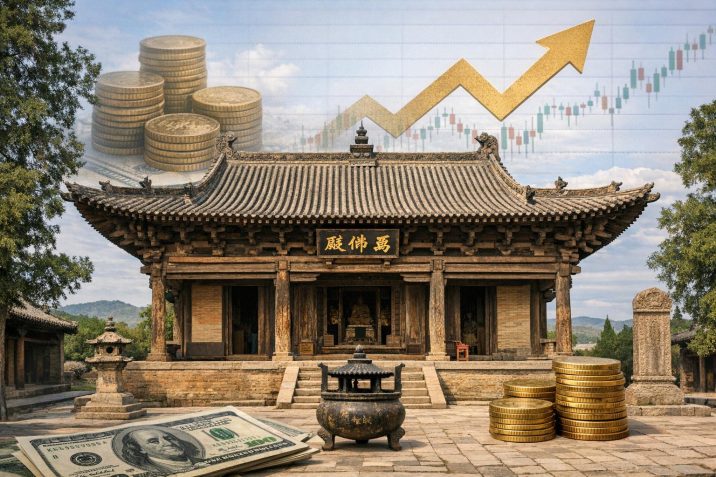
Zhenguo Temple (镇国寺) is a historic Buddhist temple complex located in Pingyao County, Shanxi Province, China. It stands approximately 12 kilometers northeast of the ancient city of Pingyao, a settlement internationally recognized for its preserved Ming and Qing dynasty urban fabric and designated as a UNESCO World Heritage Site. Within this broader cultural landscape, Zhenguo Temple occupies a distinct place due to its exceptional architectural and sculptural survival. The temple is especially known for its early wooden structure, the Wanfo Hall, and for a rare group of colored clay sculptures dating primarily to the Five Dynasties period (907–960). Together, these elements make the site one of the most important surviving examples of early medieval Chinese Buddhist architecture.
Geographical and Cultural Setting
Zhenguo Temple is situated in the central region of Shanxi Province, an area long recognized for the preservation of early wooden architecture. Shanxi’s geographic features, including loess plateaus and relatively dry climatic conditions, have contributed to the survival of timber structures that would have decayed in more humid environments. The province also developed as an important corridor of commerce and religious exchange, linking the North China Plain with Inner Asia. Religious institutions in Shanxi often benefited from regional patronage networks connected to trade, agriculture, and local governance.
Pingyao County, located nearby, was historically a center of commerce and finance, particularly during the Ming and Qing periods. Although Zhenguo Temple predates Pingyao’s financial prominence, its proximity to an established settlement helped maintain its institutional relevance. The relationship between religious institutions and urban centers in traditional China was mutually reinforcing. Temples offered ritual services, moral legitimacy, and educational activities, while local elites provided patronage and protection.
The temple’s placement slightly outside the dense urban core reflects typical planning traditions. Many Buddhist monasteries were constructed in semi-rural locations, balancing accessibility with symbolic distance from secular life. This setting allowed for monastic routines while remaining integrated with local society.
Historical Background
Zhenguo Temple was originally established in 963 CE during the Northern Han period, one of the regimes that ruled parts of northern China during the Five Dynasties and Ten Kingdoms era. The temple was first named Jingcheng Si. Later, during the Ming dynasty, it received the name Zhenguo Temple, meaning “Temple Protecting the State.” Such terminology was consistent with longstanding traditions in which Buddhist establishments were seen as sources of spiritual protection for political authority.
The Five Dynasties period followed the collapse of the Tang dynasty in 907 CE and was characterized by political fragmentation and short-lived regimes in northern China. Despite instability at the imperial level, regional centers continued to sponsor religious construction. Shanxi, in particular, became a major repository of Buddhist art and architecture. The relative stability of certain local power structures helped sustain monastic communities even when central authority shifted frequently.
Over the centuries, Zhenguo Temple experienced cycles of repair, renovation, and modest expansion. Records indicate work carried out during the Song, Yuan, Ming, and Qing dynasties. These interventions often responded to natural wear, climatic damage, or evolving liturgical needs. Importantly, the central structure of the Wanfo Hall has retained much of its original tenth-century framework. This continuity distinguishes Zhenguo Temple from many other early religious sites that were completely reconstructed in later periods.
Architectural Layout and Spatial Organization
The overall layout of Zhenguo Temple follows the axial planning principles typical of Chinese Buddhist monastic design. The complex is organized along a north–south central axis, with primary halls aligned sequentially from the entrance gate to the principal sanctuary at the rear. Courtyards separate the halls, creating transitional spaces that structure movement and ritual progression.
Upon entering through the mountain gate, visitors proceed toward the Hall of Heavenly Kings, where guardian deities are traditionally enshrined. Beyond this lies the main courtyard, culminating in the Wanfo Hall. Subsidiary buildings flank the central axis symmetrically, reinforcing concepts of spatial order and hierarchy embedded in traditional Chinese architecture.
The structures are raised on stone platforms and constructed with timber frames joined without the use of nails. Roofs are covered with ceramic tiles and project outward with gently curving eaves. The interplay of horizontal beams, vertical columns, and bracket systems defines both structural capacity and aesthetic rhythm.
Proportions within the complex are comparatively modest when measured against monumental imperial temples. Nevertheless, the balance between built mass and open courtyard space creates a coherent and unified architectural environment.
Timber Construction and Structural Features
The timber framing of Zhenguo Temple exemplifies early medieval construction methods. Columns rest upon stone bases and support beams interconnected through mortise-and-tenon joints. The structural system distributes weight efficiently while allowing a degree of flexibility that has helped the building withstand centuries of environmental stress.
Particularly significant are the dougong bracket sets positioned between columns and roof beams. These interlocking wooden components transfer roof loads outward and downward while permitting extended eaves. In the Wanfo Hall, the bracket sets exhibit relatively restrained complexity compared to later Song and Ming examples. Their form reflects an intermediate stage between the robust Tang style and the more standardized systems described in subsequent architectural manuals.
The roof of the Wanfo Hall is a single-eaved hip structure, characterized by slopes on all four sides. The pitch is moderate, and the overhanging eaves offer protection from precipitation. The economy of form suggests that the hall was built for durability and clarity of design rather than monumental display.
The Wanfo Hall
The Wanfo Hall, constructed in 963 CE, is the principal surviving structure of Zhenguo Temple. It is widely recognized as one of the oldest extant wooden temple buildings in China. Its survival provides critical insight into architectural practices during the Five Dynasties period.
The hall measures three bays in width and three bays in depth. This compact plan supports a single large interior space arranged around a central altar platform. Light enters through doors and limited window openings, creating an interior environment conducive to ritual activity.
The interior ceiling structure reveals exposed beams and bracket arms, allowing direct observation of the timber framework. Such visibility assists researchers in identifying construction sequences and understanding the distribution of vertical and lateral loads. The structural clarity of the hall has made it a valuable case study in the history of Chinese architecture.
Despite occasional repairs, dendrochronological studies and stylistic analysis confirm the tenth-century origin of significant components. Conservation efforts prioritize stabilization rather than replacement, ensuring the integrity of original materials.
Clay Sculptures of the Five Dynasties
Inside the Wanfo Hall stands a group of eleven large colored clay sculptures dating to the Five Dynasties period. These figures form the temple’s most important artistic ensemble. Arranged on the central altar platform, they represent the Buddha and attendant figures according to established Mahayana iconographic schemes.
The central image depicts the Buddha seated in a composed posture, elevated slightly above the surrounding figures. Flanking bodhisattvas stand in symmetrical positions, while additional attendants and guardians complete the grouping. The arrangement reflects hierarchical principles consistent with Buddhist cosmology.
The sculptures were created by shaping clay over internal wooden armatures. After modeling, artisans applied layers of mineral pigment. Although some pigment has faded, traces of original coloration remain visible, indicating the former brilliance of the figures.
These works illustrate a stylistic transition from Tang precedents toward Song-era refinement. Compared to the fuller and more expansive forms of high Tang sculpture, the Zhenguo Temple figures appear more contained in gesture and proportion. Drapery folds are carefully organized, and facial expressions emphasize composure.
Artistic Techniques and Materials
Technical examination of the sculptures reveals careful preparation of clay mixtures to achieve both strength and fine surface detail. Artisans layered coarse and fine clay to shape anatomical structure and garments. After drying, surfaces were polished before receiving pigment.
Mineral-based pigments such as azurite and malachite were commonly used in medieval Chinese polychrome sculpture. Red and gold tones were applied to highlight sacred attributes. Scientific analysis conducted by cultural heritage laboratories has confirmed the presence of natural mineral compounds consistent with tenth-century practices.
The painting of the figures was not merely decorative but integral to conveying iconographic meaning. Color differentiation distinguished bodhisattvas from guardians and visually structured the ensemble. The preservation of these pigments provides rare material evidence for the study of early medieval workshop techniques.
Iconography and Religious Significance
The sculptural program of Zhenguo Temple reflects Mahayana devotional traditions. The central Buddha represents enlightened authority, while bodhisattvas serve as compassionate intermediaries accessible to worshippers. Guardian figures reinforce the sanctity of the sacred space.
The ten thousand Buddhas implied by the hall’s name do not appear literally in sculptural form. Instead, the title signals the universality of Buddha’s presence. Such symbolic naming conventions were common in Chinese temple architecture, where metaphoric language enhanced theological associations.
The arrangement of figures suggests structured ritual use, including offerings, chanting, and seasonal ceremonies. The altar platform would have functioned as the focal point for communal worship and monastic liturgy.
Renovations During Later Dynasties
Throughout the Song, Yuan, Ming, and Qing dynasties, Zhenguo Temple underwent periodic restoration. Wooden elements were repaired as necessary, and ancillary buildings were reconstructed in prevailing architectural styles. The Ming dynasty is particularly associated with formal recognition of the temple under its present name.
Stone steles and inscriptions within the complex document acts of patronage. These texts provide information about local officials, donors, and monastic administrators who oversaw repairs. They demonstrate that even after political transformations, regional communities maintained commitment to the temple’s upkeep.
Later additions were designed to harmonize visually with earlier structures, preserving axial symmetry and proportional balance. Although certain decorative details reflect Ming or Qing aesthetics, the core historical character of the site remains identifiable.
Comparative Architectural Context
Zhenguo Temple is frequently compared to other early wooden structures in Shanxi Province, including Foguang Temple and Nanchan Temple. These monuments collectively form a foundational dataset for understanding pre-Song timber construction.
Foguang Temple’s East Hall, dated to 857 CE, predates the Wanfo Hall and represents late Tang architectural achievement. Nanchan Temple, dating to 782 CE, is another important example. The Wanfo Hall occupies an intermediate chronological position, demonstrating continuity of timber principles during a transitional political era.
In contrast to later monumental complexes characterized by expansive courtyards and elaborate decorative systems, Zhenguo Temple retains a measured and regionally grounded character. Its significance lies in historical integrity rather than scale.
Preservation and Heritage Status
Although Zhenguo Temple itself is not individually inscribed on the UNESCO World Heritage List, its proximity to Pingyao enhances its cultural visibility. Pingyao’s designation as a World Heritage Site can be reviewed through the official UNESCO documentation at Ancient City of Pingyao World Heritage listing. The broader recognition of the region contributes indirectly to preservation efforts around the temple.
Zhenguo Temple is protected at the national level as a Major Historical and Cultural Site in China. Conservation initiatives focus on structural stabilization, fire prevention, and environmental monitoring. Visitor access to the Wanfo Hall is carefully managed to minimize fluctuations in humidity that could damage clay surfaces.
Modern conservation philosophy emphasizes minimal intervention. Original materials are retained whenever possible, and replacements are clearly distinguishable upon close inspection. This approach aligns with international standards for heritage safeguarding.
Archaeological and Scholarly Research
Zhenguo Temple has been the subject of architectural surveys, art historical analysis, and scientific testing. Detailed measurements of the timber framework have been compared to prescriptions found in the Song dynasty architectural treatise Yingzao Fashi. Although compiled in 1103, this manual records standardized building practices that may reflect earlier traditions.
Research into the clay sculptures includes pigment sampling, microscopy, and radiocarbon dating of wooden armatures. These studies help refine chronologies and clarify workshop affiliations. Comparative analysis with other Five Dynasties sculptures in Shanxi suggests regional networks of artisans sharing technical knowledge.
Archaeological documentation also records changes made during later renovations. By distinguishing original tenth-century fabric from subsequent repairs, scholars can reconstruct phases of adaptation and preservation.
Role in Regional Cultural Continuity
Zhenguo Temple contributes to understanding cultural continuity in Shanxi across periods of political fragmentation and consolidation. Its survival indicates sustained support at the local level regardless of dynastic change. Such continuity challenges assumptions that artistic production declined uniformly during the Five Dynasties period.
Instead, the temple demonstrates that regional centers maintained sophisticated craftsmanship and theological engagement. The integration of architecture, sculpture, and ritual space reflects a stable framework of religious life.
Today, Zhenguo Temple functions not only as a site of historical inquiry but also as part of the living cultural landscape of Pingyao County. While its primary significance lies in its medieval heritage, it remains embedded in contemporary patterns of cultural tourism and academic research.
Conclusion
Zhenguo Temple stands as an essential monument within the history of Chinese Buddhist architecture. Its Wanfo Hall, constructed in 963 CE, preserves structural features that bridge Tang precedents and Song innovations. The hall’s clay sculptures represent one of the most important surviving ensembles of Five Dynasties Buddhist art.
Through successive restorations, the temple has retained its core identity while adapting to changing historical circumstances. Situated within the broader cultural sphere of Pingyao and Shanxi Province, Zhenguo Temple offers material evidence for studying early timber construction, sculptural techniques, and regional religious practice. Its continued preservation ensures that this rare example of tenth-century architecture remains accessible for future research and cultural appreciation.
