
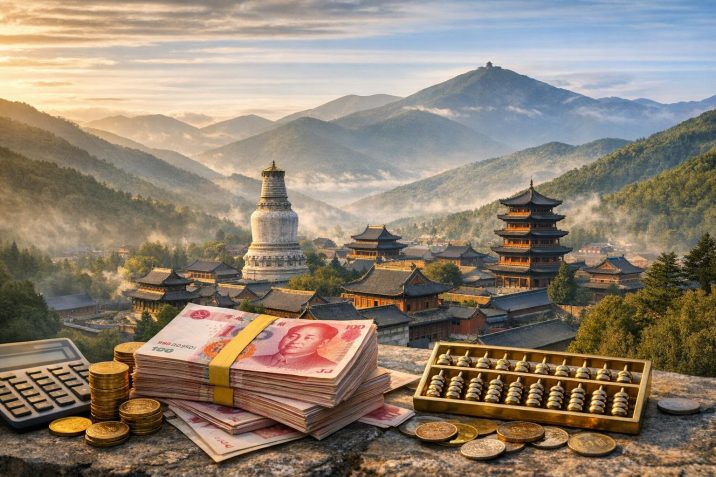
Mount Wutai, known in Chinese as Wutaishan (五台山), is one of the most important Buddhist mountains in China. Located in the northeastern part of Shanxi Province, it is recognized both for its religious significance and for its distinctive geography. The name “Wutai” means “Five Terraces,” referring to the five flat-topped peaks that form the mountain’s core landscape. For more than a millennium, Mount Wutai has been a major center of Buddhist practice, scholarship, and pilgrimage, and it remains an active religious site as well as a cultural and historical landmark.
Geographical Setting
Mount Wutai lies within the Taihang Mountain range, in Wutai County under the administration of Xinzhou Prefecture. Its geographical character differs from the sharply rising granite peaks that define some other well-known Chinese mountains. Instead, Wutai is notable for its open, expansive plateaus and gently sloping summits. The five principal terraces are identified as the East Terrace (Dongtai), West Terrace (Xitai), South Terrace (Nantai), North Terrace (Beitai), and Central Terrace (Zhongtai). Together, they create a natural configuration that has been interpreted symbolically within Buddhist cosmology.
The North Terrace, also known as Yedou Peak, reaches approximately 3,061 meters above sea level and is among the highest elevations in northern China. The high altitude contributes to a climate distinct from the surrounding lowlands. Winters are long, with extended periods of snow cover, while summers are comparatively cool. Because of these conditions, Mount Wutai was historically considered a suitable summer retreat for monks, officials, and even members of the imperial court.
Vegetation varies according to elevation. Forested slopes are found at lower levels, giving way to alpine meadows closer to the summits. Streams and springs emerging from the terraces feed into local rivers, supporting agriculture in nearby valleys. The relative openness of the plateaus allows broad views across Shanxi, reinforcing perceptions of isolation and remoteness that align with the mountain’s reputation as a site of contemplative retreat.
The relationship between geography and belief is central to Wutai’s identity. The five terraces have often been interpreted as corresponding to five forms of wisdom associated with Manjushri. This integration of topography and symbolism contributed to the mountain’s recognition as a sacred landscape rather than simply an isolated pilgrimage point.
Religious Significance in Buddhism
Mount Wutai is counted among the Four Sacred Mountains of Chinese Buddhism, each associated with a bodhisattva. Wutai’s patron figure is Manjushri, known in Chinese as Wenshu Pusa, the bodhisattva embodying wisdom. According to widely accepted tradition, Manjushri resides on this mountain and manifests there in various forms to guide living beings.
The identification of Mount Wutai with Manjushri emerged during the early centuries of Buddhism’s transmission into China. Translations of certain Mahayana scriptures described a sacred mountain in the northeast as the dwelling place of Manjushri. Chinese monks and scholars gradually associated those scriptural references with Wutai’s five-peaked formation. By the Tang dynasty, this identification had become firmly embedded in religious consciousness.
This connection elevated the mountain’s status within Buddhist devotional practice. Pilgrims believed that visiting Wutai offered not only merit but also the possibility of receiving insight. Accounts circulated of visions of Manjushri appearing as monks, travelers, or radiant figures. Such narratives reinforced the idea that the mountain functioned as an active spiritual domain rather than simply a commemorative site.
Wutai’s influence extended beyond Chinese Buddhism. It became an important center within Tibetan Buddhism, particularly from the Yuan dynasty onward. Mongol rulers of the Yuan court promoted Tibetan Buddhism and recognized Wutai’s association with Manjushri, who also occupies a central place in Tibetan tradition. Consequently, Tibetan monks and lamas established monasteries on the mountain, introducing architectural forms, ritual objects, and textual traditions that complemented existing Han Chinese institutions.
During the Qing dynasty, this interregional character intensified. Manchu emperors cultivated ties with Tibetan hierarchs and invested in Wutai as a shared sacred site. The result was a rare religious environment in which multiple linguistic and ritual traditions coexisted in relatively close proximity.
Historical Development
Archaeological and textual evidence suggests that Buddhist activity at Mount Wutai dates at least to the Eastern Han dynasty (25–220 CE), not long after Buddhism was introduced into China. Early temples were modest in scale, often supported by local patronage. By the time of the Northern Wei dynasty (386–534 CE), imperial sponsorship began to shape the mountain’s development.
The Northern Wei rulers, themselves of non-Han origin, showed considerable support for Buddhism. Temple construction expanded, and monastic institutions gained resources. The mountain’s reputation as a sacred dwelling of Manjushri became increasingly formalized during this period, supported by inscriptions and official recognition.
The Tang dynasty (618–907 CE) marked a period of sustained growth. Tang emperors patronized Buddhism in various forms, and Wutai benefited from this support. Large monasteries were constructed or expanded, and the number of resident monks increased. Records from the Tang period describe complex temple networks distributed among the five terraces and nearby valleys. Pilgrims from the Korean Peninsula and Japan also traveled to Wutai, demonstrating its prominence within East Asia.
Although Buddhism faced suppression during certain intervals, such as the Huichang Persecution of 845 CE, Mount Wutai recovered in subsequent centuries. Under the Song dynasty (960–1279 CE), the mountain maintained regional significance, though imperial focus shifted among different religious institutions.
The Yuan dynasty (1271–1368 CE) reoriented Wutai toward broader Inner Asian networks. Mongol rulers regarded Manjushri as a figure of political and spiritual legitimacy. This strengthened the mountain’s connection with Tibetan and Mongolian communities. Monasteries reflecting Tibetan architectural style appeared, and liturgical practices diversified.
During the Ming (1368–1644 CE) and Qing (1644–1911 CE) dynasties, cycles of reconstruction continued. The Qing period in particular brought renewed state attention. Emperors visited Wutai, sponsored renovations, and integrated the mountain into imperial ritual geography.
The 20th century introduced political change and challenges. Warfare and shifting governmental policies affected monastic communities, and some structures suffered damage. In the later decades of the century, preservation and restoration initiatives were undertaken. In 2009, Mount Wutai was inscribed as a UNESCO World Heritage Site, acknowledging its value as a cultural landscape of global significance. Further documentation about its World Heritage status can be found through the UNESCO World Heritage Centre.
Major Temples and Architectural Features
Mount Wutai contains dozens of significant temples distributed across valleys and terraces. Among them, Xiantong Temple is often regarded as the oldest and one of the most extensive. Its origins are traditionally traced to the early centuries of Buddhism in China, although current structures reflect reconstructions from later dynasties. The layout follows a conventional axial plan, with successive courtyards leading to main halls that house statues of Buddhas and bodhisattvas.
Tayuan Temple is distinguished by its prominent white stupa, visible from considerable distance. The stupa’s form reflects Tibetan influence, underscoring Wutai’s transregional connections. As reliquary architecture, the stupa symbolizes the Buddha’s presence and serves as an object of circumambulation.
Pusading Temple is historically associated with Qing imperial patronage. Architectural and decorative elements display a combination of Han Chinese and Tibetan design, including ornate roof structures, vibrant interior murals, and multilingual inscriptions. The coexistence of Chinese, Tibetan, Mongolian, and Manchu scripts in temple precincts illustrates the mountain’s multiethnic character.
In addition to these well-known complexes, numerous smaller monasteries and hermitages are scattered across the region. Timber construction predominates, and some halls preserve structural techniques valuable for the study of historical Chinese architecture. Bracket systems, painted beams, and tiled roofs exemplify stylistic features characteristic of their respective dynastic periods.
Murals and sculptures inside these temples depict Manjushri in various iconographic forms, sometimes riding a lion and holding a sword or scripture. These artistic representations not only serve devotional functions but also provide evidence of evolving artistic conventions. Stylistic comparisons reveal influences from Central Asia and Tibet alongside indigenous artistic traditions.
Pilgrimage and Religious Practice
Pilgrimage has shaped Mount Wutai’s identity for centuries. Devotees traditionally undertake journeys to visit the five terraces, offer incense, and participate in rituals dedicated to Manjushri. The physical act of ascending the terraces is itself regarded as part of spiritual discipline. Historical records indicate that pilgrims sometimes traveled in groups organized by monastic or lay associations.
Circumambulation of sacred sites is a common practice, especially around stupas and terrace summits. In Han Chinese monasteries, chanting of sutras and formal liturgies are regularly performed. In Tibetan Buddhist contexts, pilgrims may engage in full-body prostrations along designated paths, recite the mantra associated with Manjushri, or spin prayer wheels installed near temple entrances.
Important dates in the Buddhist calendar bring increased activity. Observances linked to Manjushri attract large numbers of visitors, including clergy and lay practitioners. Despite modern transportation networks that now allow easier access by road, many participants continue to approach pilgrimage as a structured religious undertaking rather than a casual excursion.
The coexistence of different Buddhist lineages has resulted in a ritual environment characterized by diversity rather than uniformity. While differences in liturgy and iconography are evident, the shared focus on Manjushri provides a unifying element across traditions.
Cultural and Artistic Influence
Mount Wutai’s prominence has influenced Chinese visual culture and literature. Painters during the Tang and Song dynasties created detailed representations of the mountain’s terraces and temple complexes. These works sometimes combined accurate topographical features with symbolic imagery, reinforcing the mountain’s cosmic significance.
Religious texts, travel diaries, and stele inscriptions document visits by monks, scholars, and officials. Such writings contribute to historical knowledge of temple construction, ritual practice, and interstate exchange. Japanese and Korean monks who traveled to Wutai recorded their experiences and transmitted doctrinal materials back to their home countries. These exchanges strengthened connections within the broader East Asian Buddhist sphere.
In addition to religious art, Mount Wutai has appeared in secular geographical treatises and gazetteers. Imperial surveys cataloged its temples and natural resources, integrating it into state administrative frameworks. Literary references to Wutai often evoke themes of scholarship and contemplation, consistent with its association with wisdom.
Modern Administration and Tourism
In contemporary China, Mount Wutai functions both as a living religious community and as a regulated scenic area. Administrative bodies oversee preservation, infrastructure development, and environmental protection. Visitor facilities have expanded, including transportation services and accommodations, though authorities have sought to control construction within core heritage zones.
The designation as a World Heritage Site has increased international recognition. Conservation programs focus on stabilizing wooden structures, preserving murals, and documenting inscriptions. Environmental initiatives address issues such as waste management, reforestation, and regulation of visitor flow.
Monasteries continue to conduct ordinations, study programs, and public ceremonies. Academic researchers in fields such as religious studies, art history, architecture, and environmental science conduct fieldwork on the mountain. These overlapping roles—religious center, tourist site, and research location—require ongoing coordination between monastic authorities and state agencies.
Environmental and Cultural Landscape
The concept of a cultural landscape is central to understanding Mount Wutai. The physical arrangement of terraces, valleys, temples, and pathways reflects centuries of adaptation to terrain and theology. Natural features such as springs and ancient trees are incorporated into temple narratives and ritual circuits.
Efforts to address environmental pressures include monitoring building density, protecting water sources, and limiting commercial activity in sensitive zones. Climate conditions also influence preservation strategies, as freeze-thaw cycles affect wooden and stone structures. The long-term integrity of the mountain depends on balancing religious vitality, tourism, and ecological stability.
Conclusion
Mount Wutai represents a sustained interaction between geography, religious belief, and historical change. As the sacred mountain of Manjushri, it has functioned for centuries as a focal point of pilgrimage and scholarship. Its five terraces, diverse temples, and multilingual inscriptions illustrate the convergence of Han Chinese, Tibetan, Mongolian, and Manchu influences.
Through cycles of expansion, decline, and restoration, the mountain has maintained continuity as a living religious environment. Its recognition as a UNESCO World Heritage Site underscores its importance not only within China but also within the wider history of Buddhism in Asia. Mount Wutai continues to serve as a place where natural topography and religious imagination combine to shape cultural identity and historical memory.
