
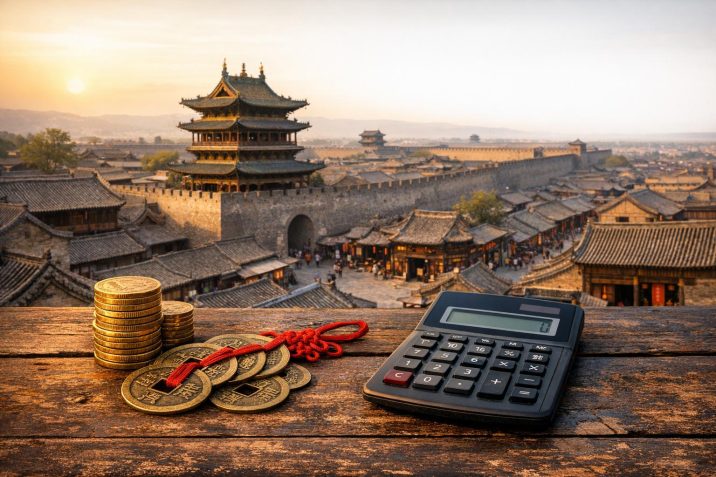
Pingyao Ancient City is a well-preserved urban settlement located in central Shanxi Province, China, approximately 100 kilometers south of Taiyuan, the provincial capital. Recognized for its architectural continuity and historical integrity, Pingyao presents a detailed representation of a traditional Han Chinese city from the Ming and Qing dynasties. In 1997, it was inscribed on the UNESCO World Heritage List as part of the site “Ancient City of Ping Yao,” reflecting its cultural, architectural, and economic significance in Chinese history. The designation recognizes not only the surviving monuments but also the comprehensive urban fabric that conveys the structure of imperial-era civic, commercial, and domestic life.
Geographical Context and Strategic Location
Pingyao’s development was closely linked to its geographical setting. Situated within the Fen River basin, the city occupies a relatively fertile and accessible region of Shanxi Province. The surrounding terrain consists of plains bordered by loess hills, providing agricultural resources that supported a stable population base. Its position between northern pastoral regions and the central plains facilitated exchange between different economic zones.
During the Ming and Qing periods, Shanxi merchants became active participants in long-distance trade networks extending across China. Pingyao’s location along established caravan routes allowed it to benefit from the circulation of goods and bullion. Roads connecting the city to Taiyuan, Xi’an, Beijing, and the Mongolian frontier further contributed to its prominence. The combination of agricultural hinterland, transport access, and merchant initiative laid the foundation for the city’s transformation into a financial center.
Historical Development from Early Foundations
The origins of Pingyao date back more than 2,700 years to the Western Zhou period. Archaeological findings indicate that early fortifications and settlements existed in the region long before the current urban configuration emerged. Throughout subsequent dynasties, the settlement evolved in response to administrative reforms, military considerations, and regional economic changes.
Much of the existing urban structure, however, took defined shape during the Ming dynasty (1368–1644). In 1370, under the Hongwu Emperor, the city walls were rebuilt and expanded in brick, establishing the layout that remains visible today. During the Qing dynasty (1644–1911), Pingyao experienced additional construction, renovation, and commercial growth. The continuity of urban planning across these dynasties resulted in a remarkably coherent cityscape, largely unaltered by industrial redevelopment that affected other historic Chinese cities in the twentieth century.
Urban Layout and Cosmological Planning Principles
The overall plan of Pingyao Ancient City reflects traditional Chinese planning principles informed by Confucian social hierarchy and cosmological symbolism. Encompassing approximately 2.25 square kilometers, the city retains a rectangular form oriented along a central north–south axis. This axial arrangement structured the placement of administrative institutions, ritual spaces, and principal thoroughfares.
The grid-like network of streets and lanes divides the interior into regulated blocks. Major streets intersect at right angles, while narrower alleys provide access to residential courtyards. The spatial hierarchy placed governmental institutions near the center, symbolizing authority and order. Commercial streets developed along key traffic routes, particularly near the south gate, reflecting the integration of governance and commerce.
This configuration corresponds with classical Chinese urban theory as articulated in ancient texts that prescribed symmetry, enclosure, and axial clarity for walled cities. Pingyao’s survival offers a material example of these principles, allowing direct observation of planning concepts that are otherwise known primarily through documentation.
City Walls and Military Architecture
The city wall of Pingyao constitutes one of the most complete examples of Ming defensive architecture in China. Constructed largely in 1370, the wall extends approximately 6,163 meters in circumference and rises between 10 and 12 meters in height. It rests on a rammed-earth core faced with grey brick, reinforced by stone foundations. This composite structure provided strength and resilience while enabling systematic repair over time.
The wall includes six principal gates—two on the east and west sides and one each on the north and south. Each gate was historically protected by barbicans that created enclosed entry passages, reducing vulnerability during attack. Heavy wooden gates fortified with iron studs controlled access. Watchtowers punctuate the perimeter at regular intervals, and crenellations line the parapets for archers and defenders.
Although advances in artillery eventually diminished the military effectiveness of such fortifications, the walls continued to symbolize municipal identity and administrative authority. Their preservation provides insight into construction techniques, logistical organization, and defensive planning during the early Ming period.
Administrative Structure and the County Yamen
The political administration of Pingyao centered on the county government office, or yamen. This complex functioned as the headquarters of the county magistrate, the official responsible for local governance, judicial proceedings, tax collection, and ritual observances. The magistrate served as the direct representative of imperial authority at the county level.
Architecturally, the yamen follows a symmetrical arrangement aligned along a central axis. Successive courtyards separate gates, reception halls, and service buildings. The main hall accommodated public ceremonies and legal hearings, while subsidiary structures housed clerks, archives, detention rooms, and residential quarters. The spatial progression reinforced bureaucratic hierarchy and ritual order.
The Pingyao yamen remains one of the best-preserved examples of such an administrative complex in China. Its layout illustrates how architecture facilitated governance, delineating areas for formal proceedings and everyday operation. Displays of legal documents and punitive instruments provide supplementary context for the functioning of local administration under Qing law.
Religious Institutions and Civic Belief Systems
Religious buildings within Pingyao underscore the interaction between governance, morality, and community life. The Confucian Temple, originally established during the Tang dynasty and extensively rebuilt in later periods, occupies a prominent position. Its Dacheng Hall is considered among the oldest surviving structures of its type in China. The temple served both as a site of ritual commemoration of Confucius and as a venue for scholarly preparation linked to the civil service examination system.
The City God Temple dedicated ritual space to the deity believed to oversee the moral and spiritual welfare of the urban population. Local officials participated in ceremonies seeking protection and prosperity for the community. Architecturally elaborate halls, ornamental roofs, and sculptural programs demonstrate the craftsmanship characteristic of the Ming and Qing eras.
The Qingxu Taoist Temple and other smaller shrines reveal the coexistence of Confucianism, Taoism, Buddhism, and local cults. Rather than existing in isolation, these institutions formed an integrated religious landscape reinforcing ethical norms and communal cohesion.
Rise of Draft Banks and Financial Innovation
Pingyao’s historical prominence expanded significantly in the nineteenth century with the emergence of draft banks, known as piaohao. These institutions developed mechanisms for transferring funds across long distances without the physical transport of silver, reducing risk and improving efficiency. The most prominent among them was the Rishengchang Draft Bank, founded in 1823.
Rishengchang and similar banks introduced remittance drafts that could be redeemed at branch offices throughout the country. Their operations required disciplined management structures, coded correspondence systems, and comprehensive accounting methods. Staff underwent rigorous training and adhered to strict ethical standards to maintain trust. Branch networks extended to major commercial centers including Beijing, Shanghai, and Guangzhou.
At its peak, Pingyao-controlled banks handled a substantial share of domestic remittances, tax payments, and merchant capital flows. Historical analysis of these institutions demonstrates how decentralized financial innovation emerged within a framework of traditional commercial practice. Further discussion of Pingyao’s designation and heritage documentation can be found on the official UNESCO World Heritage Centre page for the Ancient City of Ping Yao.
Architectural Form of Banking Compounds
The physical layout of draft banks reflected their dual commercial and residential functions. Typically organized around enclosed courtyards, these compounds included front offices for customer transactions, secure inner vaults for silver storage, and living quarters for managers and staff. Thick walls, limited external openings, and controlled entry points enhanced security.
Within Rishengchang, separate courtyards delineated areas for accounting, negotiation, and administration. Counters separated clients from clerks, while internal passageways facilitated discreet movement of documents and bullion. The architectural configuration embodied the procedural safeguards necessary for long-distance financial operations.
Residential Courtyards and Merchant Culture
The residential fabric of Pingyao consists primarily of siheyuan-style courtyard houses. These dwellings arrange rooms along the four sides of an enclosed rectangular yard. Principal rooms face south to maximize sunlight, while side and rear buildings serve subsidiary functions. Entry is typically indirect, preserving privacy and security.
Decoration varies according to wealth and status. Merchant families invested in carved wooden brackets, brick reliefs, and painted beams displaying motifs associated with prosperity, longevity, and official success. Multiple courtyards arranged in sequence indicate hierarchical family organization and generational continuity.
Ordinary residents occupied more modest compounds, though they adhered to the same spatial principles. The uniformity of planning across social levels contributes to the city’s architectural coherence. Even today, many such residences remain in use, though adapted to contemporary living standards.
Commercial Streets and Guild Organization
South Street functioned as the principal commercial artery of Pingyao. Lined with banks, shops, and guild halls, it connected the south gate with the governmental core. Stone paving, traditional storefronts, and wooden signboards remain characteristic features. Raised thresholds and lattice windows illustrate construction techniques aimed at durability and climate adaptation.
Merchant guilds played a regulatory role in commercial life. They provided mutual support, mediated disputes, and organized trade relations. Warehouses stored goods such as salt, tea, silk, and grain that passed through the city. Caravan facilities accommodated traveling traders, reinforcing Pingyao’s role as an exchange hub.
The integration of banking, trade, and local crafts created a diversified urban economy. Although financial reforms and political upheaval in the early twentieth century reduced Pingyao’s dominance, the underlying architectural framework survived largely intact.
Associated Heritage Sites in the Region
The broader Pingyao region contains additional sites connected to Shanxi merchant culture. The Qiao Family Compound and the Wang Family Compound represent expansive residential complexes constructed by prosperous merchant families. Their scale and ornamentation illustrate the wealth accumulated through banking and trade networks. These compounds provide comparative evidence of regional architectural traditions beyond the city walls.
Shuanglin Temple, located several kilometers to the southwest, is notable for its extensive collection of Ming dynasty painted clay sculptures. The temple forms part of the UNESCO listing and broadens the cultural context of Pingyao by demonstrating religious patronage and artistic production in the surrounding countryside.
Preservation Strategies and Contemporary Challenges
The inscription of Pingyao in 1997 affirmed its value as an outstanding example of a Ming and Qing dynasty county seat. Conservation strategies have focused on maintaining authenticity in materials, street patterns, and spatial relationships. Restoration projects commonly employ traditional brickwork and timber repair techniques consistent with historical practice.
Regulations restrict high-rise construction and incompatible development within the city walls. Nevertheless, heritage management faces practical challenges. Tourism has increased visitor numbers substantially, influencing residential patterns and commercial activity. Maintaining structural integrity, ensuring fire safety in wooden buildings, and balancing local livelihoods with preservation objectives require ongoing administrative coordination.
Role in the Study of Chinese Urbanism
Pingyao provides scholars with a comprehensive case study of imperial Chinese urbanism. Unlike cities that underwent extensive modernization, Pingyao retains its pre-industrial spatial organization. This continuity enables analysis of governance structures, commercial networks, architectural typology, and cosmological symbolism within a single, coherent environment.
The coexistence of administrative institutions, religious complexes, banking compounds, and residential quarters within a defined walled perimeter illustrates the integration of political authority and economic enterprise. The documentation and preservation of Pingyao contribute substantially to the understanding of regional variation within broader Chinese urban traditions.
Continuity and Adaptation in the Modern Era
While tourism now constitutes a significant component of the local economy, Pingyao remains a living community. Residential occupation persists alongside museums, guesthouses, and cultural enterprises. Adaptive reuse of historic buildings allows continued functionality without wholesale alteration.
The long-term sustainability of the site depends upon careful planning that reconciles infrastructure needs with conservation standards. Ongoing research, documentation, and international cooperation support this objective. Pingyao’s experience serves as a reference for heritage management practices in similarly preserved urban centers across China.
Pingyao Ancient City stands as a materially intact representation of Ming and Qing urban life. Its walls, streets, administrative compounds, financial institutions, temples, and residences collectively illustrate the structural foundations of a traditional county seat that evolved into a national financial center. Through sustained preservation and study, the city continues to inform contemporary understanding of Chinese architectural history and economic development.
