
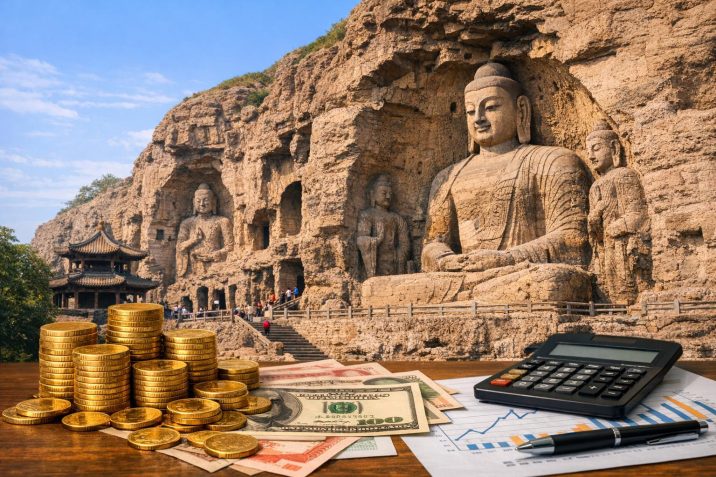
Geographic and Historical Context
The Yungang Grottoes are located at the southern foot of the Wuzhou Mountains, approximately 16 kilometers west of modern Datong in Shanxi Province. In antiquity, this region occupied a strategic position along corridors that linked the Central Plains of China with the steppe zones to the north and the trade networks extending across Central Asia. During the 5th century, Datong was known as Pingcheng and functioned as the capital of the Northern Wei Dynasty (386–534 CE), a regime founded by the Tuoba branch of the Xianbei people. The political and cultural environment of Northern Wei rule shaped the creation and meaning of the grottoes.
The Northern Wei emerged during a period of political division in northern China. As a non-Han ruling house governing a predominantly Han Chinese population, the Tuoba elite adopted policies that combined steppe traditions with Chinese administrative practices. Buddhism became an important component of this synthesis. By sponsoring Buddhist institutions and imagery, the dynasty positioned itself within a universal religious framework that transcended ethnic divisions. Monumental cave temples carved into cliffs were particularly effective as statements of state patronage and religious authority.
The geological conditions of the Wuzhou Mountains also contributed to the selection of the site. The sandstone cliffs are comparatively soft and workable, permitting sculptors to excavate extensive chambers and carve elaborate reliefs. At the same time, the rock is sufficiently stable to support large-scale statues. The alignment of the cliff face allowed the architects and carvers to create a continuous sequence of caves extending for roughly one kilometer, forming a carefully organized sacred landscape near the imperial capital.
Foundation and Early Development
The formal beginning of the Yungang project is usually dated to around 460 CE. Historical sources, particularly the Weishu (Book of Wei), record that the monk Tan Yao played a decisive role in initiating the earliest major caves. Tan Yao is said to have advised Emperor Wencheng to sponsor the carving of grand Buddha images in order to demonstrate imperial support for Buddhism and to rectify earlier persecution under Emperor Taiwu, who had temporarily suppressed the religion. The construction of monumental statues served as both expiation and renewal.
The first major excavation phase produced what are now known as Caves 16 through 20, often referred to collectively as the “Tan Yao Caves.” Each of these caves contains a colossal seated Buddha, carved directly from the living rock. The statues rise several meters in height and dominate their respective chambers. Their style reveals distinct influences from Gandharan and Central Asian traditions, transmitted to northern China through the Silk Road. The drapery falls in rhythmic, linear folds reminiscent of Greco-Buddhist sculpture, and the facial features exhibit prominent noses and deeply carved eyes.
The iconographic program of these initial caves likely carried political resonance. Some scholars have proposed that the five colossal Buddhas symbolized five Northern Wei emperors, suggesting an implicit comparison between earthly sovereigns and enlightened rulers of the spiritual realm. Whether or not such identifications were universally understood, the scale and prominence of the statues underscored the intimate association between the dynasty and the Buddhist faith.
After this initial phase, excavation continued under imperial and aristocratic sponsorship. New caves were carved to the east and west of the original group, with increasing complexity in layout and decoration. Records and inscriptions indicate that members of the court, officials, and wealthy donors contributed resources to the undertaking. The result was a large-scale collaborative enterprise sustained over several decades.
Scale, Organization, and Architectural Design
The Yungang Grottoes comprise more than 250 caves and niches containing over 50,000 statues of varying sizes. These figures range from tiny devotional images only a few centimeters tall to colossal Buddhas exceeding 17 meters. The site can be divided into western, central, and eastern sectors, each corresponding to different phases and patterns of patronage.
The central sector, which includes some of the most elaborate caves, displays a high degree of architectural planning. Certain caves have symmetrical façades with carved pillars and arched openings. Inside, central columns sometimes function as structural and symbolic elements, allowing sculptors to carve images on all four sides. This arrangement creates a spatial experience in which the devotee can circumambulate the central pillar, replicating the ritual practice of walking around a stupa.
Many cave interiors were designed to imitate above-ground wooden architecture. Carved beams, rafters, bracket sets, and lattice motifs reproduce structural features typical of Northern Wei timber buildings. These details demonstrate how artisans translated architectural vocabulary from wood into stone, preserving stylistic conventions even while working within the medium of rock. The façades of some caves likely included wooden extensions or painted surfaces that have not survived, indicating that the present appearance of the grottoes represents only part of their original visual effect.
The eastern sector contains numerous smaller caves and niches sponsored by private donors. Compared with the grand imperial caves, these spaces are more modest in scale but often rich in detail. Rows of miniature Buddhas cover walls in repetitive patterns, reflecting devotional practices centered on the multiplication of sacred images. The overall organization of the site, with its combination of monumental and intimate spaces, suggests a coordinated yet flexible plan accommodating varying levels of patronage.
Artistic Development and Stylistic Transformation
The Yungang Grottoes document a formative stage in the development of Chinese Buddhist sculpture. In the earliest caves, the style retains strong connections to Western Regions models. The Buddhas appear robust and frontal, with heavy robes and sharply defined folds. The influence of Gandharan prototypes can be seen in the treatment of drapery and in certain facial features, including deeply set eyes and arched brows.
As carving progressed, a gradual process of sinicization becomes evident. The faces of the Buddhas in later caves grow rounder and smoother, with gentler expressions. Drapery patterns become less linear and more integrated with the underlying body. The shift reflects both aesthetic preferences and the increasing assimilation of Buddhism into Chinese cultural frameworks. Rather than replicating foreign models, artisans adapted iconographic conventions to local sensibilities.
Ceilings within several caves are decorated with large lotus medallions, from which flying apsaras extend outward in dynamic poses. These celestial beings, often shown playing musical instruments or scattering flowers, contribute to the evocation of a heavenly realm. Ornamental borders, geometric patterns, and narrative reliefs further enrich the visual program. Scenes from the life of the Buddha, including his birth, enlightenment, first sermon, and entry into nirvana, communicate key doctrinal themes to worshippers.
Traces of pigment remain on some sculptures, indicating that the grottoes were once vividly polychrome. Mineral-based reds, blues, and golds would have covered surfaces, enhancing legibility and dramatic effect. The combination of sculpture, painting, and architectural simulation created an immersive environment intended to manifest a sacred cosmos within the cliff face.
Religious and Political Dimensions
The Yungang Grottoes must be understood within the broader context of statecraft and religious patronage in the Northern Wei. Buddhism offered the dynasty a universal ideology that legitimized rule beyond ethnic boundaries. Through massive public displays of devotion, the court articulated its commitment to moral governance and spiritual authority.
The monumental Buddhas functioned on multiple levels. They were objects of veneration for monastic communities and lay believers, serving as focal points for meditation and ritual. At the same time, their sheer scale conveyed the power and stability of imperial patronage. The act of carving a colossal figure directly from a mountain symbolized permanence and control over the natural landscape.
Donor inscriptions carved into the walls of smaller caves provide evidence for broader participation. Officials, military officers, monks, and lay families sponsored images in hopes of accruing religious merit. Such inscriptions sometimes record the names of relatives, linking the creation of images to ancestral commemoration. The grottoes thus operated as a shared religious space in which imperial ideology and personal devotion converged.
Connections Along the Silk Road
The stylistic and iconographic features of Yungang reflect networks of exchange that extended across Eurasia. Buddhism reached China through a series of transmission routes often collectively described as the Silk Road. Monks, merchants, and artisans traveled between regions such as Gandhara, Kucha, and Dunhuang, carrying texts, relics, and artistic conventions.
Comparisons with cave complexes in Central Asia, including Kizil in present-day Xinjiang, reveal shared motifs and compositional strategies. For example, the use of narrative wall paintings, lotus medallions, and flying celestials appears across multiple sites. At Yungang, these elements were integrated into a context shaped by Chinese architectural traditions and imperial ambitions.
The relocation of the Northern Wei capital to Luoyang in 494 CE marked a turning point. Artistic patronage shifted southward, leading to the development of the Longmen Grottoes. At Longmen, Buddhist imagery exhibits a more restrained and sinicized style, reflecting deeper incorporation into literati culture. The progression from Yungang to Longmen illustrates the dynamic interaction between external influences and internal adaptation. Additional information about this broader network of cave temples can be found through the UNESCO World Heritage listing for the Yungang Grottoes, which situates the site within patterns of intercultural exchange.
Archaeology, Inscriptions, and Craft Organization
Modern archaeological research has clarified aspects of construction and workshop practice. Tool marks visible on unfinished surfaces indicate the sequential process of excavation. Workers first cut a cavernous space into the cliff, roughing out the general form. Sculptors then refined the major figures before artisans completed fine details and surface finishing. Painters applied pigments as a final stage.
The scale of the undertaking suggests coordination by centralized authorities, at least during the main imperial phase. Teams may have included foreign craftsmen familiar with Central Asian styles, working alongside local artisans trained in Chinese techniques. Variations in carving quality between caves point to differences in funding and expertise.
Inscriptions provide invaluable chronological data. Some record precise dates and the names of donors or supervising monks. Through the study of paleography and historical records, scholars have established relative sequences among clusters of caves. This evidence confirms that the majority of major carvings occurred between approximately 460 and 494 CE, with subsequent activity on a smaller scale.
Scientific analysis of remaining pigments has identified compounds such as cinnabar and azurite. These findings not only inform reconstructions of original appearance but also shed light on trade networks supplying mineral resources. The presence of imported materials underscores the interconnected economic context in which the grottoes were produced.
Preservation, Conservation, and Management
Over centuries, the Yungang Grottoes have faced environmental pressures. Sandstone is susceptible to weathering, particularly when exposed to fluctuating temperatures and moisture. Wind erosion, water infiltration, and salt crystallization gradually degrade carved surfaces. In the modern era, industrial activity and air pollution have introduced additional challenges.
Systematic conservation efforts began in the 20th century and intensified after the founding of the People’s Republic of China. Protective measures have included structural reinforcement of vulnerable sections, installation of drainage systems to manage water runoff, and monitoring of microclimatic conditions within caves. Researchers employ laser scanning and digital documentation to create detailed records of sculptures, enabling precise assessment of change over time.
The inscription of Yungang as a UNESCO World Heritage Site in 2001 formalized international recognition of its value. The designation emphasizes not only artistic excellence but also testimony to cultural exchange and the historical role of Buddhism in China. Management plans now regulate visitor numbers in particularly sensitive caves, and certain areas are closed periodically to stabilize humidity and temperature levels.
Balancing public access with preservation remains an ongoing concern. The popularity of the site as a cultural destination contributes to regional development, yet excessive foot traffic can alter environmental conditions. Authorities continue to refine visitor routes and educational programming to minimize impact while facilitating scholarly and public engagement.
Contemporary Significance
In contemporary China, the Yungang Grottoes serve multiple functions. They are a site of academic inquiry, attracting historians of art, religion, and architecture. They are also an educational resource for broader audiences seeking to understand the historical development of Buddhism in East Asia. Museum facilities near the grottoes display explanatory materials, scale models, and artifacts recovered through excavation.
The site also contributes to discussions about cultural continuity and adaptation. The transformation of imported religious imagery into forms aligned with Chinese aesthetics provides a case study in how societies negotiate external influences. Through its monumental scale and artistic synthesis, Yungang demonstrates that cultural transmission is neither linear nor passive, but involves selective reinterpretation.
Although active monastic life no longer defines the grottoes in the way it may have during the Northern Wei, the Buddhist imagery continues to command respect as an expression of historical belief. Preservation initiatives ensure that the physical fabric of the caves remains accessible for research and reflection.
Conclusion
The Yungang Grottoes constitute one of the most significant early Buddhist cave temple complexes in China. Carved primarily during the 5th century under the Northern Wei Dynasty, they represent a formative moment in the integration of Buddhism into Chinese society. Their monumental statues, intricate reliefs, and architectural simulations record a dialogue between Indian, Central Asian, and indigenous Chinese traditions.
Through imperial sponsorship and private patronage, the cliffs near Datong were transformed into a vast sacred landscape of more than 250 caves containing tens of thousands of images. The stylistic evolution visible across the site charts the gradual sinicization of Buddhist art, culminating in developments that would later flourish at Longmen and other centers.
As a World Heritage Site, Yungang stands as an enduring testament to artistic innovation, religious devotion, and intercultural exchange. Ongoing conservation and research continue to uncover new dimensions of its history, ensuring that the grottoes remain central to the study of early medieval China and the wider history of Buddhist art.
