
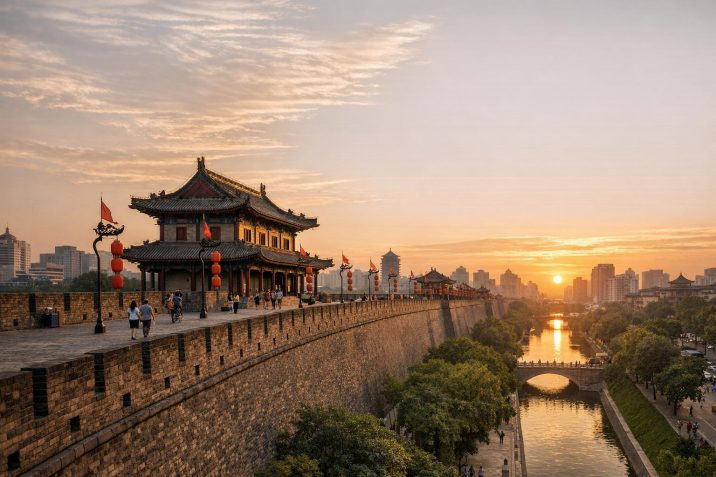
The Ancient City Wall of Xi’an is one of the most complete and best-preserved city walls in China. Located in the historic center of Xi’an, the capital of Shaanxi Province, the wall represents layers of Chinese urban development, military engineering, and political history. Xi’an, historically known as Chang’an, served as the capital for several major dynasties, including the Western Han and Tang. While the present wall structure dates primarily to the Ming dynasty, it stands on earlier foundations that trace back centuries.
The structure is not an isolated monument but part of a broader historical landscape shaped by imperial governance, interregional trade, and architectural innovation. The wall encloses the traditional core of the city and defines a geographical boundary that has influenced patterns of residence, commerce, and administration for generations. Its preservation offers insight into the physical organization of imperial cities and the methods by which premodern states asserted control over territory and population.
Historical Background
The origins of city walls in Xi’an can be traced to the Western Zhou dynasty (1046–771 BCE), when early fortifications were established in the region. During this early period, walls primarily consisted of compacted earth and functioned as protective barriers around settlements and administrative centers. Over time, as political authority consolidated and urban populations increased, fortifications grew in size and complexity.
During the Tang dynasty (618–907 CE), Chang’an became one of the largest cities in the world. Its urban plan was carefully organized, reflecting cosmological principles and bureaucratic precision. The Tang capital featured extensive walls that enclosed wards arranged in a grid pattern. However, the current structure does not directly survive from that period. The decline of the Tang dynasty and subsequent political fragmentation led to damage and transformation of earlier fortifications.
The existing wall was built during the Ming dynasty. Construction began in 1370 under the rule of the Hongwu Emperor, founder of the Ming dynasty. The Ming government pursued comprehensive defensive reforms designed to secure strategic regions and strengthen border protection. Xi’an, situated in northwest China and historically significant as a former imperial capital, held military and logistical importance. The wall was built over the foundations of the Tang imperial city, thereby linking Ming defensive objectives with earlier urban structures.
Throughout the Ming dynasty, routine inspections and repairs maintained the wall’s effectiveness. Local officials were responsible for organizing labor and securing materials. During the Qing dynasty (1644–1912), the wall remained in use, though its military significance gradually diminished as warfare technology evolved. Restoration projects addressed structural wear, weather-related erosion, and damage caused by conflict.
In the twentieth century, rapid modernization in China led to the demolition of many historic city walls. Xi’an’s wall survived due to a combination of administrative decisions and increasing awareness of cultural heritage preservation. It was later designated as a protected historical site, ensuring state-supported conservation measures and academic study.
Dimensions and Overall Layout
The Ancient City Wall of Xi’an forms a roughly rectangular enclosure surrounding the historic urban center. It measures approximately 13.7 kilometers in circumference. The wall averages 12 meters in height and varies between 12 and 18 meters in width, with a broader base that tapers slightly toward the top. These dimensions provided both structural stability and sufficient space for troop movement.
The enclosed area covers about 11.5 square kilometers. This internal zone historically contained governmental offices, residential districts, temples, military installations, and marketplaces. The rectangular layout reflects established traditions of Chinese city planning, in which cardinal orientation and axial alignment played essential roles.
The four corners of the wall are marked by substantial corner towers. Each tower is positioned to enable surveillance along adjacent wall segments. This arrangement reduced blind spots and maximized defensive coverage. The corners also reinforced the structural integrity of the rectangular design.
Materials and Construction Techniques
The structural core of the wall consists primarily of rammed earth. This method involved compacting successive layers of moist earth within wooden frames. Workers used wooden or stone tampers to compress the material until it achieved significant density. Over time, the compacted earth hardened into a durable mass capable of supporting brick facing and defensive architecture.
Brick cladding was later added to strengthen the surface and improve resistance to weathering. Many bricks bear stamped inscriptions identifying workshops or production sites. These markings provide valuable data for historians studying Ming administrative organization and supply chains. The bricks were bonded using lime mortar, which added cohesion and helped resist moisture infiltration.
Drainage systems were integrated into the wall to reduce water accumulation. Small outlets allow rainwater to flow outward, preventing internal erosion. Proper drainage is crucial for rammed earth structures, as prolonged exposure to moisture can compromise stability. The inclusion of drainage channels demonstrates an understanding of long-term maintenance requirements.
Stone elements were employed selectively, particularly in gate foundations and lower structural supports where greater load-bearing capacity was required. The combination of rammed earth, brick, and stone illustrates a pragmatic adaptation of materials to functional needs.
Gates and Defensive Architecture
The original Ming design incorporated four principal gates aligned with the cardinal directions: Changle Gate to the east, Yongning Gate to the south, Anding Gate to the west, and Anyuan Gate to the north. Each gate complex consisted of multiple architectural layers that created depth in defense.
A typical gate arrangement included a main gate tower, an arrow tower, and a barbican. The barbican formed an enclosed outer courtyard. An approaching force that penetrated the first gate would find itself confined within this space, exposed to defenders positioned above on surrounding walls. Such layered design increased the difficulty of direct assault.
The gate towers were constructed with projecting eaves and multi-tiered roofs characteristic of Ming architecture. Internally, passages were fitted with heavy wooden doors, reinforced by iron fittings. Some gates originally featured drawbridge mechanisms enabling the removal of direct access routes during emergencies.
Over time, additional gates were opened to accommodate population growth and transportation needs. While these newer portals lack the historical depth of the original four gates, they reflect the city’s adaptation to modern infrastructure requirements.
Ramparts, Parapets, and Watchtowers
The wall’s upper surface functions as a broad rampart capable of supporting the movement of soldiers and equipment. Its width allowed defensive units to be deployed efficiently along various segments. Horses and supply carts could traverse certain sections, enhancing operational flexibility.
Along the outer edge stands a parapet fitted with crenellations. The alternating solid sections and openings enabled defenders to fire arrows or later firearms while remaining partially shielded. The inner parapet provided additional safety, preventing falls and offering protection from potential disturbances within the city.
Watchtowers are spaced at regular intervals along the wall. These towers served as observation posts and signal stations. Communication methods included flags during daylight and lanterns or smoke signals at night. Coordinated signaling allowed rapid dissemination of information about potential threats.
Defensive platforms positioned between towers accommodated artillery during later historical periods. As gunpowder weapons became more prevalent, the wall’s broad structure supported adaptation without requiring fundamental reconstruction.
The Moat and External Defenses
Encircling the wall is a moat approximately 14 meters wide. The moat constituted an additional defensive barrier separating potential attackers from the main fortification. Water depth varied seasonally and could be managed through controlled channels.
The moat complicated direct assaults by limiting the approach of siege engines and undermining attempts. In many cases, attackers would be exposed to arrow fire while attempting to cross temporary bridges or fill the trench. The combination of height, thickness, gate complexity, and water barrier created a multilayered defense system.
Military and Administrative Function
The primary purpose of the Ancient City Wall was defensive, yet its role extended beyond pure military considerations. Xi’an served as a regional administrative center. Securing the city ensured continuity of governance, taxation, and supply distribution.
The presence of military garrisons within the walled perimeter reinforced imperial authority. Soldiers stationed along the ramparts conducted patrols and maintenance duties. At the same time, the wall regulated entry and exit, enabling authorities to monitor goods and people. Gate checkpoints functioned as control points for trade and security.
During periods of unrest or threat, gates could be closed and traffic restricted. The physical boundary provided by the wall thus facilitated administrative order as well as defense against foreign incursions.
Urban Organization Within the Enclosure
The layout of the city within the wall reflects longstanding planning principles. Main avenues align along north–south and east–west axes. Government offices were positioned according to hierarchical significance, while markets operated in designated zones. Residential neighborhoods developed in proximity to occupational and commercial centers.
Throughout the Ming and Qing eras, nighttime gate closures regulated movement. Internal ward divisions further organized urban life. The wall therefore functioned as a framework within which social and economic activities unfolded in structured patterns.
Religious institutions, including Buddhist temples and Islamic mosques, were situated within the enclosure, illustrating the city’s diverse cultural composition. Xi’an’s role as a historical nexus for trade contributed to this diversity, even though the current wall dates from a later period.
Decline of Military Importance and Modern Transformation
Advancements in artillery during the late imperial period gradually reduced the effectiveness of traditional city walls. By the nineteenth century, high-powered cannonry could breach fortifications that once seemed impregnable. Nevertheless, the wall of Xi’an remained a symbol of urban identity.
In the early twentieth century, modernization efforts in many Chinese cities led to widespread demolition of walls to facilitate transportation and industrial expansion. Xi’an’s wall faced similar pressures. However, local advocacy and recognition of historical significance contributed to its preservation.
After 1949, systematic surveys assessed structural conditions. Damaged areas were stabilized, and restoration policies sought to respect original construction methods. Conservation strategies balanced public accessibility with safeguarding historical fabric.
Restoration and Preservation Efforts
Major restoration initiatives began in the 1980s. Efforts focused on repairing brick facades, reinforcing earthen cores, and reconstructing deteriorated towers using historical documentation. Traditional materials were employed when feasible to maintain authenticity.
Engineers introduced discreet reinforcements in vulnerable sections to ensure long-term structural stability. Preservation guidelines emphasize minimal alteration, prioritizing repair over replacement. Continuous monitoring addresses issues such as vegetation growth and water infiltration.
The wall is designated as a National Key Cultural Relic Protection Unit. This status ensures legal safeguards and funding for maintenance. Academic research contributes to improved conservation practices and documentation standards.
Tourism, Education, and Public Use
Today, the wall functions as both a historical monument and a public recreational space. Visitors may walk or cycle along the ramparts. The elevated perspective reveals contrasts between traditional neighborhoods within the enclosure and modern developments beyond it.
Information panels placed at intervals describe construction phases, defensive mechanisms, and historical context. Educational tours organized by schools and universities use the site to illustrate principles of architectural history and heritage management.
Public events are occasionally held near major gates, particularly at Yongning Gate. These activities integrate the wall into contemporary civic life while maintaining respect for preservation requirements.
Comparative Perspective
Numerous cities around the world were historically fortified, yet few retain extensive walls in active urban contexts. Comparisons are often drawn with European fortified cities such as Avila or Carcassonne. While European examples typically rely on stone masonry, Xi’an’s structure demonstrates the endurance of rammed earth enhanced by brick facing.
Within China, the contrast with Beijing’s demolished walls underscores Xi’an’s rarity. The survival of such a comprehensive urban fortification provides scholars with opportunities to study Ming defensive planning in situ rather than through fragmented remains.
Cultural and Symbolic Meaning
The wall marks the boundary between historical Chang’an and the expanding metropolis of modern Xi’an. Although constructed in the Ming period, it encloses districts connected to earlier epochs, including areas associated with Silk Road exchange.
Its continued presence reinforces awareness of historical continuity. Rather than serving only as a relic of military architecture, it operates as a material reference point for understanding how imperial Chinese cities structured authority and regulated movement.
Archaeological Research
Archaeological investigations conducted near the foundation have uncovered remnants of earlier fortifications, pottery fragments, and infrastructural traces. These findings confirm that Ming builders incorporated previous defensive alignments into their design.
Scholarly study of brick inscriptions and construction layers contributes to knowledge of labor organization and regional resource distribution. The wall therefore provides both above-ground architectural evidence and subsurface archaeological data.
Integration with Contemporary Urban Planning
Modern Xi’an has expanded far beyond the Ming perimeter. Transportation systems now connect outer districts with the historic center. Roads run adjacent to the moat, and controlled access points accommodate vehicular traffic without significantly altering the wall’s structure.
Illumination systems installed along the ramparts highlight architectural details during evening hours. These lighting measures are designed to minimize structural impact while enhancing visibility. Urban planners have sought to integrate the monument into daily life rather than isolate it from surrounding development.
The Ancient City Wall of Xi’an remains an instructive example of how historical infrastructure can coexist with contemporary urban growth. Its endurance reflects both the technical competence of its original builders and the sustained commitment to preservation in subsequent centuries. Through continued maintenance and study, the wall provides tangible insight into military engineering, administrative organization, and urban continuity in Chinese history.
