
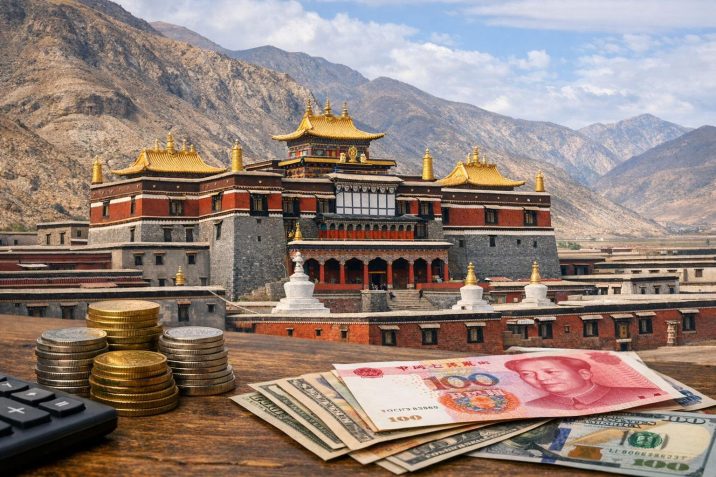
The Sakya Monastery, located in the Tibet Autonomous Region of China, is one of the principal religious institutions of Tibetan Buddhism. Situated in Sa’gya County of Shigatse Prefecture, the monastery is the traditional seat of the Sakya school, one of the four major schools of Tibetan Buddhism. Founded in the 11th century, it became not only a religious center but also a significant political and cultural authority in Tibet, particularly during the period of Mongol rule in the 13th and 14th centuries. Over the course of nearly a millennium, Sakya Monastery has served as a center of doctrine, ritual practice, governance, literary production, and artistic development within the Tibetan world.
The historical trajectory of Sakya illustrates the close relationship between religious authority and temporal power in Tibet. Unlike institutions that function exclusively as monastic centers, Sakya assumed administrative responsibilities that extended across large portions of the Tibetan Plateau. Its leaders acted as religious teachers, political intermediaries, scholars, and diplomats. As a result, the monastery occupies a distinctive place not only in religious history but also in the institutional development of Tibetan governance.
Geographical Setting and Name
Sakya Monastery stands approximately 25 kilometers southeast of Shigatse and about 127 kilometers west of Lhasa. The monastery is positioned on a broad, windswept plain at an altitude of more than 4,200 meters above sea level. The climate of this region is characterized by cold winters, strong sunlight, limited rainfall, and large seasonal temperature variations. These environmental conditions strongly influenced the choice of building materials, architectural methods, and even patterns of monastic life.
The surrounding landscape is composed of arid hills, expanses of agricultural fields sustained by irrigation, and distant snow-covered peaks. Historically, the area’s geographic location allowed it to maintain relative independence while still remaining connected to trade and pilgrimage routes that linked central Tibet with Nepal and western regions of the plateau.
The name “Sakya” derives from the Tibetan words sa (earth) and skya (gray or pale), referring to the distinctive grayish soil of the site where the monastery was constructed. The coloration of the earth influenced the visual identity of the complex itself, as many of its structures were built from locally sourced materials that retained similar tones. Over time, the name of the place became inseparable from the identity of the religious school that developed there, demonstrating the close association between landscape and lineage in Tibetan tradition.
Foundation and Early Development
Sakya Monastery was founded in 1073 by Khön Könchok Gyalpo (1034–1102), a prominent member of the Khön family, whose lineage traced its origins to early Tibetan aristocracy. The Khön clan had longstanding connections to both the religious and political structures of Tibet. By establishing a monastery at Sakya, Könchok Gyalpo created an institutional base for consolidating doctrinal transmission and strengthening family leadership.
The late 11th century was a period of religious revitalization in Tibet commonly known as the “Later Diffusion” of Buddhism. After earlier periods of fragmentation, scholars and translators renewed contacts with Indian Buddhist centers, bringing back texts and tantric teachings. Sakya emerged within this broader movement, aligning itself closely with Indian sources while cultivating rigorous internal scholarship.
In its formative decades, the monastery expanded steadily. Students gathered to receive training in scriptural study, ritual performance, meditation techniques, and scholastic debate. Emphasis was placed on mastering Sanskrit-derived terminology, interpreting philosophical treatises, and maintaining precise lineage transmission. This structured approach enabled Sakya to establish a distinct identity amid a growing number of competing monasteries.
Central to Sakya doctrine is the system known as Lamdré, translated as “The Path and Its Fruit.” The Lamdré teachings articulate a comprehensive path to enlightenment that integrates sutra-based ethics and philosophical analysis with advanced tantric visualization practices. According to tradition, these teachings originated with the Indian master Virūpa and were transmitted through a lineage of scholars to Tibet. At Sakya, they were organized into a systematic curriculum and became the defining doctrinal feature of the school. Even today, the Lamdré transmission remains a core religious responsibility of Sakya hierarchs.
The Sakya School of Tibetan Buddhism
The Sakya school is one of the four principal traditions of Tibetan Buddhism, alongside the Nyingma, Kagyu, and Gelug schools. While these traditions share foundational Buddhist doctrines—such as the Four Noble Truths, the concept of dependent origination, and the aspiration toward enlightenment—they differ in lineage structure, ritual emphasis, and interpretive approaches to Indian philosophical texts.
A distinctive feature of the Sakya tradition is its hereditary leadership. Authority within the school has historically been concentrated in the Khön family. This pattern contrasts with the reincarnational system that characterizes certain other Tibetan lineages, such as that of the Dalai Lama within the Gelug school. In the Sakya context, succession typically passes within a defined familial line, though spiritual qualifications and ritual training remain prerequisites for leadership.
Doctrinally, Sakya scholars made important contributions to the Madhyamaka philosophical tradition, particularly the interpretation of emptiness (śūnyatā) as articulated by Nāgārjuna and Candrakīrti. Sakya commentators engaged in detailed analyses of logical reasoning, epistemology, and metaphysics. Their writings addressed complex questions concerning the nature of reality, perception, and valid cognition. Through debate and textual commentary, they participated in a broader intellectual exchange that shaped Tibetan scholastic culture.
Educational training within the Sakya school often followed a graded structure. Novices memorized foundational texts and learned ritual recitations before advancing to philosophical study. Structured debate sessions helped refine logical clarity and rhetorical precision. Over time, Sakya scholasticism earned recognition for its analytical rigor and disciplined curriculum.
Political Role During the Mongol Period
The 13th century marked a turning point in Sakya’s history. As the Mongol Empire expanded across Eurasia, its leaders sought to establish relations with Tibetan religious authorities. In 1247, Sakya Pandita Kunga Gyaltsen (1182–1251), one of the most distinguished scholars of the tradition, met with the Mongol prince Godan. This meeting initiated a formal relationship that would redefine the political structure of Tibet.
Sakya Pandita’s intellectual reputation and diplomatic skill enabled him to negotiate terms that acknowledged Mongol supremacy while preserving Tibetan religious autonomy. Following his death, his nephew Phagpa Lodrö Gyaltsen (1235–1280) assumed leadership and further strengthened ties with the Mongol court. Phagpa became spiritual advisor to Kublai Khan and was granted the title of Imperial Preceptor.
Under Mongol patronage, Sakya hierarchs were given administrative authority over much of Tibet. This arrangement is often described as a patron-priest relationship: the Mongol ruler offered military and political support, while the Sakya leader provided spiritual legitimation. Through this structure, Tibet was integrated into the Yuan imperial framework without direct military occupation on the same scale as other regions.
Administrative reforms implemented during the Sakya-Yuan period included regional governance divisions and the appointment of officials responsible for taxation and legal matters. Although secular administrators handled many practical functions, ultimate authority derived from the Sakya leadership. This marked one of the earliest instances of centralized governance across the Tibetan Plateau.
By the mid-14th century, Mongol influence declined and political authority within Tibet shifted to other regional powers. Nonetheless, the institutional memory of the Sakya-Yuan alliance continued to influence later relationships between Tibetan leaders and foreign courts, including the Ming and Qing dynasties.
Architectural Features
The Sakya Monastery complex consists historically of northern and southern sections, situated on opposite sides of a river. The northern monastery, which contained some of the earliest structures, suffered significant damage during periods of conflict. The southern complex, largely rebuilt in the 13th century, forms the core of the surviving architecture.
Unlike many Tibetan monasteries distinguished by whitewashed façades, Sakya’s exterior walls are predominantly gray, reflecting the soil from which they were constructed. Red and white vertical bands appear along the upper sections of certain buildings. These markings symbolize the bodhisattvas Manjushri, Chenrezig, and Vajrapani, representing wisdom, compassion, and spiritual power. The strong walls and limited external openings give the complex a fortified appearance, reflecting both defensive considerations and the monastery’s historical administrative role.
The principal structure within the southern complex is the Lhakang Chenmo, or Great Assembly Hall. Built in the 13th century, it covers a vast area supported by numerous wooden pillars. The interior houses significant statues, including representations of Buddhas, bodhisattvas, and lineage masters. Murals covering the walls depict narrative scenes, tantric deities, and cosmological diagrams arranged in precise iconographic schemes.
Art historical research has identified stylistic influences from Nepalese artisans who were active in Tibet during periods of Yuan rule. Certain decorative motifs and sculptural forms display cross-cultural interaction, demonstrating that Sakya functioned within wider Himalayan artistic networks.
The Library and Manuscript Collection
One of the most significant aspects of Sakya Monastery is its manuscript collection. Within long shelves built into the walls of assembly halls are thousands of wrapped volumes. These include printed editions of the Kangyur and Tengyur as well as handwritten manuscripts spanning centuries.
Texts preserved at Sakya cover a wide range of subjects. In addition to canonical scriptures, the collection contains works on grammar, poetics, medicine, astrology, ritual liturgy, and historical chronicles. Some manuscripts are written in gold ink on dark paper, reflecting high levels of craftsmanship. Others serve as working copies bearing marginal annotations that reveal patterns of scholastic engagement.
Modern preservation initiatives have sought to catalog and digitize rare materials. Collaborative research projects involving Tibetan scholars and international institutions aim to ensure that fragile documents are protected from environmental degradation. Digital archiving also expands academic access, enabling comparative research across regional collections. Additional information on Tibetan canonical texts can be found through resources such as the Buddhist Digital Resource Center, which works to preserve and share Buddhist manuscripts globally.
Religious Life and Ritual Practice
Contemporary monastic life at Sakya continues established traditions of study and ritual. Daily schedules include collective prayers, recitation of liturgical texts, philosophical debate, and ceremonial observances. Senior monks provide instruction in both exoteric philosophy and esoteric tantric practices, ensuring generational continuity.
Festival cycles follow the Tibetan lunar calendar. During major observances, large thangkas may be displayed publicly, and ritual cham dances are performed in monastery courtyards. These dances combine symbolic gestures, elaborate costumes, and rhythmic music to convey doctrinal themes. Although visually striking, they serve pedagogical and commemorative functions within the religious community.
Transmission of the Lamdré teachings remains a defining responsibility of senior lamas. Such transmissions require preparatory study and adherence to ritual discipline. Through initiations and oral instruction, the lineage continuity that began in the 11th century is maintained in contemporary practice.
Decline, Disruption, and Restoration
After the end of Sakya’s political supremacy in the 14th century, the monastery continued to function primarily as a scholastic and ritual center. Over subsequent centuries, shifting regional alliances and sectarian developments altered the political landscape of Tibet. Nevertheless, Sakya retained prestige due to its historical contributions and textual resources.
The 20th century introduced substantial upheaval. Political integration into the People’s Republic of China and the events of the Cultural Revolution (1966–1976) affected religious institutions throughout Tibet. Sakya Monastery sustained structural damage, and many monastic activities were interrupted. Artworks were harmed and certain buildings fell into disrepair.
In later decades, restoration efforts were undertaken with support from governmental and religious bodies. Reconstruction projects focused on stabilizing walls, restoring murals, and reestablishing monastic education. Today the monastery functions both as an active religious institution and as a protected cultural heritage site. Visitors include local pilgrims, domestic tourists, and international researchers.
Leadership in the Contemporary Period
The title of Sakya Trizin, meaning “Throne Holder of Sakya,” designates the head of the Sakya school. In modern practice, leadership alternates between branches of the Khön family, preserving hereditary continuity while adapting to contemporary conditions. Members of the lineage reside both within Tibet and in exile communities, particularly in India.
Outside Tibet, Sakya-affiliated monasteries and centers have been established to continue religious education and public teaching. These institutions support translation projects, publish commentaries, and organize international conferences on Buddhist philosophy. Through such efforts, the Sakya tradition participates in global intellectual exchange while maintaining its historical foundations.
Cultural and Historical Significance
Sakya Monastery represents a convergence of religious authority, artistic production, and political organization. Its role during the Yuan dynasty established precedents for structured relations between Tibetan leaders and imperial courts. The patron-priest framework developed there influenced later diplomatic interactions in Inner Asia.
The monastery’s manuscript collections provide primary evidence for the development of Tibetan scholasticism. They preserve records of translation activity, doctrinal controversy, and ritual innovation. For historians of religion, Sakya offers insight into how monastic institutions can function simultaneously as centers of contemplation and administrative coordination.
Architecturally, the complex stands as an example of fortified monastic design adapted to high-altitude conditions. Artistic programs within its halls reflect centuries of stylistic evolution shaped by regional and cross-cultural influences. Continuing preservation initiatives underscore its recognized heritage status.
Conclusion
Since its foundation in 1073, the Sakya Monastery has exerted sustained influence on Tibetan religious, intellectual, and political life. Through its development of the Lamdré system, its contributions to Madhyamaka scholarship, and its historical partnership with the Mongol Empire, the monastery shaped both doctrine and governance. Although it experienced periods of decline and disruption, restoration and continued lineage leadership have ensured its ongoing relevance.
As a living institution, Sakya remains a site of ritual practice and formal education. As a historical monument, it embodies nearly a millennium of Tibetan cultural development. Its buildings, texts, and lineages collectively illustrate the enduring interplay between spiritual authority and temporal organization in the Tibetan world.
