
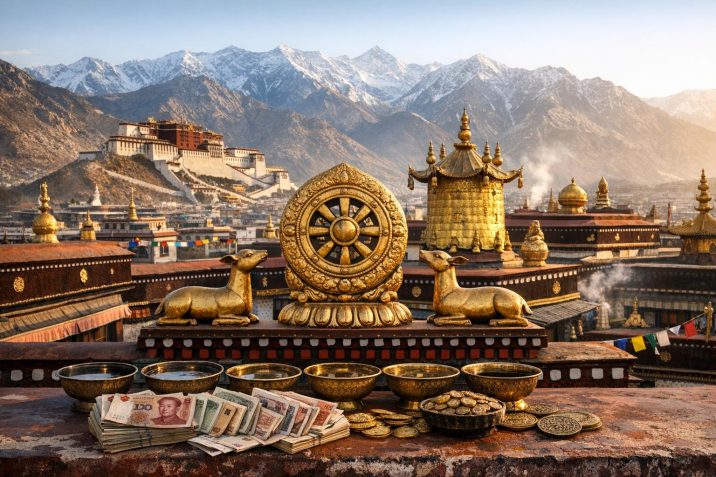
Jokhang Temple, located in the heart of Lhasa in the Tibet Autonomous Region of China, is one of the most significant religious and cultural sites in Tibetan Buddhism. Situated in the historic Barkhor area, the temple has functioned for centuries as a spiritual center, pilgrimage destination, and symbol of Tibetan identity. Its architectural features, religious artifacts, and long history make it central to understanding both Tibetan Buddhism and the broader development of Tibetan civilization. Unlike many religious monuments that serve primarily historical purposes, Jokhang remains an active locus of ritual practice, connecting early Tibetan state formation with contemporary religious life.
The prominence of Jokhang Temple derives not only from its antiquity but from its continuous use. Over more than thirteen centuries, the structure has been repeatedly renovated, expanded, restored, and ritually reconsecrated. Each generation has contributed physically and symbolically to the temple’s layered character. As a result, Jokhang represents a rare synthesis of political history, artistic exchange, and religious devotion within a single architectural complex.
Historical Background
The construction of Jokhang Temple dates to the 7th century during the reign of King Songtsen Gampo, a pivotal figure in Tibetan history. Songtsen Gampo unified large parts of the Tibetan Plateau, established administrative reforms, and positioned Tibet as an emerging regional power. His diplomatic marriages with the Tang dynasty of China and the Licchavi kingdom of Nepal are commonly cited in historical and religious sources as events that accelerated the introduction and consolidation of Buddhism in Tibet.
According to long-standing tradition, the temple was built to house sacred images brought to Tibet by his foreign wives. The Chinese princess Wencheng is said to have brought a statue of the Buddha known as the Jowo Shakyamuni. The Nepalese princess Bhrikuti reportedly brought an important image associated with Akshobhya Buddha. Although historians debate certain aspects of these accounts, most scholars agree that the 7th century marked a decisive period during which Buddhism received strong royal patronage and began to assume institutional form within Tibet.
At the time of its founding, Lhasa was not yet the monumental capital it would later become. The site where Jokhang stands was, according to traditional narratives, a wetland or lake. The draining of this area to permit construction is interpreted symbolically within Tibetan historiography as the domestication of landscape and the establishment of sacred geography. The very name Rasa Trulnang Tsuklakang, the temple’s early designation, reflects its position within the older settlement of Rasa, which later evolved into Lhasa.
Subsequent centuries witnessed alternating periods of imperial expansion, fragmentation, and religious revival. During the Tibetan Empire (7th–9th centuries), Jokhang benefited from state support. After the empire’s collapse in the mid-9th century, political decentralization reduced central patronage, yet the temple retained local importance. During the so-called Later Diffusion of Buddhism in Tibet (10th–12th centuries), renewed monastic movements reinvigorated sacred sites, including Jokhang. Renovations during these periods introduced new artistic motifs and expanded the temple’s chapels.
By the 15th century, the temple had become firmly integrated into the religious reforms associated with Tsongkhapa and the rise of the Gelug school. Its historical trajectory illustrates the extent to which major Tibetan Buddhist traditions, despite doctrinal distinctions, have regarded Jokhang as a common sacred center.
Architectural Features
Jokhang Temple’s architecture reflects a combination of Tibetan, Nepalese, and Tang Chinese influences, demonstrating the interconnected nature of Himalayan and East Asian artistic cultures in the early medieval period. Covering roughly 25,000 square meters, the complex comprises multiple halls, chapels, storage rooms, residential quarters for monks, and open courtyards. The structure rises several stories in particular sections, with rooftops accessible for ritual circumambulation.
The exterior is characterized by whitewashed walls, inward-sloping façades typical of Tibetan buildings, and gilded roof ornaments. The golden roofs, added and enhanced during later renovations, are highly visible from elevated areas of Lhasa. Bronze sculptures of deer flanking a dharma wheel adorn the roofline, symbolizing the Buddha’s first sermon in Sarnath. These motifs, though widely used in Buddhist architecture, have become particularly associated with Jokhang due to its iconic status.
Timber plays a crucial structural and decorative role. Large wooden beams support ceilings within major assembly halls, and carved window frames display intricate floral and geometric patterns. The use of timber required advanced craftsmanship given Lhasa’s altitude and climate. Stone foundations and rammed earth walls provide stability against seismic and environmental stress.
The central courtyard forms the organizational core of the temple. Chapels extend outward around this courtyard, creating a spatial experience that progresses from outer to inner sanctity. Pilgrims move clockwise through designated corridors, pausing before altars to present offerings. The most sacred chamber houses the Jowo Shakyamuni statue. This statue, believed by many Tibetan Buddhists to have been consecrated during the lifetime of the historical Buddha, represents Shakyamuni at approximately twelve years of age. Over centuries, layers of gold, jewels, and textiles have been added as votive gifts.
The temple’s interior decoration includes wall paintings representing major events in Tibetan religious history. Scenes depicting King Songtsen Gampo, Princess Wencheng, and Princess Bhrikuti visually connect the founding myth with sacred narrative. Other murals portray cosmological diagrams, protective deities, and episodes from sutras and tantric texts. Certain sections reveal stylistic features linked to Newari artisans from Nepal, especially in early sculptural elements.
Religious Significance
Jokhang Temple is regarded by many Tibetans as the spiritual heart of Tibet. Its centrality transcends sectarian divisions. Although the Gelug school historically exercised administrative influence over Lhasa from the 17th century onward, the temple remains a revered pilgrimage site for followers of the Nyingma, Kagyu, Sakya, and Bon traditions as well.
The Jowo Shakyamuni statue constitutes the primary object of devotion. Pilgrims approach the image with offerings that may include butter lamps, incense, ceremonial scarves known as khatas, and monetary donations. The act of viewing the Jowo, known as receiving its blessing, is believed to establish karmic connections extending beyond a single lifetime. Devotees often consult monastic attendants for ritual guidance on appropriate offerings and prayer recitations.
The temple also serves as a venue for communal prayer assemblies and ritual observances linked to the Tibetan lunar calendar. One of the most historically significant events associated with Jokhang is the Monlam Chenmo, or Great Prayer Festival. Established in the early 15th century by Tsongkhapa, the festival brought together monks from different monasteries for collective chanting, philosophical debate, and merit-making ceremonies. Although the political and social circumstances of such gatherings have changed over time, the association between Jokhang and the festival underscores its function as a national religious center.
Ritual specialists conduct daily liturgies inside the main halls. These include recitations of canonical texts, invocation of protective deities, and dedication of merit to the welfare of all sentient beings. The repetitive rhythm of prayer, combined with the steady glow of butter lamps, reinforces the temple’s character as an active sacred environment rather than a static monument.
The Barkhor Circuit
Encircling Jokhang Temple is the Barkhor circuit, a devotional path used by pilgrims to circumambulate the temple in a clockwise direction. Circumambulation, known in Tibetan as kora, is an embodied ritual practice symbolizing reverence and spiritual orientation toward enlightenment. The Barkhor route traces the outer perimeter of the old temple complex and extends into surrounding streets.
Historically, the Barkhor developed organically as pilgrims created pathways around the temple. Over time it evolved into a defined circuit lined with shops, residences, and administrative buildings. Merchants sell ritual objects such as prayer wheels, rosaries, incense, thangka paintings, and statues. This intermingling of religion and commerce reflects a longstanding pattern in Central Asian pilgrimage centers, where devotional and economic activities reinforce one another.
Many pilgrims perform full-body prostrations along the circuit. This practice involves stretching flat upon the ground, standing, stepping forward, and repeating the motion in a continuous sequence. Some undertake extended journeys to Lhasa, completing prostrations along entire routes from their home regions. The Barkhor therefore functions not only as a spatial boundary but as a kinetic field of ritual movement.
Political and Cultural Context
Throughout its history, Jokhang Temple has been closely linked with political authority in Tibet. During the Tibetan Empire, royal patronage affirmed its symbolic role. In later centuries, regional rulers and religious hierarchs sponsored restoration projects as demonstrations of legitimacy. Renovations often coincided with broader institutional reforms, reinforcing the perception that political stability and religious patronage were interconnected.
The 17th century marked a decisive transformation when the Fifth Dalai Lama consolidated political power over central Tibet. Lhasa became the recognized administrative capital, and monuments such as Jokhang acquired heightened ceremonial importance. State rituals conducted within the temple underscored its integration into governance. The temple thereby embodied both spiritual devotion and political continuity.
The 20th century introduced profound changes. Following the incorporation of Tibet into the People’s Republic of China in the 1950s, monastic institutions were reorganized under new administrative structures. During the Cultural Revolution (1966–1976), many religious sites in Tibet suffered damage, and public worship was sharply curtailed. Jokhang Temple experienced destruction of certain artworks and temporary suspension of ritual life. However, accounts indicate that some objects were concealed or protected by local custodians.
Since the 1980s, religious practice at Jokhang has resumed within a managed framework. Monks reside on-site, ceremonies are performed regularly, and the temple operates under joint supervision by religious figures and state agencies. Restoration projects have sought to repair damage while preserving historical authenticity.
UNESCO World Heritage Status
In 1994, the Potala Palace in Lhasa was inscribed on the UNESCO World Heritage List. Jokhang Temple was later added in 2000 as an extension to what is formally known as the Historic Ensemble of the Potala Palace. The subsequent inclusion of Norbulingka Palace in 2001 further expanded the designation. According to the UNESCO World Heritage Centre, the ensemble illustrates the development of Tibetan architecture and the integration of religious and administrative functions.
World Heritage status brought increased international attention as well as conservation obligations. Preservation policies emphasize structural stability, fire prevention, and compatibility between restoration methods and traditional techniques. The temple’s wooden superstructure requires careful monitoring due to climatic stress and the continuous presence of butter lamps used in ritual offerings.
The designation also influences visitor management. As both a sacred site and a major cultural landmark, Jokhang must balance liturgical activity with tourist access. Controlled entry numbers, designated photography zones, and periodic closures during important ceremonies are measures adopted to protect the site.
Art and Iconography
Beyond the Jowo statue, Jokhang Temple houses an extensive array of sculptures, ritual implements, and painted scrolls. Many objects are donations accumulated across centuries. Patrons ranged from emperors and Dalai Lamas to local families who contributed small offerings as acts of devotion.
Murals constitute an especially valuable component of the temple’s artistic heritage. Some walls display layered painting campaigns that allow researchers to trace shifts in style. Early works exhibit affinities with Kashmiri and Nepalese prototypes, characterized by delicate facial modeling and symmetrical compositions. Later murals display stronger Tibetan stylistic conventions, including bold color fields and elaborate iconographic programs.
Metal sculptures within the temple demonstrate sophisticated casting techniques. Bronze and copper alloy statues are often gilded and embellished with semi-precious stones. Clay statues, another widespread medium in Tibetan monasteries, permit larger narrative groupings. Collectively, these artworks offer insight into artistic transmission across the Himalayas, Central Asia, and China.
Contemporary Pilgrimage and Tourism
Improved transportation infrastructure, including the Qinghai-Tibet Railway and expanded airport facilities, has increased visitor access to Lhasa. Jokhang Temple consequently receives substantial numbers of domestic and international tourists. Tourist visitation occurs alongside ongoing pilgrimage, creating a multi-layered environment in which devotional acts and observational viewing coexist.
Visitor regulations aim to mitigate congestion within narrow corridors and protect the central shrine. Monks and guides facilitate orderly movement, particularly during peak seasons. Informational materials explain the importance of modest dress, respectful behavior, and restrictions on photography in certain chapels.
Despite increased tourism, Jokhang retains its primary function as a sacred site. Early morning hours are typically dominated by pilgrims rather than tourists. Offerings of yak butter sustain the light of lamps before dawn, and the sound of recitation fills assembly halls. This continuity of ritual practice underscores the temple’s resilience amid modernization.
Preservation Challenges
The physical preservation of Jokhang Temple involves complex technical considerations. Wooden structural components are vulnerable to fire, insect activity, and environmental fluctuation. Fire suppression systems must be compatible with fragile murals and sculptures. Engineers and conservation specialists collaborate to reinforce beams without altering historical appearance.
Environmental conditions at high altitude pose additional challenges. Intense ultraviolet radiation can degrade pigments, while seasonal humidity changes affect wooden joints. Conservation strategies include climate monitoring, controlled ventilation, and periodic structural assessment.
Urban growth in Lhasa has altered the temple’s immediate surroundings. Road expansion, commercial signage, and infrastructure projects must be regulated to preserve the visual integrity of the Barkhor area. Protective zoning policies seek to maintain traditional architectural scale around the temple complex.
Role in Tibetan Identity
For many Tibetans, Jokhang Temple functions as a nexus of historical memory and living faith. Literary references, pilgrimage songs, and oral narratives situate the temple at the center of cultural imagination. The golden roofline visible above the Barkhor district symbolizes Lhasa in visual representations and postcards.
The temple’s endurance across centuries of political change reinforces its significance as a stabilizing landmark. Pilgrimage to Jokhang is commonly regarded as a meritorious act that strengthens communal bonds. Even Tibetans living outside the region often identify the Jowo image as a focal representation of their religious heritage.
Although administrative frameworks and political contexts have evolved, Jokhang Temple continues to occupy a distinctive position at the intersection of devotion, heritage management, and cultural continuity.
Conclusion
Jokhang Temple stands as one of the most important religious and historical structures in Tibet. Established during the transformative reign of Songtsen Gampo in the 7th century, it embodies the early institutionalization of Buddhism on the Tibetan Plateau. Its architecture reflects multiple cultural influences, while its sacred contents illustrate centuries of accumulated devotion.
As part of the Historic Ensemble of the Potala Palace recognized by UNESCO, Jokhang carries both local and global significance. Yet its essential character remains defined by ongoing ritual use and pilgrimage. The interaction of preservation, religious observance, and regulated tourism shapes its present condition.
Through more than a millennium of change, Jokhang Temple has maintained a central role in Tibetan religious life. Its historical layers, artistic wealth, and enduring devotional practices ensure that it remains indispensable to the study of Tibetan Buddhism and Himalayan cultural history.
