
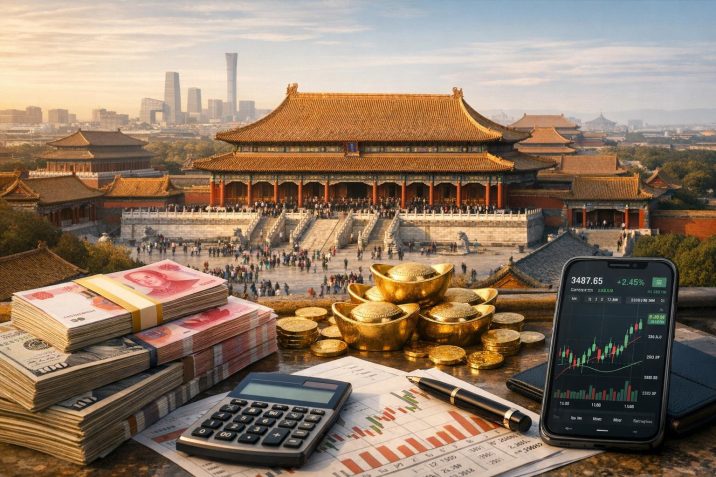
The Forbidden City, located in the center of Beijing, China, served as the imperial palace for nearly five centuries. From 1420 to 1912, it functioned as the political and ceremonial heart of successive Chinese dynasties, specifically the Ming and Qing. Today, it is known as the Palace Museum and stands as one of the most extensive and well-preserved wooden palace complexes in the world. Its architecture, spatial organization, and decorative systems were designed to express political theory, ritual hierarchy, and cosmological order. The complex is not only an architectural achievement but also a structured representation of imperial governance.
Historical Background
The construction of the Forbidden City began in 1406 under the reign of the Yongle Emperor of the Ming dynasty and was completed in 1420. Yongle had seized the throne in a civil conflict and sought to consolidate his authority by relocating the capital from Nanjing to Beijing. This decision strengthened imperial oversight in northern China and improved defensive readiness against Mongol forces. Establishing a new capital required large-scale planning, and the palace complex formed the central anchor of the redesigned city.
Historical records indicate that more than a million laborers and artisans participated in the project. Specialized craftsmen were recruited from across the empire. Precious nanmu timber was transported from the forests of southwestern China, while marble and stone came from quarries near Beijing. Massive stones were moved during winter months over ice-coated roads to reduce friction. The logistical coordination required for this undertaking demonstrates the administrative capacity of the Ming state.
The term “Forbidden City” reflects controlled access rather than secrecy. The compound was enclosed by a high wall and wide moat, and entry points were strictly regulated. Commoners were barred from entry, and even senior officials were confined to designated areas depending on their rank and purpose. The emperor was regarded as the Son of Heaven, holding a mandate to rule granted by cosmic order. The palace therefore functioned as an earthly extension of the celestial realm.
The Ming dynasty ruled from the complex until 1644, when rebel forces captured Beijing. The Manchu-led Qing dynasty soon established control and retained the palace as the imperial residence. Although the Qing rulers introduced cultural and administrative adjustments, they preserved the architectural layout and ceremonial framework of the complex. The last emperor, Puyi, abdicated in 1912 following the Xinhai Revolution. Imperial rule ended, yet Puyi was permitted to reside temporarily in part of the Inner Court until 1924. In 1925, the palace was formally converted into a public museum.
Urban Context and Spatial Planning
The Forbidden City occupies a central position within Beijing’s historical layout. The capital itself was redesigned during the Ming dynasty according to principles of axial symmetry and geomancy. The palace complex sits along a north–south axis that continues through the city, linking gates, ceremonial spaces, and administrative compounds. This alignment reflects concepts associated with feng shui and traditional cosmology, in which orientation and balance were considered essential to harmony and political legitimacy.
The palace measures approximately 961 meters from north to south and 753 meters from east to west, covering around 72 hectares. A defensive wall approximately 10 meters high surrounds the compound, with corner towers positioned at each angle. Outside the wall lies a 52-meter-wide moat. The primary entrance, the Meridian Gate to the south, provided controlled access to the ceremonial axis.
Within the walls, the complex is divided structurally and symbolically into the Outer Court and the Inner Court. The southern section emphasizes state authority and ritual performance, while the northern section houses residential and administrative quarters associated with the imperial household. Transitional spaces connect these areas, reinforcing hierarchical passage from public governance to private life.
The Outer Court
The Outer Court opens with a broad courtyard crossed by the Golden Water River, spanned by five marble bridges. Beyond this space rise the three principal ceremonial halls: the Hall of Supreme Harmony, the Hall of Central Harmony, and the Hall of Preserving Harmony. These halls rest atop a three-tiered marble terrace adorned with balustrades and sculpted drainage spouts.
The Hall of Supreme Harmony is the largest wooden hall in China and functioned as the central location for state ceremonies. Enthronements, imperial birthdays, New Year rituals, and military appointments were conducted here. The emperor’s throne stands on a raised dais beneath an elaborate caisson ceiling decorated with carved and painted dragons. Spatial arrangement within the hall reinforced rank: officials assembled in precisely ordered rows according to status.
The Hall of Central Harmony, smaller in scale, served as a transitional preparation space. The emperor reviewed ritual procedures and rested briefly before major ceremonies. Its architectural form echoes that of the main hall but on a reduced scale. The Hall of Preserving Harmony, located to the north, hosted banquets and later became the site of the final stage of the imperial civil service examinations, underscoring the link between scholarship and state service.
Flanking these main halls are additional gateways and side buildings that supported administrative operations. Storage facilities housed ceremonial objects, while auxiliary halls accommodated ministries during important events. Every structure was positioned according to a carefully graded system of importance.
The Inner Court
Crossing into the Inner Court introduces a shift from public authority to domestic governance. The central structures here include the Palace of Heavenly Purity, the Hall of Union, and the Palace of Earthly Tranquility. Together, they symbolized the balanced relationship between heaven and earth within imperial ideology.
During the Ming dynasty, the Palace of Heavenly Purity functioned as the emperor’s residence and office. In the Qing period, emperors increasingly used adjacent halls for daily living to reduce exposure to formal spaces, yet the palace retained its symbolic prominence. Behind it, the Hall of Union stored imperial seals that validated official documents. The Palace of Earthly Tranquility was traditionally associated with the empress and hosted imperial wedding ceremonies.
Surrounding courtyards contained residences for consorts, imperial heirs, and attendants. These quarters were arranged in clusters, each governed by detailed protocols concerning conduct, dress, and interaction. The Inner Court also contains the Imperial Garden at the northern end, where pavilions, rockeries, and ancient cypress trees provided a controlled natural environment within the enclosed complex.
Symbolism and Cosmology
The Forbidden City embodies principles drawn from Confucian hierarchy and traditional cosmological systems. Numerical symbolism appears frequently. The number nine, associated with imperial authority, recurs in decorative patterns and architectural proportions. Rows of door studs are typically arranged in multiples of nine. Mythical creatures placed along roof ridges also correspond to a graded ranking system, with the most important halls permitted the highest number.
Color usage reinforces political meaning. Yellow glazed tiles cover the primary roofs, as yellow symbolized the earth element and central authority. Red-painted walls define enclosed courtyards and corridors, contributing both visual coherence and symbolic resonance. Interior decoration incorporates motifs of dragons, cranes, clouds, and waves, each signifying aspects of cosmic governance.
Symmetry along the central axis expresses an ordered universe in which each element occupies a predetermined position. Buildings decrease in scale and ornamentation as they recede from the axis, visually reinforcing distinctions of status. Spatial sequences were therefore not arbitrary but encoded with political intention.
Construction Techniques and Materials
The structural system of the Forbidden City relies primarily on timber-frame construction. Large columns made of whole tree trunks support beams connected through interlocking joints. The use of dougong, a bracket system composed of layered wooden components, distributes structural weight while allowing flexibility. This assembly method contributes to the complex’s resilience during seismic activity.
Roofs with sweeping eaves extend outward to protect wooden walls from rain. Layers of ceramic tiles provide insulation and drainage. Foundations and terraces incorporate stone and marble, ensuring stability for the elevated halls. Drainage systems concealed within balustrades channeled rainwater away from platforms.
Decorative painting followed codified patterns applied to beams and ceilings. Mineral pigments created vivid colors designed to endure. Artisans specialized in carving, joinery, masonry, and painting collaborated under central supervision, reflecting the coordinated governance of state-sponsored construction.
Administrative Functions and Court Ritual
Beyond its residential function, the Forbidden City structured political interaction. Officials approached the palace through sequential gates, awaiting summons in designated courtyards. Memorials were submitted in written form, reviewed by the emperor, and annotated with decisions. Seasonal rituals reinforced state ideology, including sacrifices to heaven, earth, and ancestors conducted at related sites near Beijing.
Ceremonial performance regulated the relationship between ruler and bureaucracy. Dress codes signaled rank through embroidered insignia and color distinctions. Court protocol governed posture, speech, and spatial position during audiences. Such procedures standardized governance and underscored the emperor’s central role.
Social Hierarchy and Daily Operations
Life within the palace required extensive organization. The imperial household included members of the royal family, consorts, princes, princesses, scholars, physicians, guards, artisans, and a large population of eunuchs. Each group was subordinated within a hierarchical framework regulated by written statutes.
Eunuchs performed domestic and administrative tasks, including document transmission and supervision of workshops. At certain periods, especially during the late Ming dynasty, some eunuchs accumulated significant political influence. Qing rulers implemented reforms to limit this concentration of power, restructuring internal management to balance authority among agencies.
The rhythm of daily life followed both administrative necessity and ritual calendar cycles. Morning audiences addressed governance matters, while afternoons often included study of classical texts or consultation with advisors. Religious observances, ancestor veneration, and seasonal festivals punctuated the year.
Artistic Production and Court Workshops
Imperial workshops operated within and near the palace complex, producing lacquerware, porcelain, textiles, cloisonné enamel, and metalwork. Court artists created paintings documenting ceremonies, landscapes, and portraits. The Qing emperor Qianlong in particular was an active patron who commissioned catalogues of the imperial collection and inscriptions on artworks.
These workshops integrated regional techniques into a centralized aesthetic program. Objects produced for court use often influenced broader artistic trends throughout China. The palace thus served as both administrative headquarters and cultural production center.
Transformation into the Palace Museum
After 1912, the complex entered a transitional phase. Political change required redefining the site’s purpose. Following Puyi’s departure in 1924, inventories were conducted to assess imperial holdings. In 1925, the Palace Museum opened to the public, marking a shift from exclusive occupation to national stewardship.
During the Second Sino-Japanese War, curators evacuated major artworks inland to protect them from conflict. After 1949, part of the collection was transferred to Taiwan. Both institutions continue to preserve related holdings. Restoration campaigns in Beijing have prioritized structural reinforcement, conservation of painted surfaces, and careful visitor management.
Collections and Research
The Palace Museum maintains a collection exceeding 1.8 million objects, including paintings, calligraphy, ceramics, jade, bronze vessels, archival documents, and ritual implements. Many artifacts predate the Ming dynasty, representing centuries of accumulated heritage. Detailed cataloguing supports ongoing research into craftsmanship, provenance, and court history.
Rotational exhibition schedules help limit light exposure and environmental stress on delicate works. Conservation laboratories apply scientific analysis alongside traditional craft skills to stabilize fragile items. Academic departments collaborate on publications that examine historical records preserved within palace archives.
Preservation and Contemporary Relevance
Maintaining a vast wooden complex presents ongoing challenges. Environmental fluctuations, urban pollution, and high visitor numbers require systematic monitoring. Fire prevention systems have been discreetly integrated, and controlled access reduces structural strain on sensitive areas.
In 1987, the Forbidden City was designated a UNESCO World Heritage Site, acknowledging its value as a cultural landmark. Preservation policies emphasize continuity of traditional construction knowledge while incorporating modern conservation science. Periodic surveys assess structural stability, pigments, and drainage systems.
Today, the Forbidden City functions both as a museum and as a reference point in discussions of cultural identity and architectural history. It has transitioned from a restricted political enclave to a public institution that documents and interprets imperial China. The continuity of its physical structure, combined with extensive archival materials and art collections, makes it an unparalleled source for the study of governance, ritual, and architectural tradition.
The layered history of the complex demonstrates adaptation without fundamental alteration of its symbolic framework. From its construction under the Yongle Emperor to its present role as a museum, the Forbidden City remains structured by axial order, controlled access, and graduated hierarchy. As a preserved urban palace complex, it offers insight into how architecture can embody political ideology and cosmological belief across centuries of historical change.
