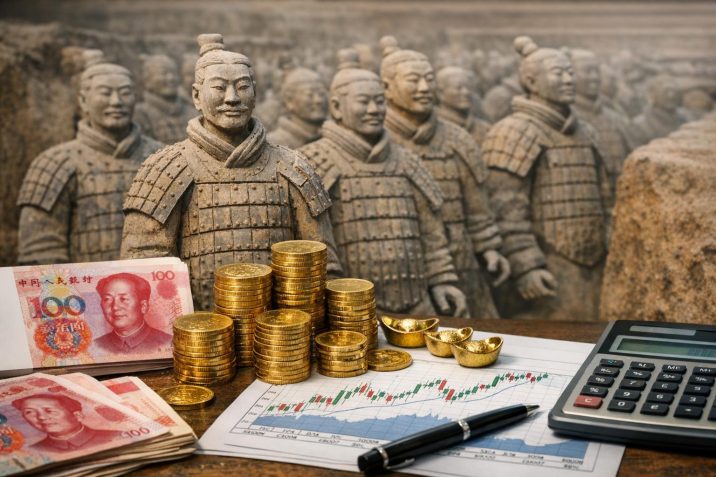
The Terracotta Army represents one of the most extensive and informative archaeological sites ever uncovered. Situated near Xi’an in Shaanxi Province, China, the complex forms part of the mausoleum of Qin Shi Huang, the first emperor to unify China. Created in the third century BCE and buried for more than two millennia, the thousands of life-sized clay soldiers, horses, and chariots discovered at the site provide detailed insight into the political authority, military organization, technological capacity, and artistic achievement of early imperial China. Since their discovery in 1974, systematic excavation and research have transformed modern understanding of the Qin dynasty and the processes through which centralized imperial rule first emerged in East Asia.
Historical Background of Qin Shi Huang
To understand the Terracotta Army, it is necessary to examine the historical and political environment in which it was conceived. Qin Shi Huang was born in 259 BCE during the Warring States period, a prolonged era of rivalry among seven major states. These states competed for dominance after the gradual fragmentation of the earlier Zhou dynasty. Constant warfare stimulated developments in military organization, metallurgy, agriculture, and administrative control, forming the foundation for later unification.
At the age of thirteen, Qin Shi Huang ascended the throne as king of the state of Qin. Initially ruling under regency, he gradually consolidated personal authority and pursued aggressive expansion. The state of Qin had already implemented reforms under the statesman Shang Yang in the fourth century BCE. These reforms were grounded in Legalism, a political philosophy that emphasized centralized authority, codified laws, collective responsibility, and strict enforcement. The Qin military benefited from standardized ranks, rewards for battlefield merit, and efficient supply systems.
Between 230 and 221 BCE, Qin forces systematically conquered the rival states. In 221 BCE, after defeating the state of Qi, Qin’s ruler proclaimed himself Shi Huangdi, meaning “First August Emperor.” This new title reflected a deliberate break from earlier kingship traditions and asserted a cosmic dimension to his authority.
Following unification, sweeping reforms were introduced to strengthen centralized rule. The emperor abolished the feudal system that had allowed regional aristocrats to govern semi-independently. Instead, he divided the empire into commanderies and counties administered by appointed officials accountable to the central government. Standardization measures extended across the realm: currency was unified, weights and measures regulated, written characters standardized, and even axle widths for carts aligned to facilitate transportation on state-built roads.
Large-scale infrastructure projects further reinforced imperial integration. Networks of roads radiated from the capital, facilitating troop movements and communication. Defensive walls in northern regions were expanded and connected, forming early segments of what would later become known as the Great Wall of China. Canal systems improved agricultural productivity and logistical coordination.
These achievements required extensive labor. Convicts, conscripted peasants, and soldiers were mobilized for construction projects. Among the most ambitious of these endeavors was the emperor’s mausoleum complex, designed to ensure his authority would continue beyond death. The Terracotta Army formed a central element of this funerary vision.
The Mausoleum Complex
The burial complex associated with Qin Shi Huang extends across approximately 56 square kilometers. At its center lies a large earthen mound marking the presumed location of the emperor’s tomb chamber. Ancient historical accounts, particularly those of the Han dynasty historian Sima Qian, describe the tomb as a subterranean palace containing replicas of the imperial court, rare treasures, and detailed representations of the known world.
Sima Qian wrote that craftsmen constructed rivers and seas of mercury within the chamber, mechanically circulated to simulate flowing water. He also described crossbows set to fire automatically against intruders. While some aspects of these accounts remain unverified, modern scientific surveys have detected unusually high concentrations of mercury in soil samples around the mound, lending partial support to the historical descriptions.
Surrounding the central mound are numerous subsidiary pits. The most famous contain the Terracotta Army, but additional excavations have revealed bronze chariots, stone armor, ceramic officials, acrobats, musicians, and animal figures. These findings indicate that the mausoleum was conceived as a comprehensive re-creation of the imperial domain, encompassing both military and civil dimensions.
Construction reportedly began shortly after Qin Shi Huang became king of Qin and continued for nearly forty years. Although ancient sources estimate that as many as 700,000 laborers were involved, modern historians approach such numbers cautiously. Even with conservative estimates, the scale of the complex demonstrates extraordinary administrative coordination and resource mobilization.
Discovery in 1974
In March 1974, local farmers digging a well near the village of Lintong made an unexpected discovery. While excavating dry soil, they encountered fragments of terracotta and pieces of bronze weaponry. Recognizing the potential significance, authorities were notified, and archaeological teams initiated investigation.
Excavation soon revealed a vast underground chamber filled with broken clay figures. This site, later designated Pit 1, proved to be the first of several large burial pits. Continued exploration identified Pit 2 and Pit 3, each containing distinct configurations of soldiers and equipment.
Pit 1, the largest, covers roughly 14,000 square meters and contains the main body of infantry. Pit 2 presents a more complex arrangement, including cavalry units, standing and kneeling archers, and chariots. Pit 3, considerably smaller, appears to function as a command center, housing high-ranking officers and a ceremonial chariot.
To date, more than 8,000 soldiers have been identified across the pits, along with approximately 130 chariots and hundreds of horses. Not all figures have been fully excavated, as archaeologists proceed cautiously in order to preserve fragile materials. In 1987, the mausoleum complex was designated a UNESCO World Heritage Site, reflecting its global cultural significance.
Structure and Organization of the Army
The arrangement of the Terracotta Army closely mirrors the organizational principles of the Qin military. In Pit 1, soldiers stand in orderly formations arranged in columns and rows. Vanguard units occupy the front, flanked by lateral guards, with the main infantry extending behind them. Such layout suggests a formation prepared for engagement rather than a random distribution of figures.
Pit 2 demonstrates tactical diversity. Here, archaeologists have identified distinct units of archers positioned to provide ranged support, cavalry arranged for mobility, and chariots forming coordinated components of battlefield strategy. The positioning of kneeling archers indicates awareness of staggered firing techniques, allowing continuous volleys.
Pit 3 contains a smaller number of figures believed to represent commanders and staff officers. The spatial separation of this pit from the main formations suggests a hierarchical command structure consistent with historical accounts of Qin military discipline.
Many soldiers were originally equipped with functional bronze weapons, including swords, spears, lances, halberds, and crossbows. Metallurgical analysis has revealed high tin content in certain blades, enhancing hardness. Some weapons display evidence of surface treatments that reduced corrosion, contributing to their preservation.
Artistic Techniques and Craftsmanship
The Terracotta Army demonstrates a complex interplay between mass production and individual craftsmanship. Artisans constructed figures from locally sourced clay using modular methods. Torsos, limbs, and heads were formed in sections, often employing molds for standardized shapes. These components were then assembled and refined by hand.
Facial details exhibit significant variation. Differences in hairstyle, facial hair, expression, and headgear create the impression of individualized portraits. Although scholars debate whether the faces represent actual individuals or standardized types, the diversity reflects careful finishing work after molding.
Height and attire denote rank. Generals are portrayed taller and more elaborately armored, with distinctive headdresses. Middle-ranking officers display intermediate features, while common soldiers wear simpler garments. Armor plates, belts, and fastenings are rendered with attention to structural realism.
After shaping and assembly, figures were fired in kilns at high temperatures to secure durability. A lacquer coating was then applied, followed by mineral-based pigments in vibrant hues including red, green, blue, black, and purple. Upon excavation, exposure to air caused rapid flaking of much of this pigment. Conservation teams now employ chemical stabilization and controlled humidity to preserve remaining traces.
The horses display anatomical precision, with carefully modeled musculature and harness details. Wooden chariots, which once accompanied many figures, largely decayed over time, though impressions and surviving bronze fittings allow partial reconstruction.
Manufacturing Systems and Labor Organization
Evidence suggests that workshops operated under centralized supervision. Some figures bear inscriptions identifying production units or workshop supervisors. These markings imply a structured administrative system with quality control mechanisms.
The production process resembles an early assembly-line model. Standardized components were manufactured in batches, assembled into complete figures, and then customized. This approach reflects broader Qin administrative practices characterized by uniform standards and bureaucratic oversight.
Kiln remains discovered near the site imply local manufacture rather than distant transport. The coordination required to produce thousands of figures in consistent style indicates effective logistical management and access to abundant raw materials.
The workforce likely included skilled artisans, laborers, overseers, and possibly prisoners or conscripts. While historical records are limited, the sheer scale of output implies sustained organization over several decades.
Military Insights from the Site
The Terracotta Army offers direct evidence regarding Qin military equipment and structure. The presence of crossbow trigger mechanisms demonstrates advanced mechanical knowledge. These bronze triggers were standardized and interchangeable, facilitating repairs and mass production.
Armor representation suggests use of lamellar construction, consisting of small plates connected by cords. The depiction aligns with excavated armor fragments from other Warring States sites. Differences in armor length and coverage likely correspond to tactical roles.
Cavalry representation indicates growing importance of mounted troops during the late Warring States period. Earlier reliance on chariots gradually shifted toward more flexible cavalry units, reflecting broader Eurasian military developments.
Weapon distribution patterns within the pits provide additional insight. Archaeologists have observed clustering of specific weapon types corresponding to unit positions. Such findings reinforce interpretations of organized strategic planning rather than symbolic placement alone.
Religious and Funerary Context
Funerary practices in ancient China often involved provisions intended to serve the deceased in the afterlife. In earlier periods, human sacrifice sometimes accompanied elite burials. Over time, symbolic substitutes became more common, reflecting both ethical evolution and state interests in preserving population.
The Terracotta Army represents a large-scale continuation of this substitution practice. Instead of burying living soldiers, the emperor commissioned clay representations to fulfill protective functions. The scale of the undertaking suggests an intention not merely to symbolize authority but to replicate the full apparatus of imperial governance underground.
Beliefs concerning the afterlife during the Qin period included concepts of an underworld bureaucracy mirroring earthly structures. The presence of civil officials, entertainers, and animals within the broader mausoleum complex indicates that the emperor anticipated an active continued existence requiring comprehensive support.
Mercury findings near the central mound sustain the hypothesis that cosmological symbolism shaped the tomb’s design. If rivers of mercury were indeed created, they may have represented major waterways of the empire, reinforcing the emperor’s dominion over the physical world even in death.
Preservation, Reconstruction, and Display
When excavated, many figures were discovered fragmented. The collapse of wooden roof beams, likely caused by fire or structural failure soon after burial, crushed rows of soldiers. Archaeologists carefully document fragment positions before undertaking reconstruction.
Reassembly involves matching fragments based on clay composition, break patterns, and stylistic characteristics. Missing components are sometimes supplemented with neutral materials to stabilize the structure without altering authenticity.
Protective hangar-like buildings now shelter the main pits. Environmental monitoring regulates temperature and humidity to reduce deterioration. Advances in conservation science continue to refine pigment stabilization techniques, allowing limited preservation of original coloration.
Balancing preservation with public access remains an ongoing task. The site attracts millions of visitors annually, generating revenue for research while imposing logistical demands on site management.
Ongoing Research and Future Questions
Archaeological investigation continues using non-invasive technologies. Ground-penetrating radar and magnetometry assist in mapping subsurface features. Three-dimensional scanning documents sculpture details for analysis and digital preservation.
Scholars continue to debate whether and when to open the central tomb chamber. Concerns persist regarding potential damage to fragile artifacts and the release of hazardous substances, including high mercury concentrations. For now, research emphasizes external structures and recovered materials.
Recent discoveries of additional pits containing officials, performers, and rare animal species expand understanding of Qin cosmology and court culture. Each excavation season yields new data regarding workshop organization, resource procurement, and regional variations in craftsmanship.
Global Significance
The Terracotta Army stands as one of the most substantial archaeological discoveries of the modern era. It provides material confirmation of textual records concerning Qin unification, military standardization, and imperial ambition. Few other sites worldwide present such an extensive and coherent assemblage of life-sized sculptures from antiquity.
International exhibitions have introduced selected figures to global audiences, promoting scholarly collaboration and comparative research. Nevertheless, the majority of the army remains housed near Xi’an, where controlled excavation continues.
More than two thousand years after its creation, the site remains central to the study of early Chinese state formation. It illustrates how political authority, technological capacity, artistic skill, and funerary belief converged in the service of imperial ideology. Through continued research and preservation, the Terracotta Army continues to inform understanding of ancient governance, manufacturing systems, and the cultural foundations of one of the world’s earliest centralized empires.
