
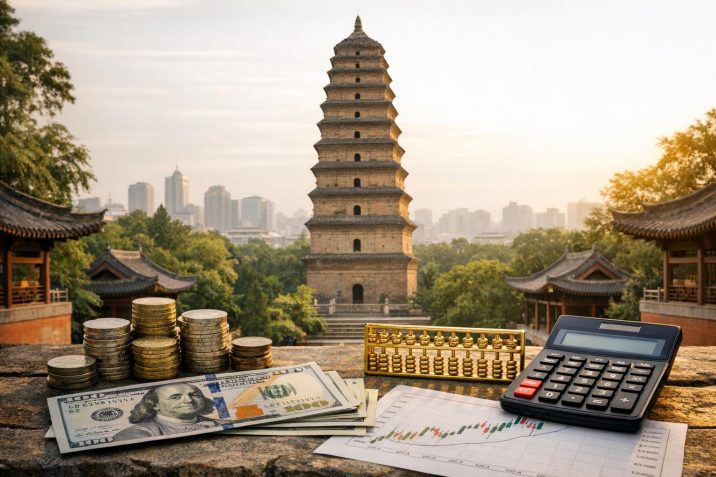
The Small Wild Goose Pagoda (Chinese: Xiaoyanta) is a historic Buddhist structure located in Xi’an, Shaanxi Province, China. Built during the Tang dynasty, it stands as one of the best-preserved pagodas from this period and forms part of the “Silk Roads: the Routes Network of Chang’an–Tianshan Corridor,” a UNESCO World Heritage Site designated in 2014. The pagoda is situated within the Jianfu Temple complex, sometimes referred to as the Small Wild Goose Pagoda Temple. It remains an important cultural and architectural monument reflecting the religious and political significance of Tang-era Chang’an, now modern Xi’an.
Positioned slightly south of the center of contemporary Xi’an, the pagoda rises above landscaped grounds that now form part of the Xi’an Museum complex. Although modern urban development surrounds the site, the monument retains a degree of spatial separation that reflects its historic religious function. Its continued prominence in the cityscape mirrors the importance of Buddhist institutions during the Tang dynasty, when Chang’an functioned as the imperial capital and one of the largest metropolitan centers in the world.
Historical Background
The Small Wild Goose Pagoda was constructed between 707 and 709 CE during the reign of Emperor Zhongzong of the Tang dynasty. The Tang period (618–907 CE) is widely regarded as a high point in Chinese civilization, characterized by administrative sophistication, territorial expansion, economic productivity, and sustained contact with foreign regions. Chang’an served not only as the political center of the empire but also as a nexus for diplomacy, trade, scholarship, and religion.
Jianfu Temple, where the pagoda stands, was originally established in 684 CE to commemorate Emperor Gaozong. The temple’s founding reflected imperial patronage of Buddhism, which had become deeply integrated into state ceremony and elite culture. Over time, the temple developed into a prominent center for the translation and study of Buddhist scriptures. Monks working there participated in the systematic rendering of Sanskrit texts into Chinese, contributing to the formation of doctrinal schools and monastic codes.
The immediate impetus for constructing the Small Wild Goose Pagoda was the need to store sacred texts and relics transported to China by the monk Yijing. Yijing was one of the most significant Buddhist pilgrims of the Tang era. He departed China in 671 CE, traveling by sea to Srivijaya in present-day Indonesia and then onward to the Indian subcontinent. Over more than two decades abroad, he studied Buddhist philosophy, ritual, and monastic regulations. His journey paralleled earlier pilgrimages by monks such as Faxian and Xuanzang, but his emphasis lay particularly on the transmission of monastic discipline according to the Vinaya.
When Yijing returned to Chang’an in 695 CE, he brought with him several hundred Sanskrit manuscripts, along with relics and ritual objects. These materials required secure storage within a religious setting that underscored their authority. The construction of a dedicated pagoda provided both a physical repository and a symbolic monument marking the successful transmission of Buddhist knowledge from India to China.
Chang’an and the Tang Political Context
Understanding the Small Wild Goose Pagoda requires situating it within the urban and political landscape of Tang Chang’an. The city was laid out on a grid system influenced by earlier capitals and cosmological planning principles. Residential wards, markets, administrative compounds, and religious institutions were arranged in an orderly pattern, reflecting centralized governance and ritual hierarchy. Buddhist monasteries occupied designated sectors within this urban framework, and their construction often involved imperial authorization.
During the reign of Emperor Zhongzong, the Tang court experienced periods of factional tension and political negotiation, yet imperial support for Buddhism remained significant. Empress Wu Zetian, who had previously ruled as sovereign, had strongly endorsed Buddhist institutions and imagery to legitimize her reign. Although her rule ended before the pagoda’s completion, the environment of Buddhist patronage that she fostered contributed to large-scale religious construction projects in the capital.
The erection of a masonry pagoda within Jianfu Temple thus aligned with broader patterns of state-sponsored religious architecture. Such projects demonstrated both piety and political legitimacy. By associating the court with the safeguarding of sacred scriptures, the Tang rulers reinforced their image as protectors of cosmic order and moral authority.
Architectural Design
The Small Wild Goose Pagoda exemplifies early Tang brick pagoda architecture. Originally comprising fifteen stories and rising to approximately 45 meters, it now stands at thirteen stories and measures about 43 meters in height. The structure follows a square ground plan, with each successive story diminishing slightly in width, producing a tapered vertical form. This gradual reduction enhances structural stability while emphasizing vertical ascent.
The use of brick rather than timber marks an important development in Chinese construction. Earlier pagodas frequently relied on wooden frameworks derived from traditional hall architecture. While timber allowed flexibility, it was vulnerable to fire and decay. By the Tang dynasty, advances in brick manufacturing and masonry techniques enabled the construction of tall, load-bearing structures with improved durability.
The exterior walls display a restrained aesthetic. Projecting brick eaves define each story, producing horizontal bands that contrast with the strong vertical lines of the structure. These eaves replicate, in simplified fashion, the layered rooflines seen in timber buildings. Small arched openings punctuate the façades at regular intervals. Some serve as windows or entry points, while others are ornamental, providing visual rhythm without compromising stability.
Inside, a narrow staircase spirals upward within the thickness of the walls. The interior is understated, lacking extensive sculptural decoration. This simplicity reflects both structural necessity and early Tang preferences for balanced proportions. The emphasis rests on mass, silhouette, and clarity of form rather than elaborate exterior ornament.
Construction Methods and Engineering Principles
The brickwork of the Small Wild Goose Pagoda reveals careful planning and technical expertise. Bricks were fired to achieve strength and uniformity, then laid in horizontal courses bonded with lime mortar. The walls are thick and bear the weight of the superstructure without reliance on an internal timber skeleton. This method distributes loads evenly downward through the masonry.
A notable engineering feature is the slight inward inclination of the walls. This design element reduces lateral stress and improves the building’s response to seismic movement. The tapering profile lowers the center of gravity as the structure ascends. Together, these features contribute to long-term stability.
The pagoda’s eaves were formed by progressively corbelling bricks outward. Though constructed in masonry, the visual effect recalls wooden dougong bracket systems. This translation from timber to brick demonstrates continuity in architectural vocabulary despite changes in material. Craftsmen adapted familiar forms to new structural contexts, ensuring both aesthetic coherence and enhanced durability.
Structural Resilience and Earthquake History
Xi’an lies in a region that has experienced significant seismic activity throughout history. Chroniclers record numerous earthquakes affecting the city and its monuments. Among the most devastating was the 1556 Shaanxi Earthquake during the Ming dynasty, widely regarded as the deadliest earthquake in recorded history.
The Small Wild Goose Pagoda sustained damage during various seismic events. Historical accounts recount the appearance of a prominent vertical crack extending from near the top of the structure downward. Later narratives describe how a subsequent tremor coincided with the apparent closing of this fissure. While modern structural analysis attributes such changes to shifting foundations, aftershocks, and repairs, the story became embedded in local tradition and underscored perceptions of the monument’s resilience.
The loss of the uppermost two stories likely occurred as a result of earthquake damage. Even so, the survival of the remaining thirteen levels attests to the effectiveness of Tang engineering. The combination of thick masonry walls, tapered design, and balanced proportions enabled the pagoda to withstand forces that destroyed many lesser buildings in the region.
Religious and Doctrinal Significance
In religious terms, the Small Wild Goose Pagoda functioned principally as a reliquary and scriptural repository. Unlike temple halls designed for congregational worship or ritual performance, a pagoda primarily symbolized the presence of the Buddha and the preservation of sacred teachings. Its verticality evoked the Indian stupa tradition, which originated as a mound enshrining relics. Over centuries, this form evolved in East Asia into the multi-storied tower.
The association with Yijing heightened the doctrinal prestige of Jianfu Temple. Yijing translated numerous texts related to monastic discipline and ritual procedure, helping standardize practice in accordance with Indian models. By housing manuscripts he retrieved, the pagoda became linked to the authoritative transmission of orthodoxy.
During the Tang dynasty, Buddhism interacted actively with Daoism and Confucianism. Imperial patronage varied depending on political circumstances, yet monasteries in the capital enjoyed considerable influence. As a visible landmark within Chang’an, the pagoda signaled the integration of Buddhist scholarship into the intellectual life of the empire.
Comparison with the Giant Wild Goose Pagoda
Xi’an also contains the Giant Wild Goose Pagoda, completed in 652 CE at Da Ci’en Temple. Both pagodas were constructed to safeguard scriptures brought from India, and both employ brick masonry in a square plan. However, differences in scale and stylistic articulation distinguish them.
The Giant Wild Goose Pagoda presents a more massive and imposing appearance, reflecting its association with the prominent monk Xuanzang and the influential Da Ci’en Temple complex. Its proportions convey solidity and monumentality. The Small Wild Goose Pagoda, by contrast, appears comparatively slender and restrained. Its detailing is simpler, and its site within Jianfu Temple suggests a distinct institutional context.
Together, these structures chart the development of Tang pagoda design. Variations in height, surface treatment, and interior configuration reveal experimentation within a shared architectural tradition. Comparative study assists historians in reconstructing broader patterns of religious construction during the seventh and eighth centuries.
Jianfu Temple Through Later Dynasties
Over the centuries following the Tang dynasty, Jianfu Temple experienced periods of decline, reconstruction, and changing function. Political upheavals, including the suppression of Buddhism in 845 CE and subsequent dynastic transitions, reduced monastic wealth and led to the destruction or secularization of some temple properties. Later dynasties restored portions of the complex, though rarely on its original scale.
During the Ming and Qing dynasties, repair campaigns addressed accumulated structural damage. Inscriptions and local gazetteers reference efforts to stabilize the pagoda and maintain the temple grounds. However, much of the original Tang layout disappeared over time, replaced by structures reflecting later architectural styles.
In the twentieth century, portions of the site were incorporated into public cultural institutions. Archaeological investigation clarified elements of the earlier temple plan, including foundation remains and artifact deposits. These findings have aided scholars in understanding the spatial organization of Tang religious complexes.
Integration into the Xi’an Museum
Today, the Small Wild Goose Pagoda stands within the Xi’an Museum precinct. Landscaped gardens, exhibition halls, and water features surround the historic monument. While these elements are modern additions, their design seeks to preserve visual prominence for the pagoda itself.
The museum presents artifacts spanning multiple dynasties, situating the pagoda within a broader narrative of regional history. Visitors encounter bronzes, ceramics, inscriptions, and architectural fragments that contextualize the Tang era. The pagoda thus functions both as an exhibit in its own right and as an anchoring structure for interpreting Xi’an’s past.
Urban preservation policies have established protective boundaries around the site, limiting high-rise construction that might visually dominate the monument. These measures reflect heightened awareness of cultural heritage management amid rapid urban growth.
UNESCO World Heritage Recognition
In 2014, the Small Wild Goose Pagoda was inscribed as part of the Silk Roads: the Routes Network of Chang’an–Tianshan Corridor World Heritage Site. This multinational designation encompasses locations across several countries that illustrate exchange along transcontinental trade routes.
Chang’an’s position as the eastern terminus of the Silk Road made it a hub of economic and religious interaction. Merchants transported silk, spices, metals, and other commodities, while monks and scholars carried texts and ideas. The pagoda, constructed to enshrine scriptures brought through these networks, directly embodies the intellectual dimension of Silk Road exchange.
World Heritage status underscores the monument’s relevance beyond national history. It recognizes the role of Buddhist pilgrimage, translation projects, and architectural adaptation in shaping patterns of interregional contact. The pagoda stands as material evidence of sustained dialogue between South Asia, Central Asia, and East Asia.
Preservation and Ongoing Study
Conservation initiatives in recent decades have emphasized minimal intervention and detailed documentation. Structural monitoring techniques assess stress distribution and seismic vulnerability. Replacement bricks, when necessary, are carefully differentiated from original fabric to maintain historical integrity.
Scholars continue to study the pagoda’s materials, mortar composition, and construction sequencing. Comparative analysis with other Tang structures refines understanding of regional masonry practices. These investigations contribute to broader knowledge of early medieval engineering in East Asia.
The Small Wild Goose Pagoda remains accessible to the public, though entry to upper levels may be restricted for safety. Its continued maintenance involves collaboration among heritage authorities, engineers, historians, and archaeologists.
Conclusion
The Small Wild Goose Pagoda represents a synthesis of religious purpose, architectural innovation, and historical continuity. Constructed in the early eighth century to house scriptures collected by Yijing, it reflects the intellectual vitality of Tang Chang’an and the broader networks linking China with the Buddhist world of South and Southeast Asia.
Its brick masonry, tapered silhouette, and measured ornamentation exemplify early Tang design principles. Survival through repeated earthquakes demonstrates the effectiveness of its engineering. Changes to the surrounding Jianfu Temple complex reveal the shifting fortunes of Buddhist institutions across successive dynasties.
As part of a UNESCO World Heritage Site, the pagoda is recognized as a monument of global historical importance. Within modern Xi’an, it provides continuity with the city’s imperial past while serving as a focal point for scholarship and public education. The Small Wild Goose Pagoda endures as an architectural record of cultural transmission and as a testament to the enduring legacy of the Tang dynasty.
