
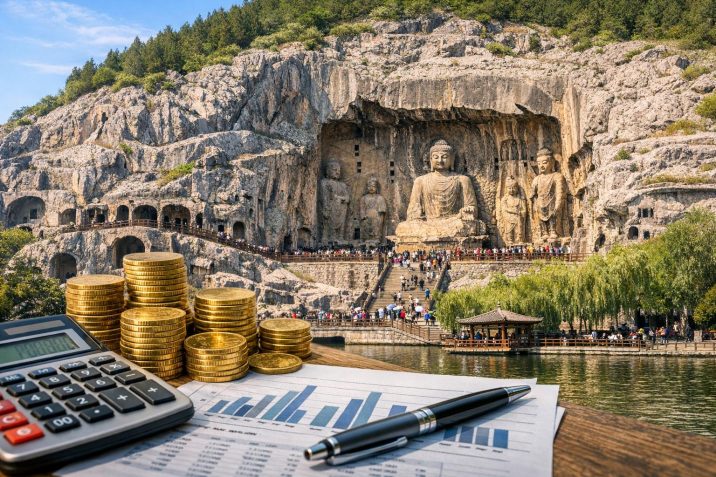
The Longmen Grottoes represent one of the most extensive and significant collections of Chinese stone carving from the late Northern Wei and Tang dynasties. Located near the city of Luoyang in Henan Province, the site stretches along limestone cliffs flanking the Yi River. Over several centuries, artisans carved thousands of Buddhist images, inscriptions, and architectural elements directly into the rock face. Today, the grottoes are recognized as a UNESCO World Heritage Site and remain central to the study of Chinese religious art, imperial patronage, and the transmission of Buddhism in East Asia.
Geographical and Environmental Context
The Longmen Grottoes are situated approximately 12 kilometers south of central Luoyang, in a narrow limestone valley formed by the Yi River. Two hills—Xiangshan (Fragrant Hill) on the eastern bank and Longmenshan (Dragon Gate Mountain) on the western bank—create a natural corridor. The name “Longmen,” meaning Dragon Gate, derives from a geological formation resembling a gate framed by cliffs. This dramatic topography contributed to the site’s symbolic and practical suitability for monumental religious carving.
The limestone of the region is relatively fine-grained and workable, allowing artisans to carve intricate details while maintaining structural integrity. At the same time, the stone is porous enough to be vulnerable to erosion, especially from water infiltration and temperature variation. Seasonal changes in humidity and the long-term effects of wind and rain have shaped both the preservation challenges and the appearance of the sculptures over time.
The Yi River not only provided a scenic foreground for the grottoes but also functioned as a transportation route. Materials, tools, and workers could be transported along waterways and connected roads linking Luoyang with other regions of northern China. The location thus combined accessibility with a natural setting conducive to spiritual contemplation.
Luoyang as Imperial Capital
Luoyang holds a prominent place in Chinese history, serving as capital for multiple dynasties. By the time the Northern Wei dynasty relocated its capital there in 494 CE, the city already possessed deep cultural and political associations. The move from Pingcheng (modern Datong) to Luoyang marked a strategic decision that reshaped the cultural trajectory of the Northern Wei state.
The ruling house of the Northern Wei, originally of Xianbei origin, sought to consolidate control over a predominantly Han Chinese population. Relocating to Luoyang symbolized greater engagement with established Chinese administrative systems and cultural traditions. Buddhism, which had already gained traction across northern China, became a significant ideological and legitimizing force. Court sponsorship of temple construction and rock-cut sites such as Longmen reinforced the dynasty’s alignment with both religious authority and cultural continuity.
The capital status of Luoyang made it a center of intellectual, artistic, and economic activity. Monks, scholars, translators, and artisans gathered there. The cosmopolitan atmosphere, influenced by exchanges along the Silk Road, created fertile ground for the development of Buddhist art that integrated Indian, Central Asian, and Chinese elements. Within this environment, the Longmen Grottoes emerged as a monumental project reflecting both religious devotion and state power.
Origins of Carving in the Northern Wei Period
Large-scale activity at Longmen began shortly after the Northern Wei capital was established in Luoyang. The initial phase of carving in the late 5th century drew upon experience gained at the earlier Yungang Grottoes near Datong. At Yungang, Northern Wei rulers had sponsored colossal images that displayed strong Central Asian and Gandharan stylistic influences. When artisans and patrons turned to Longmen, they brought elements of this tradition while adapting it to a new cultural environment.
Early Northern Wei sculptures at Longmen often feature elongated bodies, angular facial structures, and patterned drapery. The robes fall in rhythmic, linear folds that emphasize surface design over volumetric modeling. Facial expressions tend to be reserved and symmetrical, conveying a sense of spiritual detachment. These characteristics reflect both inherited stylistic conventions and the theological emphasis on transcendence in Buddhist representation.
The Guyang Cave stands as one of the most significant early grottoes. Commissioned under imperial patronage, it became a focal point for elite donors. Numerous inscriptions carved into its walls record the names and titles of officials who sponsored images. The cave’s sculptural program centers on a principal Buddha accompanied by bodhisattvas and attendant figures, arranged in a carefully structured hierarchical composition. The integration of inscription and image illustrates how artistic production at Longmen was embedded in broader networks of patronage and court politics.
These inscriptions provide valuable primary evidence for historians. They document kinship ties, official ranks, and devotional motivations. Rather than anonymous works of art, the carvings can often be linked to specific historical actors. The Northern Wei phase therefore established Longmen as both a religious monument and an epigraphic archive.
Stylistic Transformation and Sinicization
Over the course of the Northern Wei dynasty, important stylistic changes took place. As the court adopted Chinese dress, language reforms, and administrative models, artistic expression likewise shifted. Buddhist images carved in the early 6th century gradually moved toward greater naturalism. Proportions became more balanced, with less extreme elongation. Faces grew fuller, and drapery began to suggest the movement and weight of fabric rather than functioning purely as linear decoration.
This evolution is often described as part of a broader process of sinicization, whereby the originally nomadic ruling elite integrated with Han Chinese cultural forms. The process was gradual and complex, involving adaptation rather than simple replacement. At Longmen, the visual transformation of Buddhist imagery demonstrates how religious iconography remained stable in content while adjusting in style to align with prevailing aesthetic preferences.
Political instability following the division of the Northern Wei into Eastern Wei and Western Wei in 534 CE resulted in a temporary decline in large-scale, centrally funded carving. Nevertheless, activity did not cease entirely. Smaller caves and niches continued to be commissioned, often by private donors or regional officials. These modest works preserved continuity at the site until a renewed period of prosperity under the Tang dynasty.
The Tang Dynasty and the Apex of Production
The establishment of the Tang dynasty in 618 CE initiated one of the most culturally dynamic periods in Chinese history. The Tang court supported Buddhism, particularly during the 7th century, when it served as a moral and cosmological framework reinforcing imperial authority. Luoyang once again assumed capital status for certain periods, enhancing the prominence of the Longmen Grottoes.
Under Emperor Gaozong and Empress Wu Zetian, large-scale projects resumed with renewed vigor. Wu Zetian, who eventually ruled in her own name, drew on Buddhist symbolism to support her political legitimacy. She promoted texts and imagery identifying the ruler with cosmic Buddhist principles. Within this ideological climate, Longmen became a stage for monumental statements in stone.
The Fengxian Temple ensemble, completed in the 670s, represents the high point of Tang carving at Longmen. Unlike enclosed caves, Fengxian is an open-air shrine carved into a large cliff face. Its central image, commonly identified as Vairocana Buddha, rises approximately 17 meters. The figure stands in calm frontal posture, framed by a semicircular arrangement of bodhisattvas, disciples, and guardian figures.
The sculptural treatment exemplifies mature Tang style. The Buddha’s face is rounded, with softly modeled cheeks and a composed gaze. The drapery clings in smooth, flowing folds that create subtle shadow and depth. Rather than emphasizing flat linear pattern, the carving suggests three-dimensional mass. Attendant bodhisattvas display refined ornamentation, with delicate jewelry and naturalistic body contours. Guardian figures, by contrast, exhibit muscular tension and dynamic posture, providing visual contrast within the ensemble.
The scale and technical sophistication of Fengxian Temple imply organized labor and significant resources. Artisans likely worked from scaffolding platforms, carving sequentially from top to bottom. Coordination between designers, stonecutters, and finishing specialists would have been essential. The result is a unified composition that integrates religious symbolism with monumental presence.
Iconographic Programs and Buddhist Doctrine
Across the entire site, more than 2,300 caves and niches house over 100,000 statues. The iconography reflects key elements of Mahayana Buddhism, which emphasizes universal salvation and the compassionate intervention of bodhisattvas. Central Buddha figures may represent Shakyamuni, Amitabha, or Vairocana, depending on doctrinal emphasis and donor preference.
Bodhisattvas such as Avalokitesvara (Guanyin) and Mahasthamaprapta frequently flank central Buddhas. Their elaborate crowns and jewelry distinguish them from the simpler robes of the Buddha. Disciples Ananda and Kashyapa appear in monastic attire, often positioned closer to the central figure, symbolizing proximity to enlightenment. Guardian figures, including heavenly kings, occupy peripheral positions, reinforcing the protection of sacred space.
Some caves incorporate narrative reliefs depicting episodes from sutras. Scenes may illustrate the life of the historical Buddha or visualize pure lands described in devotional texts. These visual narratives functioned as teaching tools in a society where literacy varied. Through image and inscription together, donors and monks communicated doctrinal ideas to visitors.
Many small niches represent individual acts of devotion. Carved across cliff surfaces in dense clusters, these minor images attest to widespread participation in Buddhist practice. Inscriptions often record aspirations for favorable rebirth, relief from suffering, or dedication of merit to deceased relatives. The cumulative effect transforms the cliff face into a layered record of communal religious activity.
Epigraphy and Calligraphic Importance
The inscriptions at Longmen constitute one of the richest collections of Buddhist epigraphy in China. They range from short dedicatory phrases to extended commemorative texts. Scholars analyze these inscriptions to reconstruct social networks, bureaucratic hierarchies, and patterns of religious association.
Calligraphically, certain inscriptions are esteemed as models of Northern Wei script. The angular, forceful strokes characteristic of this period contributed to later developments in regular script. Students of Chinese calligraphy study rubbings taken from Longmen inscriptions to trace stylistic evolution. In this way, the grottoes influence not only art historical scholarship but also the practice of calligraphy itself.
Through epigraphy, art historians can date specific sculptures and correlate them with historical records. This combination of textual and visual evidence distinguishes Longmen from other sites where inscriptions are less abundant.
Techniques of Excavation and Finishing
The process of creating a grotto began with selecting a suitable section of cliff. Artisans marked outlines and removed large masses of stone using iron tools. Interior chambers were hollowed from the top downward to prevent structural collapse. Relief figures were left in place as surrounding rock was cut away.
After rough shaping, skilled carvers refined features such as facial expressions, hands, and decorative elements. Surfaces were smoothed and, in many cases, coated with pigment. Traces of mineral-based colors remain in protected recesses, indicating that statues once displayed vivid reds, blues, and gold accents. The present monochrome appearance of the grottoes does not reflect their original visual impact.
Large projects required coordination of labor and resources. Quarrying, tool production, and logistical support formed part of a broader economic network. Imperial sponsorship likely facilitated procurement of materials and organization of specialized craftsmen.
Later Dynasties and Periods of Decline
Following the Tang dynasty, large-scale carving at Longmen decreased significantly. Shifts in political priorities, fiscal constraints, and periodic suppression of Buddhism affected patronage. Although some Song dynasty activity is documented, it did not approach the scale of earlier efforts.
Natural erosion gradually damaged exposed surfaces. In modern times, especially during the late nineteenth and early twentieth centuries, some sculptures were removed and entered private or foreign collections. This dispersal altered the integrity of certain caves and highlighted the vulnerability of the site.
Preservation, Research, and Global Recognition
In the twentieth century, formal measures were implemented to safeguard the Longmen Grottoes. Conservation programs addressed structural stabilization, drainage control, and documentation. Scientific monitoring now tracks humidity, temperature fluctuations, and microfractures within the limestone.
In 2000, UNESCO inscribed the grottoes on the World Heritage List. The designation recognizes their outstanding value as an expression of human artistic achievement and intercultural exchange. Detailed information about the criteria for inscription can be found through the UNESCO World Heritage Centre, which outlines the global framework for protecting such sites.
Today, visitor pathways allow controlled public access while minimizing physical strain on vulnerable areas. Digital technologies, including 3D scanning and high-resolution photography, assist scholars in analyzing details without repeated physical contact. International collaboration supports ongoing research and conservation planning.
Comparative Perspective
Within the broader context of Chinese Buddhist cave temples, Longmen occupies a distinctive position. Yungang reflects earlier Northern Wei experimentation with colossal figures influenced by Central Asian models. The Mogao Caves at Dunhuang, by contrast, are known for mural painting and manuscript preservation. Longmen is particularly noted for the refinement of its Tang sculptures and the density of its inscriptions.
Together, these sites illustrate the trajectory of Buddhist art in China. Early adaptations of foreign iconography gave way to mature, regionally integrated styles. Longmen exemplifies this culmination, where sculpture, epigraphy, and landscape combine to form a coherent monumental statement.
Enduring Significance
The Longmen Grottoes provide material evidence for the interaction of religion, politics, and art over several centuries. They document how Buddhism was supported by emperors, officials, monks, and laypersons. They preserve stylistic transitions from Northern Wei formalism to Tang naturalism. They record personal dedications alongside state-sponsored monuments.
As both a research site and a public heritage destination, Longmen continues to inform scholarship across disciplines including art history, archaeology, religious studies, and Chinese history. The integration of sculpture and inscription offers a rare opportunity to correlate visual production with documented historical actors. Through sustained conservation efforts, the grottoes remain accessible for study while protected against environmental and human threats.
In aggregate, the carvings at Longmen represent a comprehensive record of medieval Chinese Buddhist art. Their scale, technical accomplishment, and documentary richness secure their position among the most significant cultural monuments in East Asia.
