
Historical Background
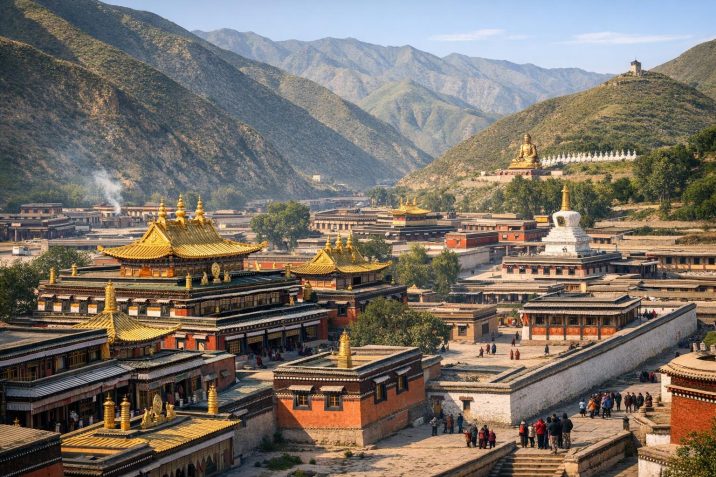
Labrang Monastery, known in Tibetan as bla brang bkra shis ‘khyil and in Chinese as Labuleng Si, is one of the most significant Tibetan Buddhist monasteries located outside the Tibet Autonomous Region. It stands in Xiahe County, Gansu Province, within the historical region of Amdo. Founded in 1709 during the Qing dynasty, Labrang developed into a major center of religious scholarship, ritual activity, cultural production, and regional governance within the Gelug school of Tibetan Buddhism. The monastery was established by Jamyang Zhépa Ngawang Tsöndrü, the first Jamyang Zhépa, an influential scholar trained in central Tibetan monastic institutions and closely connected to the lineage of the Dalai Lama.
The founding of Labrang was part of a broader pattern in which Gelug institutions expanded beyond central Tibet into Amdo and Mongolia. This expansion was not only religious but also administrative. Monasteries served as hubs of education, economic coordination, and communication across vast pastoral territories. Amdo’s position at the intersection of Tibetan, Mongolian, and Han Chinese cultural zones gave Labrang strategic importance. Through religious networks and patronage relationships, the monastery extended its influence across areas that today fall within Gansu, Qinghai, and Sichuan provinces.
During the Qing dynasty, Labrang maintained relations with imperial authorities while preserving significant autonomy in internal governance. Monastic leaders acted as intermediaries between local Tibetan communities and state officials. This dual function allowed Labrang to sustain religious authority while adapting to changing political conditions. Over time, successive incarnations of the Jamyang Zhépa strengthened the monastery’s institutional structures, expanding its colleges and consolidating its reputation as a center of learning.
Institutional Structure and Governance
Like other large Gelug monasteries, Labrang developed a complex administrative framework. Authority was shared between the incarnate lama, senior abbots, and executive officials responsible for finance, discipline, and ritual affairs. The Jamyang Zhépa served as the spiritual head of the institution. As a recognized reincarnation, he embodied both doctrinal continuity and institutional stability. However, daily administration often depended on councils of senior monks who managed specific divisions of monastic life.
The monastery historically comprised several colleges, each with distinct academic or ritual functions. These semi-autonomous units were governed by their own hierarchies while remaining accountable to the overall monastic leadership. Such a system allowed Labrang to accommodate large numbers of monks and to specialize in multiple branches of Buddhist knowledge. Regulations governed admissions, attendance at debates, ritual obligations, and ethical conduct. Discipline was understood as foundational to both spiritual progress and institutional cohesion.
Economic management formed another essential component of governance. Labrang held estates and received offerings from lay supporters across the Amdo region. Contributions took the form of grain, butter, livestock products, and monetary donations. These resources supported monastic education, ritual events, maintenance of buildings, and almsgiving. The administrative system developed mechanisms for distributing resources across colleges and for sustaining communal kitchens that fed resident monks.
Religious Significance
Labrang Monastery belongs to the Gelug tradition, often referred to as the “Yellow Hat” school. Founded by Tsongkhapa in the fifteenth century, the Gelug tradition emphasizes rigorous philosophical study, monastic discipline, and systematic meditation practice. Labrang became one of the most important Gelug centers in northeastern Tibet, sometimes described as among the major monasteries outside Lhasa.
The monastery is particularly associated with the lineage of the Jamyang Zhépa incarnations. Each recognized incarnation assumed responsibility for guiding the monastic community, overseeing educational standards, and cultivating relationships with lay patrons. These figures frequently composed commentaries, supported printing projects, and maintained correspondence with scholars in other regions. Through these activities, Labrang was integrated into wider intellectual networks that linked Amdo to central Tibet and Mongolia.
At its height, Labrang housed several thousand monks. The scale of the community enabled the monastery to sustain continuous cycles of teaching, debate, and ritual performance. Even after periods of decline during the twentieth century, Labrang continues to function as an active monastic community with hundreds of resident monks engaged in study and ceremonial responsibilities.
Architectural Layout and Sacred Geography
Labrang Monastery is a large complex composed of assembly halls, temples, residential quarters, printing houses, and auxiliary buildings. The structures reflect traditional Tibetan architectural principles while incorporating regional materials suited to the highland climate of Amdo. Thick whitewashed walls provide insulation against cold winters, while sloped roofs and layered timber supports accommodate seasonal snow and wind. Decorative features include gilded rooftop ornaments, carved window frames, and painted beams bearing symbolic motifs.
A defining element of Labrang’s spatial organization is its kora, or circumambulatory pilgrimage route. The outer kora extends for several kilometers around the perimeter of the monastic complex. Along this route stand rows of prayer wheels inscribed with mantras. Pilgrims and residents walk clockwise, turning each wheel as they proceed. This act is understood as a physical expression of devotion and as a method for accumulating merit. The kora integrates sacred space into the rhythm of daily life, as local people may complete several circuits during routine visits.
The main assembly hall, known as the Tsokchen, forms the ritual center of Labrang. It accommodates large gatherings during festivals and includes rows of low platforms where monks sit according to rank. At the front stand statues of the Buddha and important Gelug masters. Murals lining the walls depict cosmological diagrams, lineage portraits, and narratives from the life of the Buddha. Butter lamps illuminate the interior, and the scent of incense accompanies chanting rituals.
Numerous chapels distributed throughout the complex house specific deities, protective figures, and tantric images. These chapels serve both collective and individual devotional needs. The organization of sacred images reflects doctrinal hierarchies, with representations of Shakyamuni Buddha, Manjushri, Avalokiteshvara, and other bodhisattvas occupying prominent positions.
Monastic Education and Scholastic Tradition
Education has historically been central to Labrang’s institutional identity. The monastery maintained multiple colleges specializing in philosophy, tantra, medicine, and astrology. The philosophical college gained particular prominence, attracting students from across Amdo and neighboring regions. Its curriculum followed the structured progression characteristic of Gelug monastic training.
Students began with foundational texts in logic and epistemology before advancing to studies of Madhyamaka philosophy, Prajnaparamita literature, monastic discipline, and Abhidharma. Instruction combined memorization, commentary, and formal debate. Debate sessions took place in designated courtyards, where monks engaged in highly structured dialectical exchanges. One monk would stand and pose questions using prescribed gestures, while the seated respondent defended his interpretation. This method was designed to cultivate clarity of thought and command of doctrinal sources.
The tantric college provided advanced instruction to monks who had completed philosophical training. Ritual performance, visualization practices, and esoteric teachings formed part of this specialized curriculum. Admission to tantric study required adherence to strict ethical guidelines and often the recommendation of senior teachers.
The medical college contributed to the preservation of Tibetan medicine, a system synthesizing Indian Ayurvedic concepts, Chinese influences, and indigenous Tibetan medical knowledge. Students studied diagnostic techniques based on pulse reading and urine analysis, alongside pharmacology derived from regional herbs and minerals. Labrang’s medical scholars served not only the monastic community but also lay populations in surrounding pastoral areas.
Labrang’s printing house played an important role in supporting education. Using carved woodblocks, artisans reproduced canonical texts and commentaries. These printed works circulated widely, reinforcing Labrang’s intellectual influence. The monastery’s publishing activity also facilitated the standardization of curricula across affiliated institutions.
Ritual Calendar and Festival Observances
The annual cycle of rituals structures communal life at Labrang. The Monlam, or Great Prayer Festival, held in the first lunar month, is among the most prominent events. During this period, monks assemble for extended recitations, and elaborate butter sculptures are crafted to represent scenes from Buddhist cosmology and history. These sculptures are displayed temporarily, illustrating both artistic skill and the impermanent nature of material forms.
Another major observance involves the public display of a large thangka on a nearby hillside. Unveiled at dawn, the image attracts thousands of pilgrims who gather to offer prayers and prostrations. The event requires coordinated participation from monastic officials, artisans, and lay volunteers. It reinforces social cohesion and affirms the monastery’s regional significance.
Daily ritual life continues independently of major festivals. Chanting sessions occur at scheduled intervals, marked by the sound of long horns and percussion instruments. Offerings of butter lamps and incense are made before sacred images. These routines sustain continuity between generations of monks and maintain the liturgical rhythm central to Gelug practice.
Political and Social Context in the Twentieth Century
The twentieth century introduced structural changes affecting Labrang’s position in regional society. After the fall of the Qing dynasty in 1911, shifting political authorities altered established patterns of patronage and governance. Labrang retained influence within Amdo, but broader instability shaped its external relations.
Following the establishment of the People’s Republic of China in 1949, Tibetan areas were gradually incorporated into new administrative systems. Land reforms and changes in property ownership affected monastic estates. During the Cultural Revolution from 1966 to 1976, Labrang experienced severe disruption. Monastic activities were suspended, buildings were damaged, and many monks left religious life.
Beginning in the 1980s, revised state policies allowed religious practice to resume under regulatory oversight. Labrang’s buildings underwent reconstruction, and new monks entered the community. Restoration work involved both religious authorities and government heritage agencies. Although some historical artifacts were lost during earlier upheavals, efforts to preserve remaining structures and artworks continue.
Economic and Community Role
Labrang Monastery remains closely connected to the surrounding community of Xiahe and the wider Amdo grasslands. Pilgrimage generates periodic influxes of visitors who contribute to the local economy through lodging, food purchases, and handicraft sales. Small businesses, including guesthouses and shops offering prayer beads, thangkas, and incense, have developed around the monastery.
The monastery provides ritual services to laypeople, including memorial ceremonies, blessings, and calendrical consultations based on astrological calculations. These interactions maintain reciprocal relationships between monks and lay supporters. Offerings made during such services contribute to the monastery’s operational expenses.
Agriculture and pastoralism remain central to regional livelihoods. Many pilgrims travel from nomadic communities, reinforcing networks that historically sustained Labrang’s influence. Religious observances often coincide with seasonal cycles, reflecting the interdependence of monastic and pastoral life.
Cultural Preservation and Artistic Heritage
Labrang Monastery serves as a repository of artistic and literary heritage. Murals within assembly halls depict lineage masters, protective deities, and cosmological diagrams. Sculptures fashioned from clay, wood, and metal display regional stylistic elements while adhering to established iconographic standards. Thangka paintings preserved in chapels exemplify detailed craftsmanship and doctrinal symbolism.
Ritual music constitutes another dimension of cultural continuity. Instruments such as the dungchen (long horn) and gyaling (reed instrument) accompany chant cycles transmitted through oral instruction. Musical notation, preserved in monastic archives, guides performance during complex ceremonies.
Language practices also reflect preservation efforts. Classical Tibetan remains the medium of philosophical study and liturgical recitation. At the same time, Mandarin Chinese has become more prominent in interactions with external authorities and visitors. Educational initiatives sometimes incorporate bilingual approaches to ensure accessibility while maintaining doctrinal integrity.
Further information on the historical and cultural dimensions of Tibetan monasteries can be found through academic resources such as the Encyclopaedia Britannica entry on Labrang Monastery, which provides additional contextual analysis.
Tourism and Contemporary Challenges
Improved transportation infrastructure has increased access to Xiahe County. Roads linking the area with Lanzhou and other urban centers facilitate tourism. Visitors can participate in guided tours, observe debate sessions from designated areas, and walk sections of the kora.
The presence of tourists introduces administrative considerations. Monastic authorities coordinate with local officials to regulate visitor access, protect sacred spaces, and manage conservation concerns. Restrictions on photography and entry into certain chapels reflect efforts to preserve ritual integrity.
Environmental factors also require attention. The high-altitude climate subjects buildings to temperature variation, wind erosion, and seasonal moisture. Conservation specialists address structural stabilization and mural preservation using methods compatible with traditional materials. Continued collaboration between monastic leaders and heritage professionals remains essential for safeguarding Labrang’s physical fabric.
Geographical Setting
Situated at approximately 3,000 meters above sea level, Labrang Monastery occupies a valley characterized by highland meadows and gently sloping hills. The Daxia River flows nearby, supporting agriculture in the surrounding area. The elevation results in cold winters and mild summers, shaping construction techniques and daily routines.
The monastery’s visibility within the landscape reinforces its function as a regional focal point. Historically, trade routes and pilgrimage paths converged in this valley, facilitating cultural exchange. Seasonal festivals correspond with accessible travel periods, demonstrating the interplay between geography and religious practice.
Conclusion
Labrang Monastery represents a major institution within the Gelug tradition of Tibetan Buddhism. Since its founding in 1709, it has functioned as a center of scholarship, ritual practice, artistic production, and regional coordination. Despite significant political and social transformations, Labrang continues to sustain monastic education and community engagement.
Its architectural complex, scholastic colleges, festival calendar, and economic relationships illustrate the multidimensional role of a large Tibetan monastery in Amdo. Operating within contemporary administrative frameworks, Labrang maintains core elements of its historical mission while adapting to modern circumstances. Through continued practice, preservation, and study, it remains central to understanding Tibetan Buddhism in northeastern China and its broader historical development.
